
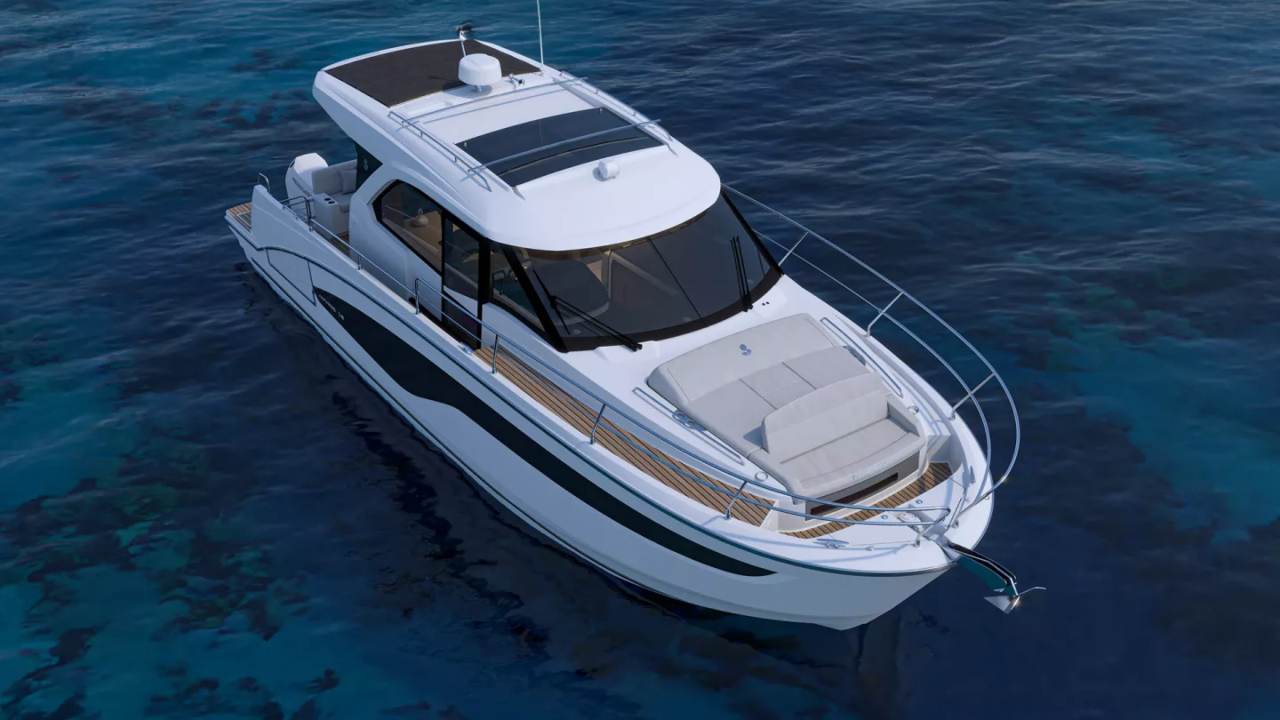
The Antares 12 Coupé represents the contemporary evolution of the mid-range family cruise in the premium outboard segment. It is a boat that combines ease of management, modularity of spaces and ready performance, integrating a modern electronic platform and naval architecture solutions designed for livability in every season. The hull, optimized for outboard propulsions of significant power, favours the efficiency of the cruise regimes and the dynamic comfort on the typical short rock of the Mediterranean. The “coupe” format — integral hard top with large glass surfaces and safe passageways — maximizes usability 12 months a year, limiting the maintenance costs compared to flybridge solutions of equal length.
In this analysis we investigate the design substance: criteria for measuring and distributing weights, material chain and lamination processes, philosophy of outboard engines in relation to autonomy and mission cycles, integration of systems (navigation, domotics, safety) and correspondence between layouts and real use profiles (family, daily charter, extended weekender). The cut is technical but oriented to readability, with clear definitions of the key concepts for those who are not naval engineer.

Site profile: history, philosophy and reputation
The brand that signed the Antares 12 Coupé has built over time a solid reputation in the motor and sailing port pointing on three pillars: industrialization of the process with homogeneous quality control, modular design that allows economies of scale without flattening the personality of the models, and attention to the real use of the Mediterranean shipowner. The Antares line, in particular, was created to combine protection, continuity between cockpit and living room, and simplicity of maneuvers management, with protected rudder, sliding doors and lateral passages also accessible by reduced crews. In the market, the range is perceived as “safe choice”: not the most extreme in terms of styling, but very consistent between promise and surrender, with a widespread after-sale and spare parts easily available.
In-depth technical analysis
Dimensions and naval architecture
The project is located in the 12-metre band outside all typical of “coupe” weekenders. Floating length (LWL), normally lower than LOA due to superstructures and platforms, is calibrated to reduce residual resistance to semi-planned and stable planing systems. The generous maximum beam improves the torque rigidity of the shell and allows a distribution of the transversal furnishings without penalizing the passers-by. The variable deadrise angle hull (V progressive) combines a fine “entry” to cut the short wave with a stern enough to damp the impacts. Redans (chine and step, if present) are optimized to anticipate the transition to the planata and channel the flow to the feet of the outboard, with benefits on consumption and steering response.
The positioning of the outboards on brackets/couple plate increases the lever arm compared to the push centre and helps the arrangement to the low regimes; with diameter and calibrated step propellers, you get a progressive planata, reducing the “hump” (the peak of power needed to overcome the fast displacement phase). The weight distribution — tanks, service groups, batteries, A/C units — is critically designed to maintain the longitudinal gravity center (LCG) aligned with the actual thrust center to the project regimes. This results in less need of flap and in more straight routes, with the skipper who intervenes until only to flatten the set with the wind of crossing.

Materials and construction processes (exhaust, superstructure, interior)
The primary structure of the hull adopts reinforced polymer matrix composites (generally glass with multidirectional fabrics), with variable thickness laminations and reinforcements in correspondence of the loading zones (motor lamps, main bulkheads, rudder/instrumentation attacks). The choice of a closed-cell core sandwich in the upper skins and the blanket allows to increase the stiffness/weight ratio and improve the thermoacoustic insulation, preserving the comfort in gear and satin. The bulkheads are glued and resin-bonded for superior structural continuity compared to simple mechanical fixing, reducing creaks and vibrations over time.
The superstructure, with hard tops and integrated mounts, uses tempered or laminated glass of adequate thickness, glued with certified cycles: the result is an increase of brightness and, above all, a reduction of “thermal plants”. In the interior, the yard employs marine melamine and veneers with scratch-resistant and anti-UV finishes, coupled with technical foams for panelling that minimize weights without sacrificing the perception of solidity. The floorings adopt anti-slip materials with noise reduction at the top; in the cabins, the underlying is often resinized to avoid moisture laughter.

Engines, propulsion and transmission
The outboard philosophy in this class of lengths is based on two elements: high power density and simplified maintenance compared to entrobordo/diede. The most popular packages include double or triple motorization with medium-high unit powers, able to combine point and redundancy. The adoption of integrated management electronics (electronic steering, multi-axis joystick, “station keeping” functions where available) transforms the experience in mooring: the boat can move, rotate on the spot and compensate for wind drift and current with automatic micro-corrections.
The poppiero foot reduction ratios and the propeller — often in steel with anti-cavitation profiles — are calibrated to ensure an economic cruising point in a window of turns sufficient to cover different scenarios (sea size vs flat water). The feeding system with properly dimensioned water/combustible separator filters and the predisposition for double parallel filters elevates reliability on long transfers. The parameter tracking (turns, instant consumption, fuel pressure, engine angle, temperature) flows into the NMEA/Can-bus network and displays in an intelligible way, using custom pages for skipper and commander.
Performance: speed, cruise, autonomy, consumption
In standard configuration, the power curve of the Antares 12 Coupé is designed to offer a comfortable and silent cruise in stable planing. In the intermediate regimes, the arrangement benefits from the generous glare and the poppiera bearing section: the boat keeps the trim angle without forcing to continuous corrections. The real autonomy depends on three variables — sea, cargo, propellers — but the project aims to daily transfers without refuel in typical routes (50–100 nm). Consumptions, more sensitive to micro-regulations of trim in powerful outboards, find mitigation in the telemetry: read the “best economy” directly on the bridge leads to tangible practical reductions, especially on hulls with wide wet surfaces.

Onboard systems: electronics, home automation, navigation
The navigation instrument is based on the latest MFD (multi-function display) with integrated sensor network: Multi-constellation GPS, eco-scandaglio with transducer suitable for speed of hull, low-emission solid radar, autopilot integrated to engines. The electrical system is divided into service counters and starting with BMS (Battery Management System) that monitors tensions and cycles; the cablings are channeled, labeled and resinized at the pass points, in order to reduce oxidation and false contacts. The air conditioning uses units with inverter and eco mode, connected to a hydraulic system with silenced sea pumps.
Onboard domotics allows “one-touch” scenarios: lighting evening scenario lights, lowering electric obscures, managing ventilation, monitoring tank level, and, where expected, remote control via app. LED lighting with different color temperatures (warm for night areas, neutral for work/kitchen) and dimmer allows energy saving and visual comfort. In night navigation, the distribution of light points avoids glazing reflections, to protect the visibility of the commander.
Design and architecture of spaces: style, layout, ergonomics
The aesthetics of the coupe favours continuous stained lines and glass surfaces; the frames are dimensioned to support rigidity and safety without closing the field of view. The high-altitude living room, with large sliding doors, creates a unique functional plan: equipped kitchen on the side, convertible dinette, rudder with adjustable seat and side door (detail essential for the management of the mooring with minimal crew). The passers-by are protected by masculine and pulpit at the correct altitude: the perceived safety in movement is high.
In the lower deck, the forward shipowning suite benefits from volumes exploited in height (where the hull geometry allows it) and custom storage rooms; the guest cabin and the second toilet (depending on the options) guarantee extended weekends without compromise. The ergonomics of the movements — openings to the outside, steps with raised and regular pawn, handrail where they really serve — reflects an iterate project on the feedback of captains and experts, not only on the designers' tables.


Innovation: efficiency, emissions, stability and security
Although the choice outboard privileges simplified promptness and maintenance, the project integrates measures for efficiency: CFD optimized hull to reduce viscous and induced resistances, fine electronic management drives and echoline functions that help maintain the optimal depth in crowded bays without stressing the government apparatus. The predisposition for gyroscopic stabilizers or anti-roll systems (if required) improves the comfort in radius and transverse navigation to the wave.
Active safety includes integrated alarm systems (smoke, gas, bilge), accessible sea valves, evacuation paths without “cul-de-sac”. Passive safety descends from stratigraphy: the compartment with resin-bonded bulkheads and the choice of fire-retardant materials in key areas delay the propagation of events. The philosophy is “designing for failure”: simplify recovery (by-pass hydraulics, quick access to filters, fuses clearly labeled) to shorten intervention times.
Life on board and comfort
Vivability is the real field in which the coupe format excels. The modular cockpit allows you to alternate lunch en plein air and a protected lounge; the poppiera platform, if equipped with climbing/vary systems for tenders or toys, becomes an extension of the living space. The light-air path is studied: roof openings, wire doors with concealed hinges and blackout/anti-insect panels combine to maintain the ideal microclimate without always resorting to air conditioning. In satin, the edge remains silent thanks to the coupling of the pumps and the correct laying of antivibrants.
The furnishings employ UV-treated marine fabrics and skins; the living edges are beveled and the finishing profiles are designed for durability: no purely “decorative” elements that over time betray the project. The courtesy lighting along the passages guides the night movements without dazzling; sockets and USB are where they really serve, not only at the table in the brochures. The result is a boat that makes you want to stay on board even at engines off.

Sailing performance: tests and behaviour on the sea
At the helm, the Antares 12 Coupé gives a feeling of immediacy: the longitudinal inertia is consistent with the mass and the helix step. In acceleration, the “bow rise” is contained in the hull geometry and the flap intervention; the transition to the bridge does not require coarse interventions. In virata, the angle of strip is progressive and legible, with a clear transmission of the load at the wheel. On the sea formed, the fine bow reduces the impact on the short wave and returns a deaf “thump” more than a dry line: sign of adequate stratigraphy and severity in prototype tests.
The lateral rudder is an endowment that changes the life in the dock manoeuvres: it allows the indoor officer to alternate with the timoniera with minimal steps, maintaining direct visual control of the parabords and bittens. The joystick, where present, drastically reduces learning time for evolutionary neophytes, but it is essential to maintain sensitivity on separate gases to manage tense wind and space constraints. Overall, the hull proves to be honest and predictable, features that on the long run count more than pure “spectacularity”.

Market and competition
Positioning for price and segment
The model is placed in the premium segment of the 12 meters outboard coupé: target of shipowners looking for a boat “one-boat solution” able to cover daily exits, prolonged weekends and seasonal transfers, with management costs under control and high residual value. Extended equipageability — electronics, comfort, stabilization — creates a wide price scissors, allowing a competitive “entry” and a “full-spec” suitable for demanding shipowners.
Analysis of direct competitors
- Outboard coupe 11–13 m: rivals with similar setting point on important aggregated powers and on single-quota salon/pozzetto layout. Key differences: weight management (triple vs double motorization), relation of stained/glass surfaces and quality of lamination of the blanket.
- Interboard sports-cruiser: sometimes they offer a slightly higher mariality with lower mass centers, but they suffer more expensive maintenance and invasive technical spaces. The outboard choice remains successful for simplicity and upgrade of the motor park.
- High-end walkaround: they exalt daytime use and bow steps, but they sacrifice the internal volume. The coupé, for cruises in shoulder season, is more transversal.
Trend of the reference sector
- Efficient Downsizing: the search for more sober cruises in consumption pushes towards optimized hulls and fine electronic management.
- Digital integration: telemetry, predictive diagnostics and remote control elevate experience and residual value.
- Comfort 4 seasons: insulated hard tops, integrated obscurants and low absorption air conditioning extend the usage season.
Target customer
- Private owners: advanced family profile, search for reliability, resellability and reduced time between arrival in dock and exit at sea.
- Luxury Charter “day & weekend”: require a robust product, intuitive for professional skippers and welcome to demanding guests.
- Representative/hospital company: they look for image, comfort and simplicity of management for corporate events and hospitality.

Results and awards
The commercial success in the segment is measured on three axes: sustainable delivery times, waiting list consistent with the production and keeping of the value on the used. The Antares line, historically, expresses solidity on these indicators thanks to the driven industrialization and a capillary distribution network. The presences in the main trade fairs and the interest of the specialized press confirm the relevance of the project for the Mediterranean and North-European market, with recurring appreciations on livability, ergonomics of the rudder and behaviour in sea formed.
Engineering: what makes the difference
Rigidity vs weight: the virtuous compromise
An effective 12-metre coupe is born from a matrix of choices: where to put matter, where to remove it. The flexional rigidity of the hull is played in external skins and longherons; the torsion is managed by bulkheads and counters that create a “box” continues. Reduce high weight (overstructure) lowers transverse metacentre, with benefits on roll stability. The blanket sandwich is therefore more than a question of isolation: it is perceived stability in shave and in cross-wave march.
Acoustics: not only decibel
The acoustic comfort is not the simple sum of “dB(A) to the fly”: it is the sound signature. Avoiding annoying frequencies at 100–200 Hz (structural vibrations) requires targeted decoupling: antivibrants for A/C pumps and units, properly dimensioned motor brackets, calibrated foot rotation. Pannellatures with high density foam combined with sound-absorbing coatings soften the peaks without “matting” the environment.

Energy and autonomy services
A well-sized service counter, possibly integrated by an auxiliary generation system or batteries with high energy density chemistry, allows to support air conditioning, electric kitchen and entertainment without anxiety to recharge. Intelligent load management (priority and automatic shed in peak absorption) preserves comfort and batteries. In the dock, multi-stage chargers extend the life of the accumulators.
Hydraulic: reliability and hygiene
Freshwater tanks in suitable materials and circuits with drain points facilitate maintenance. Silent autoclave pumps and well-placed vacuum pumps avoid siphoning and air blows. In the easily accessible toilets, valves and macerators are the substance of a boat that wants to stay “family friendly”.
Equipment and customization
The modular platform allows the site to scale optional without compromising the coherence of the project. “step-up” electronic packages, alternative fabrics and finishes, integrated shading solutions, possible predispositions for stabilization and A/C upgrades make the boat “made to measure” within the boundaries of industrial standardization. The correct approach is to start from real use: crowded bays, cruises between islands, metropolitan movements on the coast. Each option has a weight (literal and figurative): a competent technician goes beyond aesthetics to assess impact on plant and plant.
Management, maintenance and TCO (Total Cost of Ownership)
The life cycle of a modern boat passes from the yard to the dealer, then to the shipowner and service centers. The outboard choice simplifies periodicity and downtime: direct accessibility, diffused exchanges, wide network specialization. Scheduled maintenance — oils, impellers, anods, periodic inspections — is supported by sequence of digital checks and automatic logs on the display. On the hull front, sweet washes and suitable waxes preserve gelcoat and seals; annual controls on fixings, bolts and seals maintain integrity over time. The TCO also benefits from the lively resellability of the category: wide demand and liquidity of the market accelerate the dismissal when you rise in size.

Why choose an outboard coupe at 12 meters today
- Simple: ready-to-go from the dock, intuitive systems, nautical parking simplified by the joystick.
- Versatility: from the spring Mediterranean to mild winters, the protection of coupe extends the useful season.
- Efficiency: optimized hulls and real telemetry help travel longer with less.
- Value: mature industrial product, capillary net, use seal.
User profile configuration tips
Family cruiser
- Electronics: double MFD, integrated autopilot, AIS.
- Comfort: integrated obscurants, inverter air conditioning, quick curtains.
- Security: gas and smoke sensors, felt alarms with differentiated threshold, baby-saving equipment (networks, closures).
Sports Weekender
- Propulsion: upper motor cut with propellers suitable for fast cruise.
- Asset: automatic flaps with fast response profiles, fuel economy display pages.
- Stability: anti-roll predisposition for shaving with residual wave.
Premium Charter
- Duration: high-wear finishes, washable coatings, corner protections.
- Operation: hour counters services, remote diagnostics, digital check-in/out.
- Experience: zoned audio, scene lights, additional fridge.
Pre-book technical check: what to check
- Alignments: doors, doors and windows, closing tolerances.
- Equipment: voltage falls under load, noise on board pumps, autoclave calibration.
- Electronics: firmware updates, sensor calibration, custom MFD pages.
- Sea trial: three-stage data (fast displacement, cruise, WOT), automatic flap response, specific consumption.
Critical assessment
The strength of Antares 12 Coupé lies in the balance: it does not extremize a single dimension of the project but works up on ergonomics, accessibility and consistency between hull and outboard. For the Mediterranean shipowner who alternates rades, transfers and ports citizens, it is a rational and desirable proposal. The margins of improvement, as always, live in conscious personalization: choosing the right package, calibrating air conditioning and real-life plants, do not exceed with optional “heavy” at the top. The result is a boat that ages well because it is born correct.
Positioning and prospects
In the current panorama of outboard coupes between 11 and 13 meters, the Antares 12 Coupé occupies a reference position for usability and ease of management. It is the product that allows a family to rise in category without facing the complexity of an inboard with deeply invasive machine rooms or a flybridge requiring additional maintenance on extended overstructures. Natural progression, for those who want, will be towards higher sizes without “learning kit”: the logic of board, the ergonomics of the paths and the language of electronics are the right ones.
In perspective, the most interesting evolution concerns energy integration: more capacious batteries, smart load management, possible auxiliary hybridization of services. On the hull front, additional CFD optimizations and the use of materials with better rigidity/weight ratio can still reduce vibration and consumption. The trajectory of the yard — industrial, centered on real use, attentive to the network — makes think that fleet feedback will be capitalized with regular refresh cycles, keeping the boat “up to date” at the level of electronics and plants.
For the owner who chooses today, the message is clear: Antares 12 Coupé offers a mature platform, capable of combining perceived quality and technical substance, with an ecosystem of assistance that protects its value over time. It is a sensible investment in the segment, with a precise identity: Mediterranean, concrete, modern.