
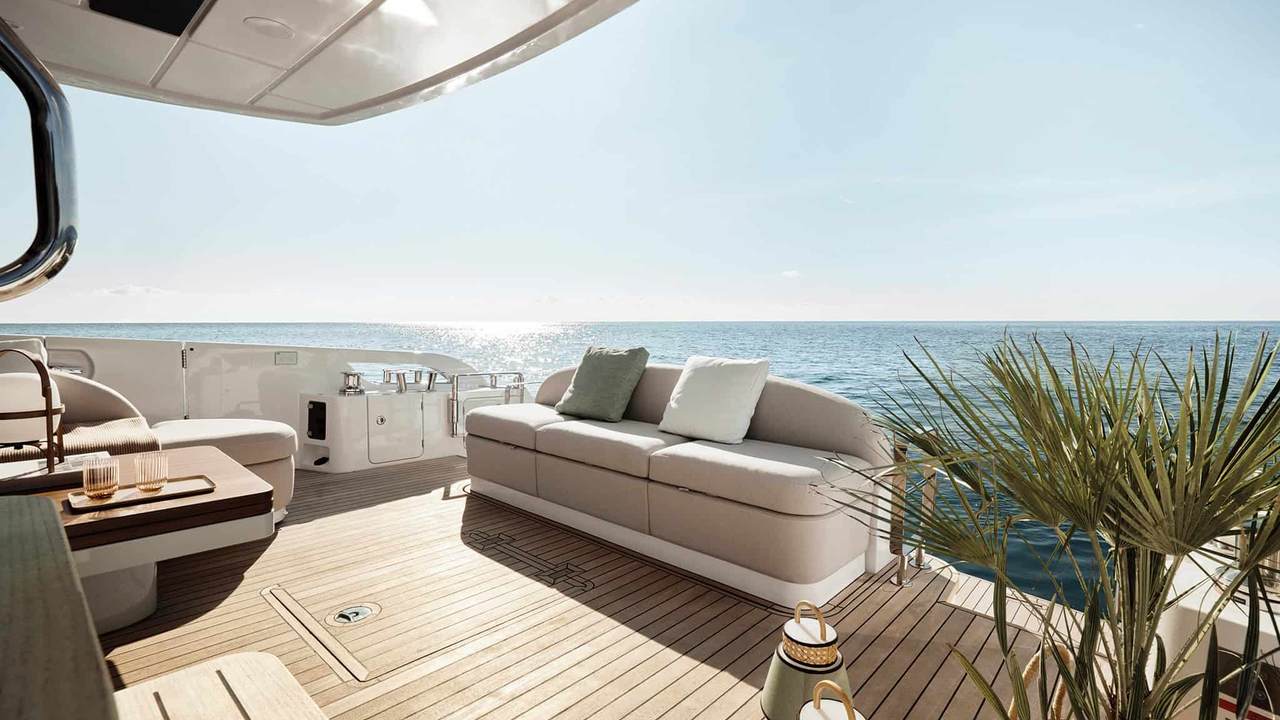
Configuring Azimut Fly 62 means managing a complex platform, not only choosing colors and furnishings. Three guest cabins, local crew, dual motorization IPS, flybridge, Beach Cockpit and important reservoirs concentrate numerous interdependence in 19,22 meters. The correct method is to build a separate unit, connect each optional to its system and verify that documents, commands and components coincide. This reading prefers testing, maintenance and contract: the data of the model is the starting point, while the final approval always concerns the hull actually delivered.
Identity of the specimen before optional
Number of hulls, model year, certificate and engine configuration must appear in the same file. Fly 62 is declared in category B and with NMMA certification; the presence of commercialcronyms does not replace documents relevant to the registration market. They photograph plates and freshmen of motors and pods, so they compare with invoices and guarantees. Each difference is resolved before the balance, not entrusted to a subsequent promise.
Verified configuration card
The table distinguishes declared equipment and acceptance controls. Performance is not guaranteed in any condition: it must be referred to motorization and test mass.
| Element | Declared configuration | Pre-book control |
|---|---|---|
| Out | 19.22 m | Documents and boat seat |
| Baglio | 5,09 m | Mooring and side access |
| Cabins | 3 guests + 1 crew | Inventory, closures and ventilation |
| Bathrooms | 3 + 1 crew | Pumps, drains and seals |
| Propulsion | IPS 1200 or IPS 1350 optional | Tools, software and maintenance |
| Fuel | 2.800 l | Indicators, vents and valves |
| Water | 750 l | Autoclave, fittings and tanks |
Two engine packages not to be confused
The standard solution uses two Volvo Penta IPS 1200 900 hp, while the optional one rises to two IPS 1350 from 1,000 hp. In the contract it is not enough to write “IPS”: model, power, relationships and components are indicated. The separate must follow the unit also on the market of the used. Hours, alarms, updates and interventions are acquired by diagnosis; a display without messages at least does not exclude stored abnormalities.

Performance associated with motorization
Azimut indicates up to 30 maximum knots and 25 cruise with IPS 1200; with IPS 1350 optional references become 32 and 26 knots. Fuel, water, people, dinghy and equipment are noted before the test. Steps are made in the two senses by recording GPS speed, system and consumable data available. If the result differs, you control famine, propellers, load and conditions, avoiding immediately attributing the cause to a single component.
iPS pod verification
With dry boat we inspect propellers, edges, anodes, seals and shock tracks. The declared catch of 1,63 meters includes full load propellers and must appear in the planning of the seabeds. In the water there are triggers, response to the low regimes, steering and uniformity of the two sides. Rumors, vibrations or temperature differences require technical feedback. Active products and maintenance procedures must comply with the instructions of installed components.

Commands and government stations
Fly 62 has a main government and a superior station. Each function must be tested in both: start, stop, tools, alarms, steering and station selection. Displays must show consistent data and maintain readability under the expected light conditions. The actual electronic configuration is obtained from the separate, without assuming brands or undocumented functions. Manuals, codes, licenses and update procedures enter the delivery along with keys.
Electric panels and documentation
The unifilare pattern must match the pictures and labels. Powers, drives, protections and essential utilities are identified. It is not necessary to disassemble everything: it is necessary to reach fuses, clamps and mass points for inspection. Each added accessory must have proper cable protection and section. During testing, tensions and absorptions are observed in different modes, looking for falls or abnormal heats.

Batteries and charging
Number, technology and capacity of the batteries occur on the specific unit, because the installations can change. They measure tension at rest, behavior during the start and response of the chargers. The batteries must be fixed, ventilated according to the type and protected by accidental contacts. Installation dates must be recorded. A system that starts regularly can still have insufficient reserve; for this the test includes onboard utilities and not only engines.
Fuel tanks and indicators
The 2,800 liters declared impose an accurate verification of vents, vents, levels and valves. Indicators should not be considered linear without proof. There is a record of the quantity taken from reading and odours or drawings are checked in accessible compartments. A reserve consistent with route and conditions applies for autonomy. Catalog consumption does not replace the one measured on the specimen with its load.
Freshwater Circuit
The declared capacity is 750 liters. During acceptance, the system is filled, it takes pressure and controls pumps, fittings, taps and drains. The autoclave must not depart without request. Health and remittance procedures must be compatible with tanks and pipes. They also clarify location, access and inspection possibilities. Different levels change the weight that is placed, so they should be noted during the performance test.

Baths and drains
The configuration includes three guest bathrooms and one for the crew. Each room is tested separately for power, exhaust, ventilation and seal. Valves and trays must be identified and accessible; operational positions must be indicated to the crew. Prolonged control is more useful than a single drive, because small losses emerge under pressure or after multiple cycles. Exhaust rules applicable to the navigation zone enter on board procedures.
Listen, drains and alarms
Before the test the sentries are photographed dry, so each variation is comparable to the return. There are compartments, pumps, sensors and suction points present, verifying accessibility and fixing. Water in the well, on the flybridge and in the aft area must reach the drains without stagnations. Alarms are tested according to procedure, avoiding improvised activations. Cleaning should not erase traces useful to distinguish fresh water, sea, fuel or lubricant.

Beach Cockpit: sequence and interlocks
The transformation of the stern lowers the sofa and opens the mirror to the outside. The test must follow the intended order and check buttons, actuators, stops and reports. No one remains in the movement area. It proves the complete closure and it is checked that the elements cannot move during navigation. Drainage and seals are observed with water present on the bridge. Delivery includes instructions that can also be understood to an occasional crew.
Flybridge and loads at altitude
The upper deck offers guides, seats and living areas, but each added object moves the center. The distinction must indicate furnishings and components provided; subsequent changes require an evaluation, not only available space. They control hardtops, supports, lights, handrails and drains. Each pillow or table must have a safe location in navigation. The view from the location is tested with the normal layout of people and furnishings.

Salone, kitchen and fixtures
Fabio Fantolino's design alternates soft lines in the lounge area and more net geometries in the kitchen. In acceptance, it mainly affects the functionality: doors, drawers, tables and chairs must block and not produce abnormal noise. Appliances and accessories compare with the distinct, recording models and manuals. The surfaces near the windows are seen in full light, while seals and frames are controlled by condensation or infiltration.
Three guest cabins
The six declared beds are distributed in three cabins. For each one you control mattresses, boots, sockets, lighting, ventilation available and closing doors. Accessible panels help to search for moisture without damaging the furnishings. Mobile objects must have adequate stops. The bunk count does not replace a proof of use: heights, steps and privacy should be evaluated with people who really use the boat.

Local crew and separation of routes
The crew cabin is declared for two people and has its own bathroom. Access, ventilation, lighting and storage are compatible with the intended use. The separation from guests is useful, but must not hinder access to valves or technical components. If the boat is conducted without a professional crew, that space enters the safety and maintenance plan; it does not automatically become a limitless deposit.
Engine and ordinary maintenance
The inspection path must allow to reach levels, filters, belts, sea grips and components provided without relying on hot or mobile parts. A sequence of daily checks is agreed with normal points and values. Labels and lighting must make the two sides readable. Minimum losses are better identified on clean surfaces, but cleaning should not precede the expertise to the point to hide the unit’s historian.
Functional test at the pier
Before leaving you control power, pumps, lights, tools, kitchen, bathrooms, Beach Cockpit and closures. You perform a function at a time by announcing result and responsible. The test at the pier reduces the variables and prevents a short navigation from hiding simple defects. Each anomaly is described with photography and appearance condition. The phrase “to be regular” is not enough: it serves intervention, new proof and acceptance.
Try in navigation
The exit begins with cold motors and sentine controlled. Government, triggers and low-speed response are tested, then the regime increases by steps. Speed, consumption, temperature and vibration are recorded on the two senses. The virates are progressively executed on both sides. On the return, check in the engine compartment and under the paglioli. Environmental conditions are part of the minutes, because without them numbers are not comparable.
Delivery minutes and reservations
The final document lists hulls, engines, pods, equipment, manuals, keys, remote controls and accessories. Each reserve has a deadline, a manager and a closing test. Photographs and diagnostic data are stored together with the contract. Performance is carried out with load and conditions, avoiding absolute formulas. An ordered delivery protects both sides and creates the first chapter of the historic maintenance of the unit.
To those who want this configuration
Fly 62 is consistent with those looking for three cabins, large upper spaces and a transformable stern, accepting the management of double IPS, cinematics and numerous services. The choice between IPS 1200 and 1350 must start from use, not only from the maximum value. The best equipment is documented and accessible, in which every option has real function and sustainable maintenance. A complete verification sequence makes the Beach Cockpit an operational advantage, not a complexity left without control.