
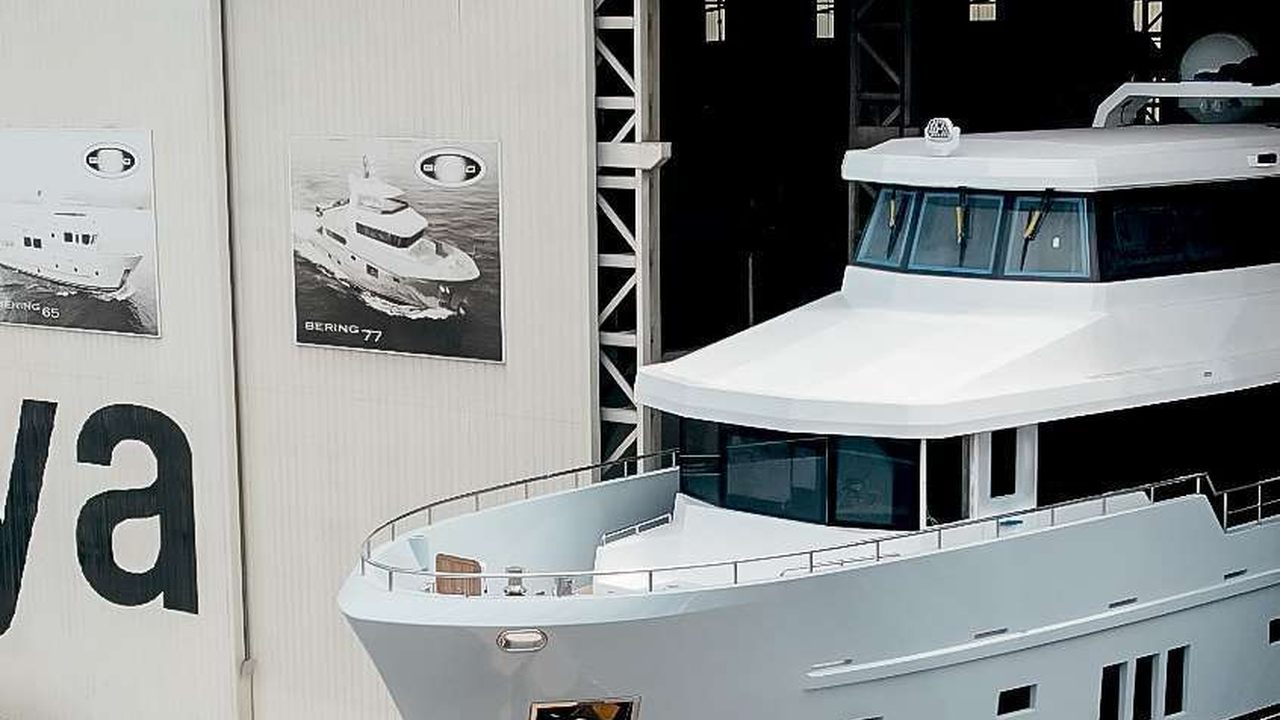
The Bering 72 is a 22.18-metre-long, full displacement explorer, built with steel hull and aluminum superstructure. The yard declares 120 tons full load, 24,000 liters of fuel and over 4,000 miles of autonomy to the cruise of eight knots. Numbers of this scale require an operational reading: tanks, energy, redundancies, technical access and crew procedures determine the real ability to deal with remote routes. This guide only uses official specifications and does not give the editorial staff a test at sea not performed.
Identify the configuration before evaluating it
The model offers volumes that can be arranged according to the needs of the shipowner. The declared configuration indicates six guests and two crew members, but layout, furniture and equipment must be set in the specification of the single construction. General drawings, weights list, plant scheme and equipment inventory are contractual documents, not secondary attachments.
Every change has cross effects. A more complex kitchen increases electric loads; a different dinghy changes cranes and baricentro; additional batteries or air conditioning affect the energy balance and ventilation. The configuration revision must therefore involve structure, plants and operation.

Steel below, aluminum on
The steel hull favours robustness and repairability; the aluminum superstructure limits the mass at the top. The combination zone between different materials requires appropriate joints, electrical insulation, drainage and documented protection. Control is not limited to external paint: it includes thicknesses, accessible welding, anods and potential.
The maintenance plan must record inspections and interventions, especially in the hairpins, the gavones and near the plant passages. Trapped humidity or damage to the protective cycle must be treated quickly. On an explorer corrosion prevention is a continuous process, not an activity to be postponed to remittance.

Carena full displacement and speed
The full displacement hull works on a declared cruise of eight knots and reaches ten knots by load. It is not designed to plan: it uses length to float, volume and mass to proceed regularly. The declared floating length is 20.57 meters, on a maximum width of 6.45.
Testing must measure regimen, consumption, vibration, temperature and ability to keep the route in multiple conditions. Elicans, axes, gearboxes and thymones must be verified as a whole. An increase in resistance due to dirty hull or incorrect trim can quickly erode the margin of autonomy.

Two Cummins QSL9 and propulsive lines
The declared motorization includes two Cummins QSL9 from 335 horses each. The redundancy of two engines is only useful if shared dependencies are understood. Power, cooling, start, unloading and controls must be isolated according to the approved scheme.
The test starts from the cold start and continues to the stabilized temperature. Pressure, load, smoking and vibrations are recorded; after stopping, there are leaks and hot areas. Filters, impellers and scrap points must be reached with normal tools and safe working spaces.

The engine compartment as a working space
An explorer must be able to deal with maintenance away from assistance. Lighting, ventilation, flooring, service outlets and protection of hot surfaces are therefore functional requirements. Routes around the engines need to remove filters and components without disassembling unrelated elements.
Pumps, valves and paintings require permanent labels, consistent with drawings. Critical parts and absorbent materials must have dedicated boots. An exercise of isolation of a loss or replacement of a prefilter reveals much more than just a visit to clean rooms.

Twenty-four thousand liters of fuel
The declared capacity is 24,000 liters. Full fuel is a decisive variable mass; during consumption it changes trim and may require a precise sequence between tanks. The manual must indicate usable capacity, reserve, low points, transfers and indicators logic.
Supply, vents, separators and drainage are carefully tested. Sample, treatment and monitoring of water protect the engines during long stops. Management should not depend on a single indicator: levels, calculated consumption and manual checks must be compared.

Over four thousand miles: how to read the data
Bering declares more than 4,000 nautical miles at the cruise speed of eight knots. It is a project reference, not a valid guarantee for each route. Sea, wind, fouling, generators, temperature, load and operational reserve reduce the planned distance.
The boat must build its own curve in liters by mile after testing. The calculation separates propulsion and hotel loads, includes weather margins and saves fuel for deviations. Each long route requires alternative points and explicit criteria to decide when to continue or return.

Fresh water and onboard production
The declared fresh water reserve is 2.855 liters. This volume does not eliminate the need to control quality, sanitization and consumption. If a dissalator is installed, its production must be measured in real conditions, checking prefilters, membranes, salinity and availability of spare parts.
Pumps, autoclaves, boilers and collectors must be tried with more open utilities. Minimum losses can become important during a crossing. Tanks, vents and inspection points must be accessible; a drive plan allows the crew to react without improvisation to a failure.

Energy and hotel loads
Kitchen, refrigeration, air conditioning, electronics and services can require energy for many hours a day. The budget must indicate continuous absorption, peaks, capacity of batteries, power of generators and margin. A list of devices is not equivalent to a sized energy system.
The test simulates the worst allowed combinations, controlling frame temperatures, voltage falls and switching between power supply. Essential circuits and comfort must be separated. The emergency plan sets out which loads to disable to preserve navigation, communications, pumps and start-up.

Cabins, guests and crew
The specification indicates six guests and two crew members. The distribution must maintain access, exit routes, ventilation and practical storages with all places occupied. Doors, drawers and heavy objects require closures that do not open with roll and beaking.
The crew spaces must allow separate rest from the operating shifts. Bathrooms, laundry and linen affect water and energy. The night test is useful to check noises, safety lights, alarms and routes to rudder and bridge.
Bering 72 Technical Table
| Parameter | Summary |
|---|---|
| Length outside everything | 22,18 m |
| Floating length | 20,57 m |
| Maximum | 6,45 m |
| Maximum fishing | 1,87 m |
| Full load dislocation | 120 t |
| Gross state | 120 GT |
| Fuel | 24 000 tonnes |
| Fresh water | 2.85 |
| Engines | 2 × Cummins QSL9 from 335 hp |
| Cruise / maximum | 8 / 10 kn half load |
| Autonomy | over 4,000 nm to 8 kn |
| Certification | EC category A |
These values describe the model and must be found on the documents of the single unit. The operating weight depends on equipment, liquids and supplies. The EC category does not replace limits, procedures and responsibilities in the onboard manuals.
4.2 meter Tender and deck equipment
The yard indicates a 4.2 meter long tender. Cranes, intruders, fixing points and reach of the bridge must be dimensioned on the actual tender, complete with motor and fuel. The handling is tested with defined wind and trim limits.
Chains, psalm still, bits and cable passages must be suitable for displacement and navigation area. The anchoring procedures include communication between bow and rudder, manual recovery and management of a fault. Parapets, lighting and non-slip surfaces are part of the same control.
Fishing, height and access to ports
The declared maximum fishing is 1.87 meters. The measure should be updated for load and trim and integrated in planning. A careful margin takes account of tide, wave motion, quality of the reliefs and possible settlement on the seabeds.
The actual height with antennas and trees must be measured on the finished boat. Bridges, airlines and yards require a verified data, not deduced by a rendering. The operating boards must carry encumbrance and lifting points with photographs.
Steering, sensors and alarms
Remote navigation requires radar, AIS, GPS, echo sound, compass and communications to be integrated without creating a single fault point. The dash must immediately show critical alarms. A network blackout should not make propulsion or security invisible.
The test includes alternative power supplies, sensor accuracy, data recording and internal communication. There are windshield wipers, disconnection, sitting and visual. Manuals, software versions and configuration backups must be available on board.
Feel, fire and compartment
Sentry pumps, level alarms and valves are tested in each compartment. The bulkheads must retain integrity after the passage of the plants. Pond doors and doors require seals, closures and functional signals.
The fire system must be compatible with volumes, ventilation and fuels. Detectors, extinguishers, remote arrests and escape routes must be inserted in periodic exercises. The crew must know what to isolate before setting up a fixed system.
Spare parts and scheduled maintenance
The spare parts list comes from critical analysis, delivery times and crew capacity. Filters, straps, impellers, pumps and sensors must have codes, quantities and location. Tools and lifting devices must correspond to realistic interventions.
Maintenance software is only useful if powered with hours, deadlines and verified jobs. Up-to-date diagrams and photographs reduce diagnosis times. Each change must be reported in the documentation, avoiding that the real boat progressively diverges from the drawings.
Delivery and acceptance test
The test is carried out with a representative load and includes maneuver, arrest, government with only one motor, stabilization, generators and services. Regimes, consumption, temperature, noise and vibration are recorded. Each data must indicate conditions, tools and tolerances.
After navigation technical rooms, hair dryers and fixings are inspected. Non-compliance remains open until correction is checked. A second test may be necessary: acceptance should not transform a list of problems into informal promises.
long distance checks
Before leaving, weather, route, reserves, fuel, water, spare parts, medicines and communications are controlled. Shifts, consumption thresholds and alternative ports are defined. Tender, equipment and furnishings are fixed; exit routes and technical access remain free.
During the crossing there are levels, engine hours, water production and anomalies. Trends count more than one value. A slow loss or a gradual increase in temperature must activate a procedure before it becomes an emergency.
The operational judgment
The Bering 72 offers consistent numbers with a compact explorer: a lot of fuel capacity, moderate speed and metal construction. The goodness of the unit, however, depends on the quality of execution and the discipline with which plants, weights and documents are kept aligned.
For the shipowner the decisive question is not only as far as it can arrive, but how it can continue to work when assistance and spare parts are far away. Accessibility, redundancy, training and verified consumption transform the official specifications independently that can be used.