
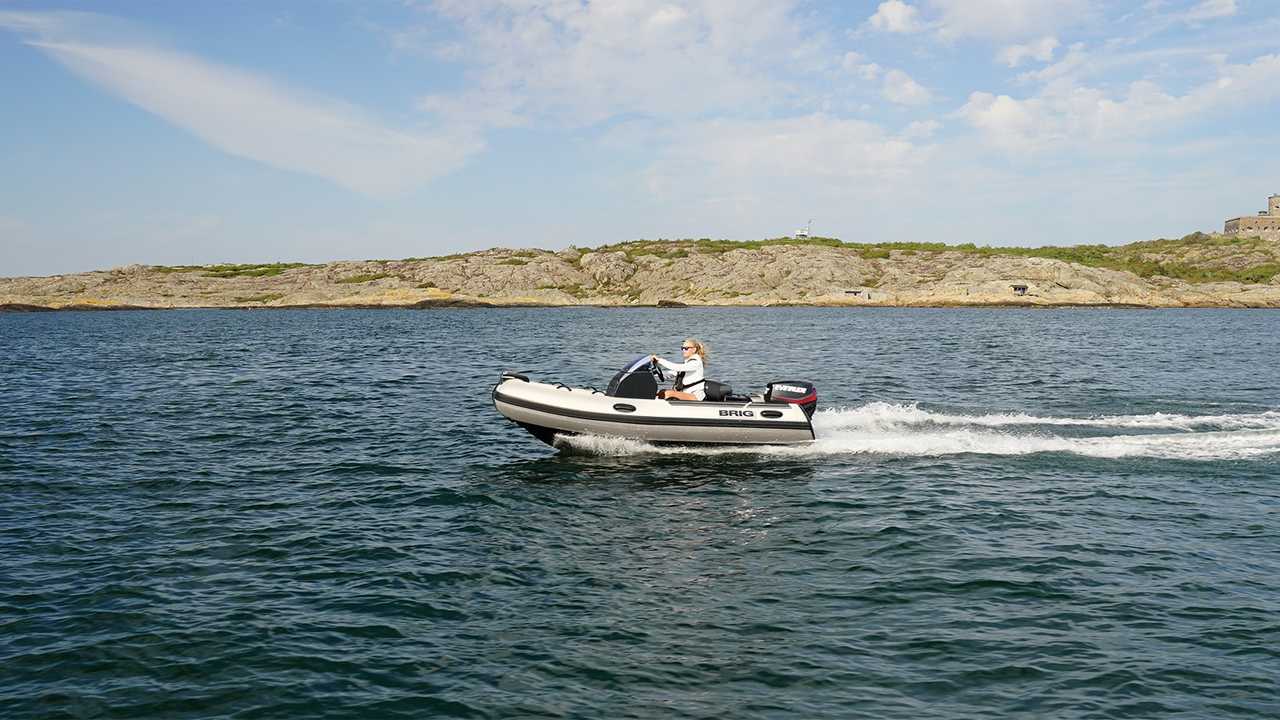
Configuring a BRIG Eagle 3.5 means working in small margins: 3,50 meters long, four people, 40 hp maximum and a declared load displacement of 860 kg. The boat already integrates reservoir, console, electrical system and drainage, therefore it should not be treated as a shell on which to add accessories without calculation. The following verification sequence separates what the manufacturer declares from what must be verified on the specimen. It does not replace the manual, nor the test of installer and dealer; it serves to order configuration, delivery, functional tests and maintenance without inventing performance.
Open a real drive card
The first document should report identification number, year, tubular material, motor, propeller, battery, tools and accessories. The manual distinguishes the maximum configuration from the actual equipment and warns that the settings can change. As a result photographs and commercial list are not enough. Each component must be classified as installed by the manufacturer, dealer or a third party. This traceability is essential for guarantee, spare parts and diagnosis. Upon delivery, there are schemes, certificates, user manuals and records of the tests performed.
Initial control of measurements and capacity
It is confirmed length without motor of 3,50 meters, beam of 1,78 meters, height without motor of 1,13 meters and well of 2,18 for 0,85 meters. The maximum diameter of the tubular is 0.46 meters. The design category is C and the capacity is four people. These data feed the load card, the choice of the cart and the verification of the space on the mother medium. For the operating encumbrance are also measured lowered and lifted motor, curved cables, rudder and any protruding accessory.

outboard verification
The manufacturer indicates 30 hp recommended, 40 hp maximum, 20 inch long stem and 145 kg as total maximum mass of motor, controls and battery. Before mounting, compare the engine board, components mass and battery position. Then they occur centering on the mirror, locks, steering freedom, lever race, cable protection and lack of rubbing. The maximum power requires special experience and caution; it is not a mandatory goal. Elica and installation height must be defined by the installer and validated in water.
Gas steering and control
The console houses steering system, engine lever and instrument panel. At a steady boat you bring the steering wheel to a bar looking for shots, game or contacts with wiring and pipes. The lever must move without bumping the windscreen, seat or accessories added. They control fixing of the cable, exit to aft and radius of the curves. With engine lowered and raised no component must be tense. The stop command and the safety cord must be reached from the normal position of the helmsman.
33 litre tank
The fuel circuit includes 33 liters integrated tank, sensor, indicator, vent, filling line, ventilation and motor connection; the manual also mentions filter and canister as components that can depend on installation. The verification sequence records material and date of the pipes, path, clamps, accessibility of the doors and fixing of the tank. It performs a dry visual control, then a seal test during a partial supply. Persistent smells, drops or blotting impose immediate stop and qualified verification.

Battery, battery and main fuse
The battery is a market component and must be placed in the intended container, in a ventilated area and far from the fuel. Type, capacity, orientation and restraint system are noted. Terminals must be tightened, protected and without accidental contact possibilities. The detachment and the main fuse should be identified, labeled and accessible. The verification sequence includes rest voltage, fall during start and operation of charging, but acceptable values are those prescribed by the engine and battery manufacturer, not generic numbers.
Switch and fuse panel
Four commands manage side lights, white light and bilge pump in automatic and manual mode. The fuse box, accessible from the console door, provides protection for lights, pump, socket 12 V and USB as well as reserve positions. Each switch must match the indicated user. Try a circuit at a time, observing spies, abnormal absorptions and overheating. Replacement fuses must have the correct value and be kept in a dry place; replace them with larger amperages hides fault and reduces protection.
Navigation lights
The prodier plate integrates red and green lights; the aft is provided with white light on rod. Before sunset it occurs ignition, support stability, lens cleaning and absence of obstacles in the visible sector. Bearings, bags or covers should not shield the lights. The test must be repeated with motor on to exclude intermittents due to vibrations or faulty connections. If the rod is removable, you control grafting and sealing, and you assign a storage place that does not deform contacts or support.

Drainage in three circuits
The system includes drainage of the well, exhaust of the engine recess and bilge circuit. Two sockets in the cockpit connect to the poppie outputs through tubes and diaphragms; the engine compartment has a dedicated hose; the bilge uses automatic pump, tube, output and valve. The verification must follow the complete path, not just listen to the pump. They control caps, bands, folds, obstructions and seal. During navigation the cockpits remain open and no baggage must be weighed on the pipes.
Sentry pump test
The pump is tested both automatically and manually, introducing clean water in controlled quantities and observing the output. Time is noted for triggering, continuity of jet and residual level, without turning the exercise into a universal performance value. The test confirms the operation and path of the pipe. If the pump turns but does not discharge, you look for obstructions, air, closed valve or folded pipe. At the end it dries the compartment and it occurs that the automatic switch returns to the correct state.
Limit tab for testing
| Voice | Given the need to respect |
|---|---|
| Category / persons | C / 4 |
| Length / glare | 3,50 m / 1,78 m |
| Tubular | 3 rooms, 0,46 m, 0.2 bar |
| Engine | 30 hp recommended, 40 hp maximum |
| Gambo | 20 inches long |
| Engine mass, controls and battery | 145 kg maximum |
| Fuel | 33 l |
| Maximum empty boat mass | 190 kg |
| Maximum total load | 520 kg |
| Charge for plate | 495 kg |
| Load dislocation | 860 kg |
Tubular: pressure and sequence
The three rooms are initially subject to partial pressure, starting from the stern, and only later they reach 0.2 bar. The value is measured at a stabilized temperature and rechecks when exposure to the sun changes. Valves, caps, bulkheads, joints, handles and rubbing band are inspected. A room that loses shape within a few hours requires diagnosis, not a simple addition of air. The manual excludes unapproved compressors or equipment. On the board board there is also the tubular material, because cleaning and repair depend on the specific version.

Gavoni and technical accessibility
The bow gavone, the console door and the poppiero compartment must open completely with the mounted cuscineria. It occurs that hinges and stops do not pinch pipes or cables and that water does not stagnate. In the poppiero battery, detachment, parts of the fuel circuit and drainage can not be buried under equipment. The objects are fixed in dedicated containers, avoiding weight on pipes. The best test is to simulate an urgent control: to reach fuse, valve and battery with the load normally placed and with the tools provided.
Tools and service outlet
The instrument area can include counters, speedmeters, fuel level and chartplotter, while a 12 V socket with USB feeds compatible devices. The separate must specify the brand, model and source of each data. A fuel indicator must be compared with known quantities, without requiring absolute precision in all inclinations. The sockets are under proper load and are controlled by cappucci and protections. The addition of electronics requires calculation of the absorptions, dedicated fuse and path of the cables; no flying derivations are used in the console door.
Carichi: build three scenarios
The maximum vacuum mass is 190 kg; the light condition declared 340 kg; the maximum load 520 kg and the load displacement 860 kg. To avoid misunderstandings three scenarios are prepared: tender with an operator, transfer with four people, exit with complete equipment. In each you add people, fuel and luggage according to the definitions of the manufacturer, also checking the limit of 495 kg intended for the tag. It is noted where every weight is placed. The numerical capacity does not allow to concentrate everything on the same field of the blanket.

Static test with crew
Before the dynamic testing, the expected people will board, once at a time, observing order, steps and accessibility of the controls. Each identifies at least two hooks in its position. It proves the opening of the gavones, the freedom around the console and the access to aft without approaching the propeller. The presence on the tubular is allowed by the manual only with two sockets and should be evaluated with caution. The operation reveals interference that an empty boat hides: knees against the steering wheel, tops under the feet, pillows that cover lights or luggage that close the drains.
Water testing at subsequent steps
The first start takes place with responsible technician, known fuel level and free area. They control engine cooling, steering, triggers and emergency stop. The speed grows by degrees, changing only one variable at a time and without pursuing values not published by the manufacturer. They observe trim, ventilation of the propeller, response to the controls and presence of water in the rooms. After a short process you return to a minimum, you turn off and inspect fixes, pipes and bilge. Any adjustments are documented before the next test.

Lifting on the mother medium
If used as a tender, the test includes a controlled lifting test. Real weight is calculated with engine, fuel, battery and equipment that remain on board; then crane capacity and approved belt configuration occurs. The eyelets must be intact and the boat must climb in a stable order, without the tubular turkey straps, consoles or controls. Before the operation they close the rooms and remove loose objects. The storage position must allow drainage, ventilation and access for a control before each drop.
Delivery, spare parts and responsibilities
The final report lists engine, propeller, battery, tools, workshop, cover, pedal pump, paddles, repair kit, pressure gauge, straps and any accessories installed. Essential parts are identified: correct fuses, tubular material, plugs and components provided by the manufacturer. The dealer signs motor tests and plants; the shipowner receives instructions on detachment, supply, pump and valves. The photographs of the open technical compartment and cable routes become part of the dossier, useful when the boat is remitted or entrusted to third parties.

verification sequence before each exit
Weather and program control, pressure of the three rooms, free discharges, fuel, engine fixing, steering, lever, stop cord, battery, lights and pump. People and luggage are distributed without exceeding the limits; jackets, tops and equipment remain accessible. On the half mother confirms unlocking of the crane and closing of the passages; on the cart there is safe feed. After the return there are anomalies, rinse the salt water and dry the rooms. A short but repeatable verification sequence is worth more than a very extensive occasional control.
Configuration test
A correctly configured Eagle 3.5 is the one in which no accessory reduces access, useful load or reliability of basic systems. The positive result requires consistency between the power and mass of the outboard, fuel seal, electrical protection, working drainage, tubular to the prescribed pressure and complete documentation. Testing must not produce any measurement-free speed or consumption statements: it must demonstrate that the individual unit responds to commands, remains inspectable and respects limits. It is this discipline, more than the amount of optional, to make reliable the small tender.