
The BRIG Eagle 6 is a 5.95 meters long RIB and 2.40 meters wide, approved in category C for ten people. The system board can not stop at the size: the model manual describes five pneumatic chambers, 121 litre fixed tanks for fuel and 39 for water, a single outboard up to 150 hp and a network of components concentrated under consoles, seats and blankets. The configuration is then read as a verifiable set. Before delivery we identify model and mass of the engine, battery position and detachment, fuel and water routes, drainages, pumps, tools and accessories really installed. The commercial pages help to reconstruct the equipment, but tag, declaration of unity and manuals of the individual devices remain decisive references.
Identify the specimen before the controls
The first sheet of the verification sequence records identification number of the hull, year, tag, design category, maximum number of people and limits applicable to the ship delivered. We attach readable photographs and copy of documents. This passage is essential because the official documents do not match each item: the manual indicates 550 kilograms of vacuum, while the British and Swedish pages report 560; the recommended power is 135 hp in the manual and UK, but 115 hp on the Swedish page. You don't choose an average. It leads back every data to the specimen and the market it belongs to.

Verified configuration table
| Voice | Official data | Control over the unit |
|---|---|---|
| Length / width | 5,95 / 2,40 m | Real encumbrance with motor and accessories |
| Tubular | 0.51 m, five rooms, 0.2 bar | Valves, pressure and joint status |
| Persons / category | 10 / C | Plate and load distribution |
| Vacuum mass | 550 kg in the manual; 560 kg in the commercial pages | Ready configuration weight |
| Outboard | Single, maximum 150 hp, stem 20 inches | Model, mass, assembly, propeller and controls |
| Maximum engine mass | 285 kg included controls and battery | Complete description of the propulsion system |
| Fuel | 121 l | Tank, vent, vent, piping |
| Water | 39 | Tank, pump, shower and drain |
The table separates the project data from material verification. It is the easiest way to avoid an option presented in the catalogue being exchanged for a present equipment or that the engine power is considered sufficient to describe compatibility and behaviour.
Outboard: not enough to read the horses
The manual admits only one outboard, with maximum power of 150 hp and 20 inch stem. The limit mass of 285 kilograms includes commands and battery, so the control does not concern only the motor block. The distinguishing features brand, model, serial, declared mass, type of command, battery, rudder, propeller and assembly share. They compare the fixings in the mirror with the instructions of the engine manufacturer and document locks and seals. Any variation of helix or height is recorded: these are elements that change the test and cannot remain relied on by the operator's memory.
Commands, stop and start
With a steady boat and a free area, it occurs that the cuff completes the entire race without friction and that the system prevents the start with gear inserted. The emergency stop device must be reached by the government position and tested according to the engine instructions. They control key, alarms and spies before each exit, without silenceing an undiagnosed alert. Cables and wires should not be crushed by objects placed in the rooms. At the end of the test there are anomalies, intervention performed and new functional verification.

Steering and freedom of rotation
The British page presents the mechanical rudder in the equipment and the hydraulic one between the options; the real configuration should be identified. The outboard is driven from one line to the other, observing connections, cable passages and possible interference with tubular, stair or stern equipment. The steering wheel must not show abnormal games. If there is a hydraulic circuit, fittings and pipes are inspected for leaks or rubbing and maintenance follows the specific manual. The test in water confirms the answer in the two directions, without turning control into a performance statement.
121 litre fuel tank
The published capacity is 121 liters. The check sequence follows the complete path: clearly identified vent, stopper and seal, load pipe, vent, tank, fisherman, pipes, filter and motor connection. Pipes do not have folds, abrasions or points where they can be crushed by loads in the stems. The supply takes place with engine and power sources off, adequate ventilation and continuous surveillance. After refuelling, odours and traces are checked in the compartments; a suspicion of loss interrupts use until the circuit has been inspected.
Autonomy: calculated on your unit
The volume of the tank is not equivalent to a declared autonomy. Consumption, regime, propeller, load, state of the sea and reserve chosen by the shipowner change the result. Therefore there is no theoretical distance from capacity alone. During testing, hours are recorded, fuel entered and replenished, conditions and configuration. Only a coherent set of measures on the specimen allows to build a careful plan. The indicator is periodically compared with the real supply and the return decisions maintain a reserve established before departure.

Fresh water and shower
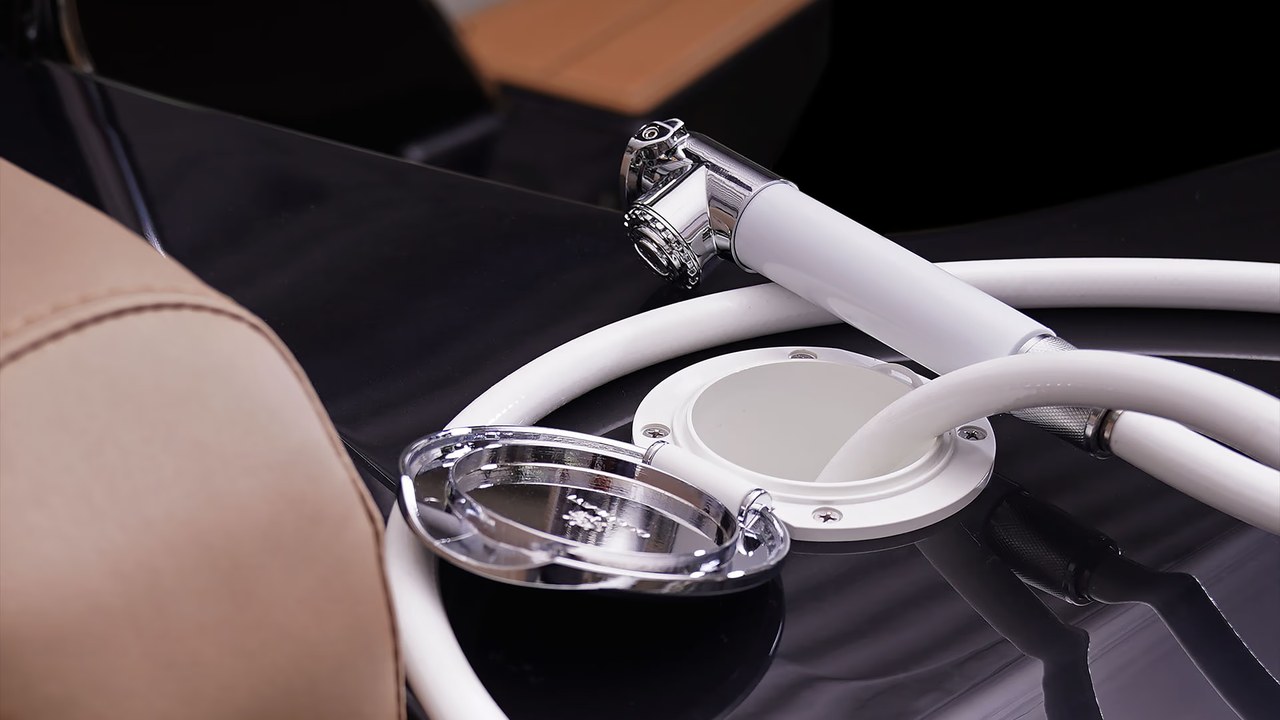
The water tank is indicated in 39 litres; the shower appears among the optional in commercial documentation. If installed, try from the vent to the shower: filling, sealing, pump, switch, tube, bellows and drainage of the water used. Tank and circuit must be cleaned according to instructions compatible with materials, then rinse. Before remittance, the emptiness is evaluated according to the climate. The pump should not work dry as permitted by the manufacturer. The file clearly distinguishes technical water and water intended for consumption, without attributing undocumented potability.
Battery, battery and protection
The manual places battery and disconnector in the stern technical area. It is photographed the initial position, they control fixing, cover of the terminals, polarity, locks and absence of oxidation. The battery must remain still during navigation and not become the support for objects placed in the compartment. The disconnection command must be reached and identified. The added circuits contain cable section, protection and connection point: to feed a new accessory from a available wire without checking flow and fuse breaks the traceability of the system.
Bridge, switches and socket 12 volts
The console described by the manual includes switches, instrument space, alarm, 12 volt socket and fuse box. The test associates each command to the real function and applies legible labels where they serve. We accept the utilities once at a time, then in the planned combinations, observing alarms and anomalous falls. The socket is verified with a compatible load, never assuming that it can feed any device. The back of the dashboard must remain inspectable: bags and equipment can not weigh on the connectors or obstruct the path of the cables.

Lights, warning and tools
The lights in the equipment are controlled with clean lens, integral fixing and stable power supply. The viewer is tried briefly. The tools present are listed by brand and function; sensors and alarms follow the manuals of their respective manufacturers. Before departure, the essential indications are visible from the driving position and that the windscreen or later accessories do not cover them. An unexpected value is not correct by replacing it mentally with an estimate: it compares with the sensor and an independent measure when available.
Bridge drainage and compartments
The documentation mentions self-emption, ombryl and pump. The verification sequence however identifies what is really mounted: bridge openings, pipes, valves, discharges and bilge pump with relative command. Dry boat remove debris and it occurs that each route is free. The pump is tried by introducing only the amount of water needed and observing start, flow and stop; it is not allowed to turn dry. Taps and valves have a defined operating position. After washing or rain, compartments are controlled, because the draining blanket does not make inspection unnecessary.
Technical rooms always reachable
The poppiero sofa and the driver’s seat integrate storing, but below or near these volumes pass components of the system. The assignment of the loads starts from the accesses: detachment, fuses, pumps, pipes and fixings must be reached without emptying the boat in emergency. Heavy objects are stopped and separated by cables and pipes. Bearings, bags and equipment cannot lock the cover. During delivery it opens every compartment in the complete configuration and notes what can be placed safely.

Five air chambers at 0.2 bar
The tubular U has a maximum diameter of 51 cm and five independent rooms, each with its own valve. The nominal pressure is 0.2 bar. The control uses a suitable instrument and follows the sequence indicated by the manufacturer, taking into account the temperature: heating in the sun, the air changes pressure. Valves, caps, joints, studs, handles and contact areas with steps or accessories are inspected. Detergents, solvents or improvised repairs do not apply without verifying compatibility with the actual exemplar material.
Weight balance and loads allowed
The manual distinguishes more values: 1.270 kilograms of load capacity of the empty boat according to the method recalled, 970 maximum load and 840 maximum load for the tag with specific exclusions. Commercial pages use definitions that are not perfectly overlapping. The verification sequence does not transfer an isolated number into the navigation plan. Separate people, luggage, fuel, water, motor, battery and optional, applying the limit indicated by the unit documents. When trolley, crane or flow are decisive, the ready configuration is weighed.
Ten people do not mean ten equivalent places
The limit of ten people should be read together with mass, sitting, clapping and distribution. Before leaving you will assign a position to each occupant and clarify the permitted movements. The passage between stern, console and bow is tried with cuscinerie and sunbathing in the planned positions. No one should use windscreen, backrests or components not intended for the nozzle. Children and people with reduced mobility require a specific evaluation. Category C and declared capacity do not replace the decision of the commander on weather, sea, distance from shelter and experience of the crew.

Scaletta and ski lift procedure
The folding ladder with platform appears among the optional, therefore its presence must be confirmed. If installed, it proves opening, blocking, hooks and route from water to blanket. The outboard must be turned off and made sure before a person approaches the stern. Tiller cables, tubular and equipment should not interfere. The procedure also considers the possibility of helping a tired person: the ladder must be accessible and usable without having to move dangerous objects. After use, you control fixations and correct storage.
Sports train and dedicated points
The official images show recreational use, but a photograph does not define loads or procedures. For each tow you can identify the point provided by the manufacturer, you can check top, equipment and free area from the propeller and apply local rules. Lifting gulls and bittens do not automatically become towing points. The conductor maintains an observer when required and agrees with signs and stop. At the end of the activity the used hardware is inspected. No performance rating is deducted from the promotional scene.
Sunsets, kitchens and coolbox
False paglioli and pillows transform the prodiera area; coolbox and other equipment can be optional. Each removable piece receives a storage space and a system that prevents its movement. Mounting should not cover the anchor, make a compartment inaccessible or delete the hooks. The assemblies are dried and controlled at the fixing points. A full container adds mass: its position enters the load plane. The test is carried out with the boat as it will be used, not only with the empty blanket.

Static testing before the varo
Static testing brings together controls without starting a premature sea test. Documents, tag, engine fixing, steering, handle, stop, battery, protections, lights, warning, pumps, drains, tanks, vents, vents, tubular, gavones and access. The positions of valves and switches are photographed. Every non-compliance generates an action and a second verification; it is not enough to note “to check”. Compulsory safety and anchoring equipment is placed in the assigned rooms, keeping the technical components free.
Water testing with declared configuration
The test report indicates people, load, tank level, engine, propeller and conditions. After the launch, immediately check the compartments, drains, cooling and outboard alarms. At low speed there are grafting, stopping, rudder and command response in the two directions. Only after these reconnaissance we explore the system provided by the engine builder program. Speed or consumption is not published unless measured by explicit method and configuration. On the return they inspect again fixings, losses, tubular and bilge.
verification sequence before each departure
The recurring control is short but precise: weather and navigation plan; documents and equipment; load and people; pressure and state of the tubular; plugs, valves and drains; fuel with reserve; battery and detachment; steering and controls; emergency stop; lights, warning and pumps; motor and propeller; again, peaks and parabords. The technical rooms remain accessible and nothing is free to move. The anomalies are not postponed because the output is short: an uncontrolled circuit remains an unknown condition.
Single unit maintenance register
The BRIG Eagle 6 becomes manageable when each intervention leaves a trace. The register contains hours of the engine, controls and maintenance, spare parts, locks, battery replacements, work on steering, pumps, tubular, fuel and water. A change adds schema, electrical protection, mass, manual and photographs. After work involving a compartment, the test of the nearby functions is repeated. The file also retains the testing configuration, so a change of propeller, motor, battery or accessory is not confused with the previous behavior of the boat.
A technical delivery, not an optional list
For this model, the value of the verification sequence is to connect each equipment to its system. The showerer involves reservoir, pump, pipe and drainage; the ladder implies safe access from the stern; the 12 volt socket implies protection and limit of the circuit; a new instrument involves wiring and inspectability. Delivery only closes when shipowner and technician can identify switches, valves, protections, maintenance points and stop procedures. So the official data of the BRIG Eagle 6 become a concrete, controllable and up-to-date configuration.