
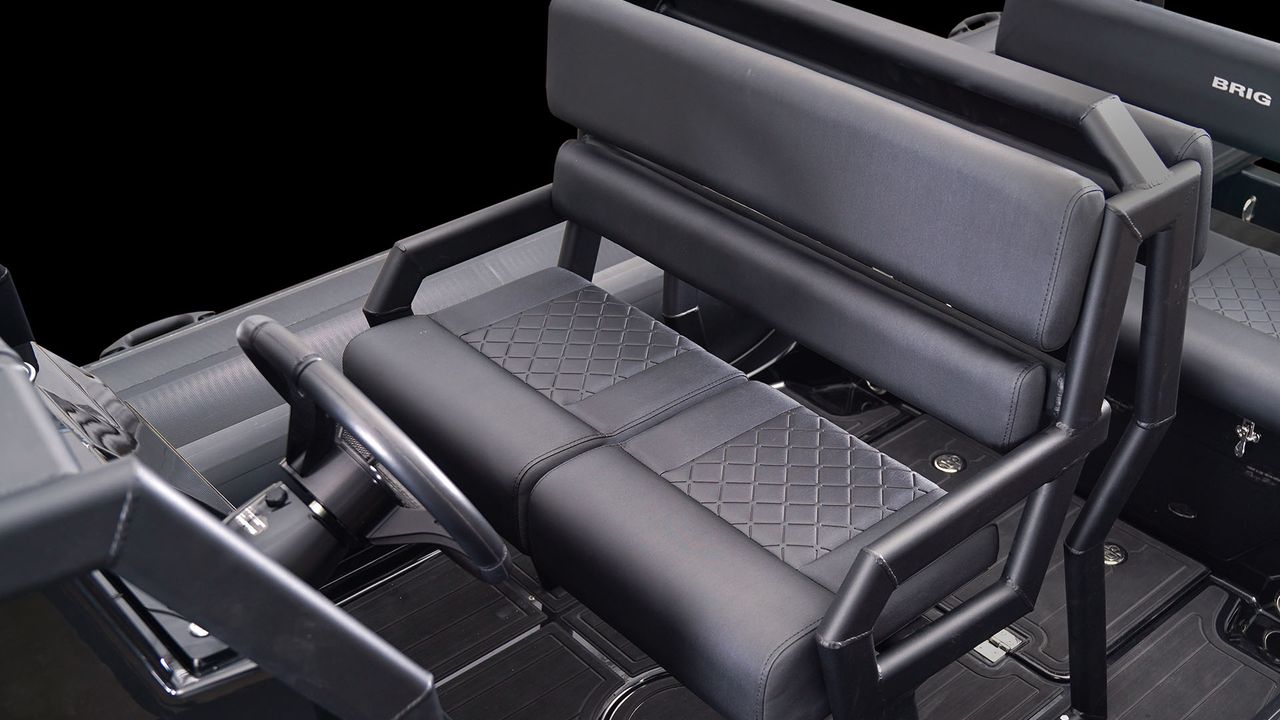
Configuring a BRIG Navigator 20 means coordinating engine, weights, tanks, electrical system, drainage and accessories within a 6.20-metre RIB. The model is approved in category C for eight people, but the conformity of the platform does not replace the verification of the specimen. This guide transforms official data into a practical sequence of controls: before ordering, during preparation, testing and ordinary maintenance.
Configuration card to be opened before order
The first page of the file must report identification number, year, tubular material, motor, propeller, batteries, optional and masses. The Navigator 20 measures 6,20 meters without motor and 6,95 meters with motor according to the manual; the width is 2,55 meters. The declared height is 2,03 meters and rises to 2.70 meters with T-top. This data is used for boat, remittance and transport, but must be confirmed on the delivered physical configuration.

Outboard compatibility
There is only one motor with extra 25 inch long stem on 625 mm stern mirror. BRIG indicates 150 hp as recommended power and 175 hp as maximum limit. There is also a mass bond: engine, controls and batteries must not exceed 285 kg in total according to the manual. The installer's verification must report model, freshman, documented weight, assembly quota and clamping pairs, avoiding choosing the engine only according to the nominal power.
Weight distribution and load margins
The vacuum mass is 775 kg and the maximum of factory equipment without engine is 800 kg. The manual contains a load capacity of 1,080 kg, a maximum load of 1,050 kg, a recommended maximum load of 865 kg and a full load of 2.130 kg. These are different normative and technical definitions: the onboard calculation must list people, fuel, water, batteries, anchors, luggage and accessories, verifying them against the specific documentation of the unit.
| Control | Reference | Recording results |
|---|---|---|
| Ingo | 6,20/6,95 x 2,55 m | Real configuration measurement |
| Height | 2,03 m; 2,70 m with T-top | Recognition compatibility |
| Engine | 150 hp recommended, 175 hp maximum | Model, mass, altitude, propeller |
| Fuel | 191 l page / 190 l manual | Plate; maximum operating 165 l |
| Fresh water | 39 | Only if installed option |
| Tubular | 5 rooms, 0.52 m, 0.2 bar | Pressing and sealing |
| Persons | 8 | Posts and distribution |
Fuel tank: three numbers not to be confused
The current product page indicates 191 liters, while the manual 2025 declares 190. You do not correct the difference by intuition: you register and the specimen tag occurs. The manual also recommends a maximum supply of 165 liters to leave expansion volume. Geometric capacity, document data and operational quantity are not synonymous. The procedure must include shutdown of the utilities, odor control, absence of discourses and subsequent verification of fittings and sentry.

Fuel line, vent and filtration
The system described includes external box, integrated tank, vented with canister and level sensor. The fuel filter is not supplied by the boat manufacturer and therefore depends on the engine setup: position, flow and maintenance must be agreed with the installer. Piping support, curvature rays, clamps, cable separation and rubbing protection are controlled. Any persistent smell requires stop and diagnosis before reusing the boat.
Batteries and electrical circuit of the equipment
Number, capacity and scheme of batteries vary with the engine and accessories ordered. For this reason the delivery must include an updated scheme, not a generic representation. There are sections of the cables, protections, detachment position, mechanical fixing, ventilation and protection of the poles. The battery masses fall within the total limit of the propulsor group indicated by the manual. After the installation, the tension is measured at rest and in charge, checking abnormal alarms and absorptions.

Automatic Sentry Pump: Full Test
The automatic pump is a declared equipment and must be tested in both available modes: automatic activation and manual control. The test includes power supply, fuse, sensor, tube, valve if present and discharge off board. It is not enough to hear the electric motor; it must be observed that the water is actually evacuated. It is also possible to check that the compartment can be reached even with a hold. Dirty and free objects can block aspiration or float.
Double cover self-empting
BRIG declares a double self-empting system. The test must be carried out with the boat in the planned set, because slope, load and obstruction influence the exhaust. Each filling must be free and the mobile parts, if present, must work without hardening. Water stagnating in the bow or around the console can signal incorrect distribution of the load or insufficient maintenance. After washing, check that no cap or object has remained in the line.

Shower and fresh water circuit optional
The declared capacity of fresh water is 39 liters, but shower and washing are listed as an option. The first verification is therefore the actual presence of the plant and its separate. If installed, they control reservoir, vent, pump, filter, pipes and delivery point. The circuit must be emptied or protected when the climate requires it; stagnant water and un inspectable fittings are weak management signals. Also these 39 liters contribute to the load and the setup.
Motor steering and control
The government system is indicated among the equipment, but the final configuration must correspond to the chosen outboard. The wheel is driven off from one end to another, observing pipes, cables, fittings and space in front of the engine. There must be no rubbing, narrow folds or interference. In water they control centering, response, possible game and alarms. The gas command must move progressively and return to mad with certain indication.

Consoles, electronics and pilot visibility
The official images show possible configurations, not an automatic list of instruments included. Display, radio, transducers and sockets must appear in the quote with precise models. Before drilling the console, rear access, drainage, ventilation and cabling separation are planned. At the test there is readability standing and sitting, night obscuring, software update and absence of obstacles to the visual. Each appliance must have an identifiable electrical protection.
Tubular: material, valves and pressure
The maximum diameter is 0.52 meters and the rooms are five. The indicated pressure is 0.2 bar, to be measured with a suitable instrument and with attention to the temperature. The page presents Hypalon in the standard and PVC equipment among the alternatives: contract, tag and repair kit must agree with the chosen material. Valves, joints, abrasions and pressure differences between compartments are inspected. A frequent reproach should not be normalized, but investigated.

T-top, A-frame and scale: options controls
T-top, A-frame and folding ladder with platform are options. For each need weight, fixing points and maintenance instructions. The T-top changes the total height to 2,70 meters and increases the wind exposure; you control locks, cracks, cable passages and interference. The ladder must open from the water and not hinder the engine. The A-frame should not be used for functions other than those declared. After the first hours, the fixtures deserve a new inspection.
Test in water with repeatable data
A useful test does not only look for the maximum speed. There are people, fuel, water, equipment, wind and sea status; then they occur flat, response to changes in trim, vira, visibility and maximum regime. The engine must reach the interval prescribed by its manufacturer. The manual of the boat declares 21 degrees of deadrise aft and 22.5 degrees in the middle section, but the final behavior depends on the entire installation. Any modification of the propeller should be recorded.

Eight people: arrangement and hooks
Homologation for eight people is a limit, not a universal sitting plan. Before leaving the moorings the commander assigns the positions, it keeps the command zone clear and distributes the weight. The manual requires two hooks for those who sit on the tubular and invites to reduce the speed in that condition. mandatory safety equipment, bags and sports equipment must be fixed without blocking technical gavones, drains or bilge pump.
periodic verification sequence to maintain configuration
Each output starts with pressure from the tubulars, fuel level, bilge, rudder, batteries, discharges and engine fixing. At scheduled intervals there are T-top clamps and accessories, fuel filter, piping conditions, electrical terminals and water circuit seal. After bumps, towings or transport, the inspection of structural points is repeated. Recording dates, engine hours and interventions allows to distinguish progressive wear from an improvised anomaly.
Inventory of compatible parts and materials
The onboard kit should be built on the real configuration. It includes fuses of the installed values, lamps or modules, tools for clamps, material for a temporary repair of the tubular compatible with PVC or Hypalon, impeller and engine spare parts indicated by the manufacturer. Adhesives, solvents or sealants are not improvised: incompatible products can expand damage. The inventory shows quantity, deadlines and location. The components of the fuel system require specification suitable for gasoline and cannot be replaced by generic couplings.
Delivery and minutes of testing
At the end of the preparation, customer and installer should sign a record with fresheners, weights, liquid levels, propeller, reached regime and correct anomalies. We attach electric schematics, fuel circuits, manuals, guarantees and photographs of accessible rooms. The divergence between 191 and 190 liters is noted along with the plate data, without altering the documents. Each option receives a line with electrical protection and maintenance. The file thus becomes the basis for assistance, resale and subsequent controlled changes.
Final configuration assessment
The BRIG Navigator 20 offers a legible base: only one outboard up to 175 hp, five rooms, integrated tank, double vacuum and automatic pump. However, the quality of use depends on the consistency of the installation. The best specimen is not the one with multiple options, but the one in which masses, wiring, pipes and accesses are documented and verifiable. A delivery with a pattern, distinct, weighed and recorded test reduces ambiguity and makes every subsequent control more effective.