
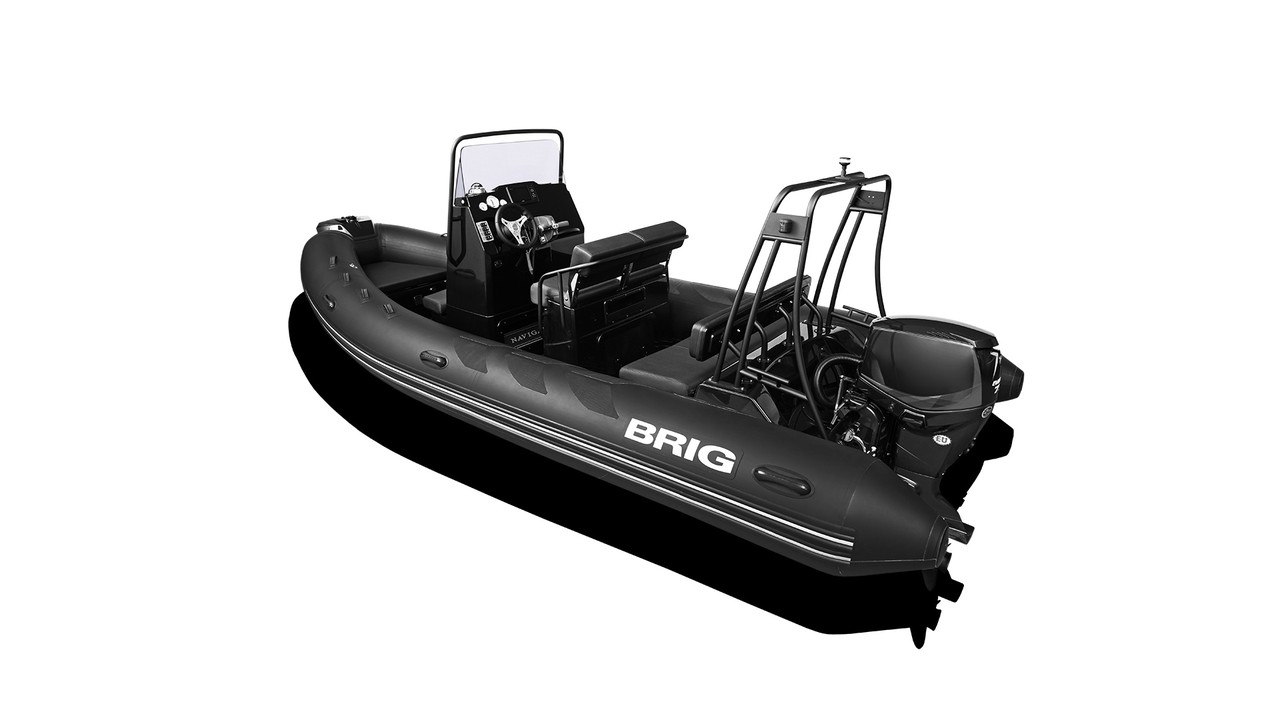
Checking a BRIG Navigator 570 means working on a model that the manufacturer defines out of production. The 2020 documentation remains detailed enough to turn the visit into a measurable sequence: identification, tubular, motor, rudder, fuel, electrical, drainage, loads and proof. Synthetic values are 5.70 meters, 2.30 glare, 480 kg and nine people. However, they do not describe the wear or modification of a single unit. For this reason, each verification connects the original data to a direct match.
Prepare the file before the visit
You collect number of the hull, tag, declaration of conformity, year, outboard registration, maintenance and invoices. A picture of the picture and technical rooms helps to compare later works. Dismissed model and used unit are not synonymous: there may be an integral specimen or a deeply transformed one. Accessories, cablings, seats and rudder that do not coincide with historical images should not be judged on sight; they identify brand, installation, protections and compatibility.

Measures to be confirmed on the unit
Length without motor 5,70 meters, width 2,30, height 1,85. The well is indicated in 4,00 for 1,30 meters and the tubular reaches 0.50 meters. The dimensions allow a tolerance of three percent; outboard and trim angle change the longitudinal footprint. They measure therefore real space in the dock, height with arch, width on the cart and openings of the gavones. A nominal centimetre does not replace control of a door, crane or assigned place.
Operating values diagram
| Element | Limit or given | Verification |
|---|---|---|
| Tubular | 5 rooms, 0.15 bar | Pressure at a known temperature |
| Persons | 9; 10 only USA | Plate and total mass |
| Engine | 75 hp recommended, 120 hp maximum in manual | Certificate of the specimen |
| Propulsion group | 280 kg maximum | Motor, controls and battery |
| Mirror / stem | 500 mm / 20 inches | Quota and drilling |
| Fuel | 98 | Estate, vent, indicator |
| Mass equipped | 480 kg | Without motor and fuel |
| L | 765 kg | Balance of the masses |
| Maximum total load | 835 kg | Do not sum other definitions |
| Load dislocation | 1.600 kg | Different from road weight |
Test of the five rooms
The pressure gauge must be reliable and the initial reading noted room per room. The nominal pressure is 0.15 bar or 2.2 psi. After stabilization in the shadows, control is repeated, avoiding a thermal change seems a loss. Valves and caps are observed together with seams, joints, studs and areas under the seats. A repair can be valid, but it must adhere, use compatible material and not conceal a more extensive damage. Rabbocco does not replace diagnosis.

What power to use as a reference
The historical page mentions up to 115 hp, while the manual contains 75 hp recommended and 120 hp maximum. The tag and certification of the examined boat solve the doubt; it is not assumed that 120 hp are always authorized. The group formed by outboard, controls and battery remains within 280 kg. Before a motor change you will acquire weight, stem, regimen field and steering requirements, then they occur with competent installer and model documentation.
Mirror, bolts and motor height
The planned mirror measures 500 mm and uses 20 inch long stem. On the ground they examine internal and external surface, holes, plates, washers and sealing. The water around a bolt, a radial crack or the bending under load require deepening. With motor rotated from one stop to another, cables and pipes should not pull, bend or touch edges. The height of the antivitation is recorded to interpret possible ventilation in the next dynamic test.

Timoneria: full static test
The manual includes mechanical system and hydraulic variant. On the first you control sheath, terminals, curves and sliding; on the second cylinder, fittings, tubes and oil. The steering wheel must move the outboard continuously, without elastic returns, impurities or excessive play. A second person observes the stern connection while the command runs through the entire race. After a few minutes, you can review any exudations and it happens that sitting or gavones do not interfere with mechanics.
Tank and power line
The declared capacity is 98 liters. From the outer cap follow filling tube, vent, reservoir, prefilter, valve and mandata. Odor, discoloration, unsuitable clamps, folds and rubbing; the compartment must allow inspection without destructive disassembly. The manual reserve installation of prefilter and valve authorized personnel. Before refuelling, engine and electrical utilities are switched off and smoke and flames are eliminated. The full enters the weight calculation.

Challenge, indicator and autonomy
An obstructed vent can deform the reservoir or disturb the power; a poorly oriented can promote water input. You control the path and exit, then the response of the indicator during known amounts of fuel. A working hand does not automatically produce reliable autonomy. Consumption and reserve depend on motor, propeller, load and sea. Register of hours and liters allows you to recognize shocks. New smells or an inexplicable drop require stop and search for loss.
Battery and mass connection
The battery must be fixed in a ventilated container, with poly protected and away from the fuel components. Clamps, caps, cables and detachments are inspected. The manual requires that motor and plant be connected to the mass braid prepared when the tank is installed by the yard: neglecting it can favor corrosion and drilling. Continuity is measured with clean criteria and connections; no random bridges are added. The battery detachment must be accessible by emergency.

Electric console and picture
Flyer, compass, fuel indicator, switches and 12 volt socket are part of the described configuration, with additional instrument space. Each switch is associated with the correct user and is under load. Fuses, conductors section and edge protection must be legible. Behind the console there are no hanging cables in the rudder or joints exposed to water. Replaced instrument openings should be sealed properly without weakening the panel.
Pozzetto drainage
Motor well and recess have a separate drain path from the bilge. Leaves and objects are eliminated, valves and pipes occur and water is introduced controlled away from the electrical components. The flow must reach the exit without accumulating under console or bench. A festive tray, a crushed tube or a modified slope during a refitting can create stagnation and input. The test is repeated with the boat in the typical setting at the mooring.

Automatic Sentry Pump
The pump tries with water, not only listening to the engine. Starting threshold, flow, shutdown and reflux are observed; suction and float must remain free. Phases and passers-by are controlled during the expulsion. The battery must support the load without anomalous voltage drops. After testing, a level that goes back up indicates residual water in the tube or an input to be localized. Oil, fuel or salt water in the bilge should not simply dry.
Seats, poppiero gavones and accessibility
The advanced console free stern seats and the page describes a large gavone for equipment under the bench. Covers, hinges, stops and supports are tested, checking that the load is not suitable for pump, battery or cable. Seats must have solid fixes and backs without games. In the bow, people and luggage cannot obstruct passages and visuals. The distribution declared by the configuration does not allow to exceed plate or loads, especially in challenging conditions.

Masses: prepare a load sheet
The naked boat is indicated at 380 kg; the one with console, arch and seat at 480 kg, without propulsion and gasoline. LCC 765 kg, maximum load 835 kg, recommended maximum load 1.040 kg and load displacement 1.600 kg are sizes with different definitions. It builds a separate list of motor, battery, full, people, anchors and equipment. The position of each mass counts how much the total: too much weight aft can make inefficient drainage and planata.
Test sequence in water
First, configuration, weather and load are noted. At the pier they try steering, triggers, cooling, alarms and charging. In safe zone you gradually increase the regime, you control trim, planata, virata and stop, remaining in the field provided by the engine builder. Documentation does not authorize a promised speed. Vibrations, cavitation or abnormal sprays connect to propeller, engine share and distribution. After the return they reopen rooms for losses, heat and loosening.
Maintenance and spare parts on a legacy
A register with dates, engine hours, pressures, batteries, supplies and jobs makes the evolution of the unit understandable. Each season we repeat the seal of the tubular, rudder, fuel, electric, pumps and hardware. After salt water rinse the compatible parts and dry the rooms. A generic replacement is not only purchased because it has similar measures: material, flow and connections must be verified. Store removed components and photographs facilitate diagnosis and future expertise.
Fire control and emergency access
The extinguisher should not be placed in a locked compartment or near the point that could become unreachable in case of fire. Type, expiry, fixing and reporting are verified according to the applicable rules. Battery and fuel valve must remain accessible without removing luggage. Before refueling, the engine shuts down, the unnecessary utilities are interrupted and every ignition source is eliminated. All on board must know where there are controls, vests and exit safer from the driving area.
Remittance and reactivation
During the long stop the hard hull is supported in the correct points and the tubular protected by rubbing, without sealing moisture under the cover. Battery, fuel and motor are managed according to the respective instructions. Reactivation is not limited to start-up: pressure, steering, fuel lines, pump, lights and charging are repeated, so a short controlled test. Each component replaced during the shelter is recorded with code and motivation, so the configuration remains reconstructable.
conclusive verification sequence Navigator 570
The verification only closes when identity is confirmed, power limit, mass of the propulsive group, 20 inch stem, mirror, five rooms, load people, 98 litre tank, mass, rudder, battery, picture, drainage and pump. Tests are added to the pier, registered exit and new control of the rooms. The Navigator 570 offers clear technical references despite its failure; reliability and value remain the property of the specific specimen and the documented quality of its maintenance.