
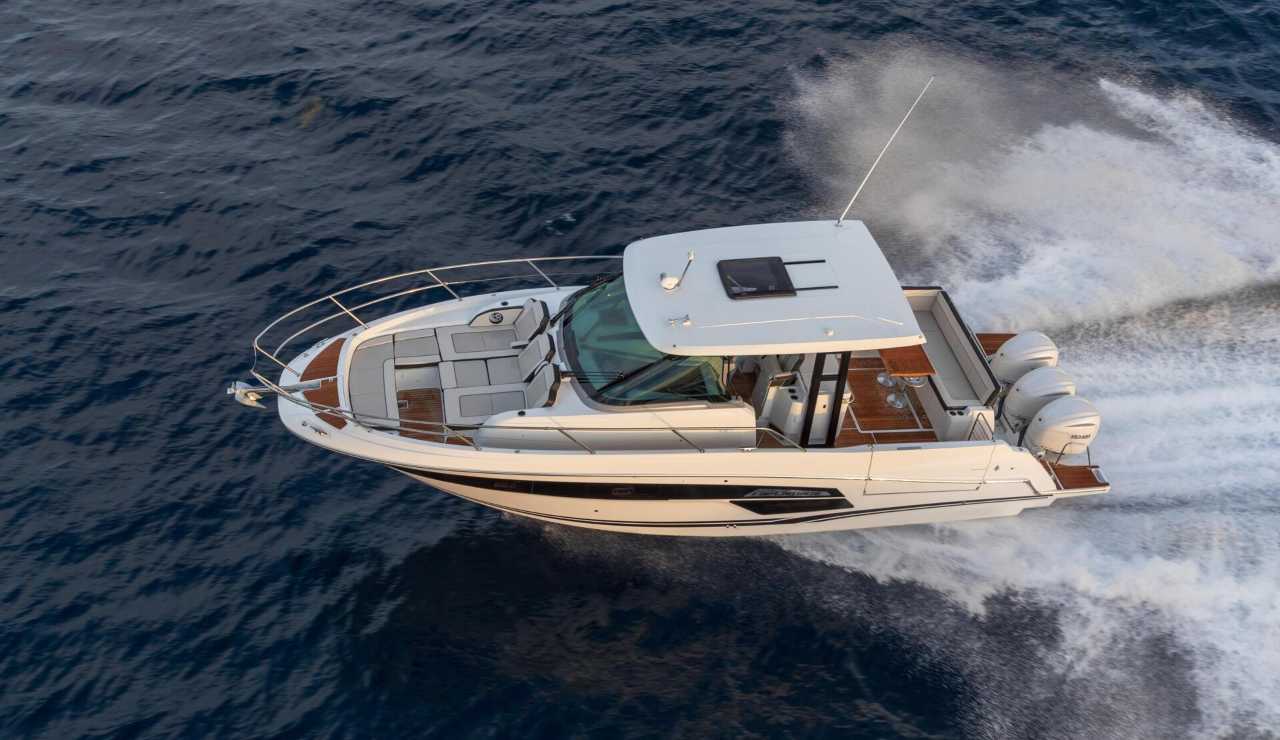
The Jeanneau Camarat 12.5 WA represents the core of the concept “walk-around” in the 12-metre band with outboard: a platform from deep V hull, signed by Michael Peters, designed to combine acceleration, wave absorption and transversal stability with loads and sports weekend speeds. Naval architecture favours a angle of deadrise high and carene weaving, able to transform up to 900 hp of installed power (2×450 hp or 3×300 hp) in supported cruises and lightning fixtures. In 2025 the model introduced the new variant to integral windscreen, which increases the aerodynamic protection of the well without sacrificing the sports setting of the profile.
Project Objective
The project brief is clear: one day cruiser with high performance able to accommodate a family for the weekend, offering a true shipowning booth, a convertible square and complete services, but with the guideability and readiness typical of the outboard. Theblanket ergonomics prefers the perimetric circulation and the usability of outdoor volumes (bazzetto, prodiero sunbathing, sun terrace), while undercover we find useful heights, domestic beds and a bathroom with a separate shower box: a rare balance in walk-arounds of this class.

Site profile: history, construction philosophy, reputation
Jeanneau, French historical brand with over 60 years of activity, is synonymous with quality industrialization in the field of sailing and motor. The brand's philosophy is consistent: smart models from great usability, built in fiberglass with consolidated processes, strict quality control cycles and a global service network. The perceived reliability – combined with a continuous range evolution – allowed Jeanneau to position the series Cap Camarat as reference of the European “family sport boat” segment and not only. The collaboration with leading external designers and premium suppliers (motors, stabilizers, electronics) demonstrates an approach platform-based but open to customization.
In-depth technical analysis
Dimensions and naval architecture
The boat is located in the 12-metre range with reference values that – depending on the layouts and regional declaration standards – range between 11,90 m of maximum length and 12,27 m by LOA, with bay around 3.57–3,58 m. The declared dry displacement is in the order of 7,1 t (versions and equipment may vary), in front of a fishing typical of about 0,75–0,82 m with lower units lower. These numbers detect two things: a large famine (generous herbicides and important storages) and a favorable weight/power ratio, which justifies pairing with 300 hp or 450 hp trio.
I do stairs is not foreseen: the hull maintains continuous bearing surfaces, favouring progressive support and predictability in the virates. Baricentro is carefully managed to integrate tanks from 1.150 L of fuel and 200 L of fresh water, so as to minimize adjustments with prolonged consumption. The wide spray rail on the prodier section dissipates spray outwards and guarantees dry to the central well even with sea formed.
Building materials (exhaust, superstructure, interior)
Shock and blanket are in GRP (vetroresin with polyester resin and local reinforcements), with lightened cores in the areas of greater panelling and full reinforcements in correspondence of the hard points (T-top weights, pulpit landes, side terrace arms). I motor transverse are oversized and laminated in continuity with main longherons. The superstructure includes a T-top made of fiberglass on stainless steel frames with sliding skylight; in the 2025 full windscreen variant, the high protection crystal is framed by painted frames that stiffen the perimeter. The interiors adopt sea-laminated panelling and clear veneers, with furniture attached to structure and elastic joints to soften vibrations.

Engines, propulsion and transmission systems
The 12.5 WA was born for high-performance outboard. The main configurations are:
- 3 × 300 hp (Yamaha/Mercury), most common solution, excellent in terms of point and redundancy.
- 2 × 450 hp, “muscular” choice that reduces the induced resistance of a third lower unit, simplifying maintenance and wiring.
The maximum installed power is equal to 900 hp. In both configurations it is available mooring joystick integrated with the outboard management system; the conduct aid electronics includes automatic trim (Zipwake or equivalent) for the control of the longitudinal and transversal arrangement. The transmission is direct, with variable step propellers depending on the preferred reduction ratio (typically 1,75–1,85 depending on the brand and the helical diameter).
Performance: maximum speed, cruise, autonomy and consumption
The tests available in literature report maximum speed between 42 and 46 knots depending on the sea, load, set-up and propellers, with full consumption in the order ~300 L/h overall for the triple 300 hp. The “comfort” cruise ranges are around 25–30 knots, with considerably more content consumption (the test data indicate consistent values with the class). In the pre-plan phase, the system of interceptor automatic helps to reduce the high bow and to anticipate the exit from the water, with entrance time in planata in order of 3–4 seconds. The fuel reserve of 1,150 litres allows for self-interesting in crocieristico use, especially maintaining medium-low regimes.
Onboard systems: electronics, home automation, navigation
The driving place, central and protected, provides more dashboard multifunctional display (12–16 inches), interfaced with NMEA 2000 network and digital outboard systems (diagnostics, performance, trim). It is present seanapps platform for remote monitoring (battery status, levels, programmed maintenance) and digital logbook; the navigation package can include solid-state radar, autopilot and latest generation CHIRP transducers.

Design and architecture of spaces: stylistic signatures, interior layouts, ergonomics
The aesthetic language is the typical Cap Camarat: stretched lines, full mascones, spray rails marked and a T-top spinning. The blanket develops on different levels: on a stern a modular well with perimeter divaneria, centered table and external kitchen configurable (grill, sink, refrigerator, glacier), walled terrace electric that widens the plan of use and favors the bathroom. In the bow, in addition to the sun, a second living room with removable table and opposite seats, obtained by working the anchor cockpit and the cover volumes in a smart way.
Undercover, the shipowning cabin aft includes a real double flanked by a single bunk that, united, forms a king-size; in the middle of the boat we find a convertible square in additional double and, towards the bow, a bathroom with separate shower box. Natural lighting is guaranteed by hull windows extended, while cross ventilation is ensured by portholes and openings on the T-top sky. Theergonomics of the whole – wide passers, continuous tientibene, useful heights – allows safe passages with sea, returning in the pure “walk-around” spirit of the project.

Innovation and research: hybrid/electric, reduction in consumption and emissions, stabilization and safety
At the heart of the innovation package we find the gyroscopic stabilization as an optional, a typical choice of larger units that here approaches to elevate comfort to anchor and transverse transfers. The management of electrical loads takes place through digital pictures with integrated protections and monitors; AGM/LiFePO battery packs4 (optional) can feed air conditioning and kitchen with low noise generators. From the environmental point of view, the optimization of the hull and the availability of engines with direct injection and lean-burn strategies reduce consumption and CO2 to equal performance compared to less efficient hulls.
Life on board and comfort
The 12.5 WA was conceived as “open to live outside”, without penalizing the night on board. In the well, the cockpit living disassembled and recomposed: folding table, extensible divaneria, sun extensions. The outdoor kitchen is modular (grill, stove top, fridge up to 2 units) and aerodynamic protection of the new integral windscreen allows longer cruises with comfort from great tourism. Undercover, the acoustic insulation is maintained; the bathroom with separate shower elevates the viability than the classic walk-around 10–11 m.


Navigation performance: sea tests and feedback
Tests published by specialized magazines show a boat fast to relax over 16 knots, with bright accelerations and light rudder. With 3×300 hp peaks were detected around 43–46 nodes, full gas consumption ~300 L/h and trim consisting of short bow sea thanks to the work of the hull to V and the interceptor automatic. At intermediate regimes (3,000–3,500 rpm) you get an efficient cruise 20–28 knots, with aerodynamic comfort further improved by the new continuous windscreen of the integral windscreen.
Market and competition
Positioning for price and segment
The 12.5 WA occupies the “high” portion of the outboard day cruiser from 12 m, where the value is not given only by the installed power, but by the quality of use: livability of the blanket (side terrace, double living room), real undercover habitability and equipment typical of larger boats (stabilizer, air conditioning, premium electronic packages). The wide distribution network Jeanneau and the ecosystem after sale services contribute to a value seal higher than the average segment, important factor for TCO-conscious shipowners (Total Cost of Ownership).
Direct competitor analysis
In the comparison perimeter the walk-around 11–13 m with outboard and setting premium dayboat. Typical competitors present:
- Carene with V and powers up to 900–1.200 hp.
- Modular cover with side terraces (always more widespread), complete outdoor kitchens and structural T-top.
- Layout undercover with shipowning cabin to stern and separate bathroom.
In favor of Cap Camarat 12.5 WA play industrialization e capillary assistance, combined with the new integral windscreen protection that makes it particularly competitive in the Nordic markets and in the Mediterranean of beginning/season, where wind and splashes can affect usability.
Industry Trend
The growth of big outboard dayboats continue: more clean power, integrated electronics, “coupe” comfort on planners. The side terraces and ♪ i am now waiting for category, as well as digital switchboards and platforms of remote monitoring. The differentiation takes place on ergonomics, finishing quality and, more and more, on aerodynamic protection and acoustic comfort.
Target customer
- Private owners with seasonal base in the Mediterranean, eager for a day cruiser fast and usable, capable of real overnight stays.
- Premium charter operators for day and weekend formulas with high marginality; the ease of conduction with joystick reduces the training times of guests.
- Representative companies and hospitality that require an elegant and modular platform for events, demos and short trips.

Technical specifications
- Length outside everything (LOA): 11,90–12,27 m (according to standard statement/sets).
- Maximum garlic: 3.57–3,58 m.
- Fishing: ~0,75–0,82 m.
- Dry dislocation: ~7,1 t (variable with equipment).
- Fuel: 1.150 L. Water: 200 L.
- CE approval: B-11 / C-12.
- Engines: 3×300 hp or 2×450 hp; max power 900 hp; joystick available.
- Maximum recorded speed (print test): ~43–46 kn; consumption WOT ~300 L/h (triple 300 hp).
Results and awards
The Cap Camarat 12.5 WA, since the launch, has cut out a significant space in comparative tests, obtaining positive reviews for gear comfort, livability and perceived quality of the blanket. The update with integral windscreen has further expanded the appreciation in the markets characterized by variable climate, improving protection in fast navigation.
Future prospects and model positioning
In the medium term, the 12.5 WA platform lends itself to receive electronic changes (hybrid networks, advanced battery management) and benefit from the inevitable progress of generations of outboard in terms of efficiency, emissions and silence. Jeanneau will probably keep the strategy: solid industrial base, customization targeted through packages, aerodynamic upgrades (full windscreen) and comfort options (stabilizer, air conditioning). For the shipowners who want a “sports open” capable of live outside e sleep well, the 12.5 WA remains a central choice and defends the value over time thanks to the brand ecosystem.
Iconographic deepening


Engineering Evaluation Board
Structure and carena
- Longitudinal rigidity: continuous longherons and glued bulkheads for vibrational damping.
- Weight distribution: central tanks for mitigating trim changes to exhaustion of fuel.
- Carena non step: progressive adherence to the virates, predictability with short front sea.
Equipment
- Electric: digital paintings, cables according to ISO 10133, thermal and differential protections.
- Idrico: silenced autoclave, optional boiler, grey/black water separation.
- Climate: compact unit with low absorption with soft-start for small generators.
Conduct and safety
- Joystick and optional thrusters for maneuvers in narrow spaces.
- Automatic interceptor for dynamic trim and reduction of beaking.
- Full windscreen (Series 2) for aerodynamic protection on fast cruise.
Equipment advice
Family weekend
- Engines: 3×300 hp for redundancy and ready plan with loads/hosts.
- Comfort: shaded electric tent, air conditioning, double refrigerators.
- Stabilization: gyro for satin and roll residue.
Sport & fun day
- Engines: 2×450 hp to maximize high speed efficiency and simplify maintenance.
- Deck living: folding terrace, modular sunbathing, premium audio system.
- Instrumentation: double MFD 16′′′, CHIRP sonar for snorkeling/fishing spots.
Notes on maintenance and TCO
Modern outboards require cadence coupons (first hours/years), with predictable costs and reduced workshop times compared to IB. The triple 300 hp multiplies filters, impellers and consumables; the double 450 hp simplifies the inventory but employs larger diameter propellers and stronger trees. The spare parts of the brand “major” and the Jeanneau network reduce seasonal boat stops.
Video
Conclusion — Positioning in the sector
Cap Camarat 12.5 WA is the successful synthesis between sporty outboard e real housing: authoritative hull, modular blanket with side terrace, undercover capable of two double “veri”, cruise equipment and a new aerodynamic protection that extends the useful season. In the panorama of 12 m walk-around, the mix of industrialization, assistance and residual value project the model among the references of the category, with customization margin (motors, electronics, stabilization) so as to adapt to different profiles of use without compromising on the quality of navigation.