
Configuring a Tempest 50 Hair means coordinating outboard propulsion, power grid, tanks, outdoor kitchen, undercover services and maneuver systems on a 14.75 meters long RIB and 4.30 wide. The official card declares category CE B, twenty people, four beds and total maximum power of 1,800 hp. This guide does not replace manuals and testing: it organizes controls that allow you to transform a list of equipment into a verifiable configuration.
First rule: fix the real configuration
The model page distinguishes standard features and options, while photographs and brochures can show different settings. The delivery file must then list each device with brand, model, serial number and position. Engines, propellers, batteries, electronics, refrigeration, maneuver systems and hotel accessories are included. If an element does not appear in the specific signature, it should not be given by present only because it is visible in an image.

initial document verification sequence
Before turning on any user compare CE tags, statements, manuals, electrical and hydraulic schemes, drive certificates and test minutes. The project is attributed to Roberto Curtò Design and the technical office Cantieri Capelli. The dry mass is indicated in about 8,700 kg: for lifting and mooring you need the weight of the finished boat. Actual capacity, valves, protections and emergency access are also recorded.
Data sheet to be confirmed on board
| Parameter | Declared value / verification |
|---|---|
| Length / glare | 14,75 / 4,30 m |
| Dry mass | about 8,700 kg; weigh the equipment |
| People / beds | 20 / 4 |
| Category CE | B |
| Propulsion | outboard |
| Maximum power | 1.800 hp overall |
| Fuel | about 2,000 l |
| Water shower | about 230 l |
| Boiler | 25 |
| Refrigerators | two units of 200 l declared |
| Verricello | electrical, 1.400 W |
| Tiller | Seastar Optimus EPS Electronics |
Motors: the maximum is not the automatic choice
The 1,800 hp represent the total roof allowed. Number of engines, power per unit and installed mass must be approved for the specific set-up. Model, foot ratio, propellers, mounting height, software and regimen field are noted in the minutes. A correct test uses known load and does not presume speed or consumption. At the end of the exit, you compare systems, temperatures and synchronization, looking for vibrations or alarms.

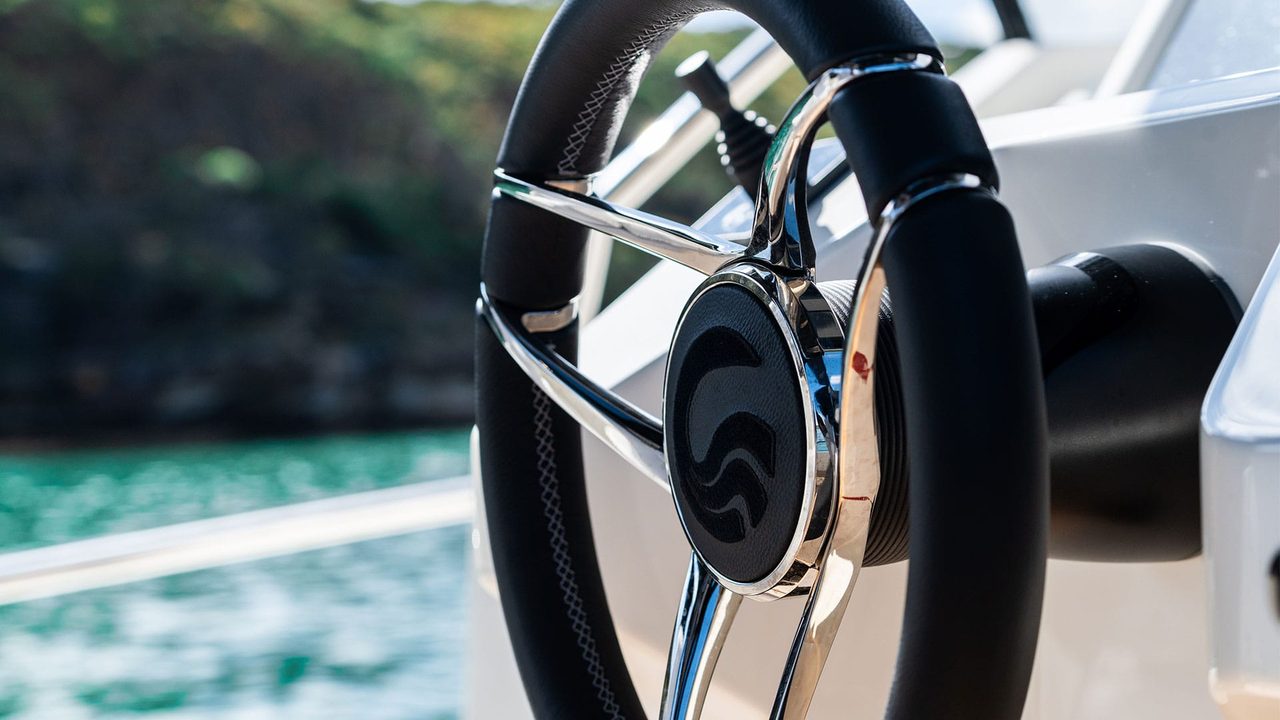
Seastar Optimus EPS steering wheel
The standard declared electronic steering wheel must be tested along the entire race with engines switched off according to procedure and then in motion. Powers, connectors, diagnostic messages, wheel response and freedom of pipes and wiring are controlled. The emergency procedure must be available to the commander. An electronic system should not be judged only by the absence of spies: it is necessary to verify that software, calibration and geometry of the engines correspond to the configuration delivered.
Elica of bow and maneuvers
The bow propeller is included in the standard equipment. The test records voltage of the batteries, straight and left response, abnormal absorption, noise and maximum operating times prescribed. Tunnels, grids are inspected, held and access to the main fuse. The side thrust assists but does not cancel inertia and wind. The crew must know the position of the drive and not insist if thermal protection or decrease of voltage signal a problem.
Network to 12/24 V to be mapped
The tension of the individual subsystems should not be deducted: we read from the patterns and the tags. Starter batteries, services, bow propeller and utilities can have separate and logical charging stations specific. The verification sequence identifies detachment, main fuses, emergency parallels and mass points. They measure tension at rest, falls under load and charging current. Hot cables, oxidized capicorda or uncoated protectors require correction.

Power supply 220 V
The charger that can be connected to the 220 V dock is standard. Before the connection you control socket, cable, earth, polarity, differential protection and seal status. The test activates the utilities one at a time and checks that chargers and dials do not run beyond normal. The cable should not be immersed or tractioned. Every intervention on the alternating network is for qualified personnel, with isolated power supply and instrumental verification.
Generator: a discrepancy to be cleared
The model page shows a 3.5 kW generator, while the 2024-2025 brochure shows 5 kW. You should not arbitrarily choose one of the two data. The valid configuration is the one described in the contract and the plate of the appliance actually installed. Power, fuel, exhaust, ventilation, sea grip and switching with the dock must appear in the schemes. The test includes cold start and progressive test under load.
Optional air conditioning
Air conditioning is optional. If present, indicated capacity, available power supply, sea water pump, filter, condensation discharge and air distribution. The circuit cannot be tried without proper water flow. After the start, losses, vibrations and stagnations are sought in the furniture. It is important to know what environments it needs and what power it requires: a generic wording does not guarantee contemporary operation with kitchen and other loads.

Two 200 litre refrigerators
The equipment describes a 200 litre drawer refrigerator and a second 200 litre double drawer integrated into the guide cabinet. The verification identifies the supply, ventilation and discharge of each unit. Locks and locks must be closed with roll and acceleration. Temperatures are measured after the expected stabilisation time, as soon as they turn on. Grills or technical rooms are not covered by luggage, pillows or carpentry.
Electric plates and outer sink
The furniture behind the guide includes sink and two electric plates. The check sequence controls tap, exhaust, valves, protections and interlocking provided by the manufacturer. Before cooking, the food available and the balance of loads occurs. Objects and lids must be fixed in navigation. Water and electrical components require intact sealing; any infiltration in the cabinet should be traced immediately, because they can reach hidden connectors and structures.
Fuel system of about 2,000 liters
The declared capacity is about 2,000 liters. Buttons, vents, tubes, valves, tanks, filters and sent to engines must be traceable. Strips, rubbish, odours and access to closures are inspected. Indicators compare with known quantities; a bar on the display is not enough for autonomy. The navigation plan starts from the consumption measured on its configuration, keeps reserve and considers that the fuel changes mass and trim.

Water, shower and boiler
The board combines a water capacity of about 230 litres with a 25 litre boiler. Test the pump, look for abnormal cycles with closed taps and control vents, filters, tubes and drains. The boiler must operate only under the conditions provided, with safety valve and internal connections. After heating, temperature and leaks occur without assuming undocumented time or absorption.
Local toilet and black water
The separate room includes toilet and sink; the black water tank is standard. Capacity and schema should not be invented: they are detected by manuals and installation. The test follows load, rinse, drain to the tank, vent and indicator. Valves and fittings must be accessible. Persistent odours, hardened tubes or bribed bands require intervention. Emptying procedures must comply with the rules of the place of navigation.
Drainage and pumps
An extended bridge requires systematic control of discharges. A controlled amount of water is poured at the points provided, observing the outflow and absence of returns. Automatic and manual pumps are tested separately, checking sensors, alarms and non-return valves. The simple noise of the engine does not show scope. At the end they reopen rooms and sentry to look for stagnations. Lowerable table, kitchen and luggage must not block access or grill.

Verricello from 1.400 W
The standard electric winch absorbs a nominal power of 1,400 W. Battery, relay, cables and protection must support the expected load. The test carries out and recovers a controlled part of chain and top, checks buttons and stop and keeps the area free. Chain, still and arrived are to be identified in the distinct; it is not assumed their measure. During the mooring the shot must be transferred to an appropriate structural point, not left on the barbotin alone.
Electric drinking table
The electric control stern table lowers and can receive the dedicated pillow. The test must be carried out without people on the surface, observing guides, actuators, fine running and stability. The procedure occurs in case of lack of power and the location of the protection. No object must fall into the mechanism. When the area is turned, the commander must restore a secure configuration before moving the boat.
Lighting and audio system
LED courtesy lights and radio with ten speakers and amplifiers are declared standard. Underwater lights and audio enhancement are options. Separate circuits, waterproofing, balancing and absorbing are controlled. Any underwater lights require a dry inspection. An audio update must not reduce the energy reserve necessary for navigation, pumps and start-up or cover sound alarms.

Cabins and ventilation
The prodier cabin offers a double bed and the undercover volume doubles two more bunks. Before night use, lighting, ventilation, exit routes, closures and presence of moisture are controlled. Mattresses and panels must be lifted to inspect the hidden surfaces. The four declared beds describe the capacity, do not automatically guarantee energy or hotel autonomy: this depends on the layout and the program.
Hard-top, curtain and covers
The hard-top is standard; the curtain is connected with two carbon poles and covers appear between options. Bolts, seals, drains and cable passages of the fixed structure are controlled. The curtain should be mounted only in the permitted conditions and placed dry. Covers should not obstruct ventilation or create water bags. Each pole and mobile hardware must be stored in a housing that prevents the movement.
Final test in four stages
Delivery is divided into dry control, test in dock, test at sea and inspection at return. Dry documents, hulls, tubulars and fixings occur; in the dock nets, pumps and services are activated; in the sea there are motors, load, wind, wave, regimes and alarms; on the return we look for losses and hot parts. Each defect receives responsibility, expiry and new evidence. Only a closed record turns the declared configuration into an accepted boat.
operating procedure before each exit
The commander controls weather and limits, fuel with reserve, battery status, pumps, bilge, valves, rudder, bow propeller, tools, lights and fixing of objects. Make sure that twenty people are a certified limit and not an invitation to embark on any condition. It distributes weights, informs the crew about emergencies and accesses and keeps the passes free. In Tempest 50 the order of the plants is an essential part of safety.