
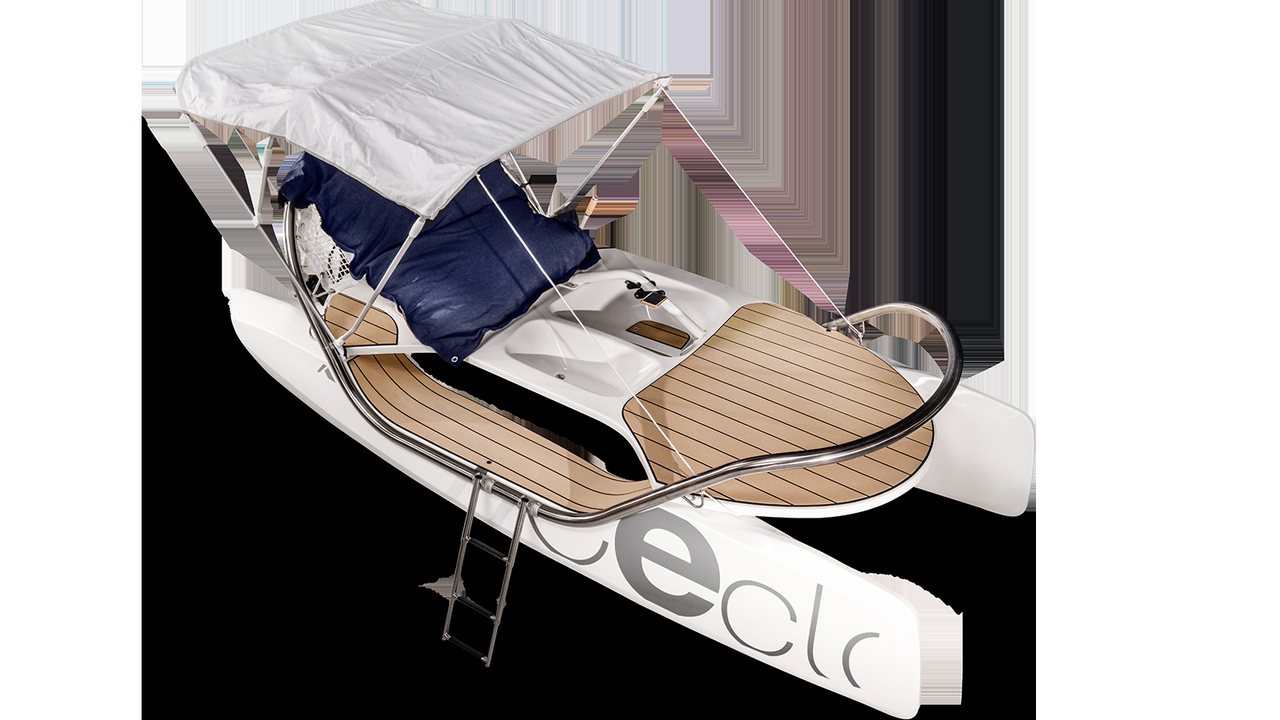
Ceclo Original is a assisted pedal set as a small diporto catamaran for calm waters. The manufacturer declares 3.93 meters in length, 1,72 in width, 210 kilograms in weight and maximum flow of 330 kilograms. The pedal controls the electrical assistance of a 500 watt Yamaha outboard powered by a 1.280 Wh LiFePO4 battery. It should not be confused with a normal pedal without plants or with an electric motorboat: it combines human drive, assistance, bathing platform and furnishings. The correct evaluation involves configuration, battery management, operating limits and maintenance. Speed and autonomy are official statements, not results of an independent test.
General configuration and use destination
The hull adopts two lateral volumes connected by a platform, which offers initial stability and usable space. Ceclo presents the model for couples or families, quiet walks and water access. This destination must remain consistent with place, weather and local rules. The shape does not automatically adapt to open sea or challenging conditions. Before use are defined as a permitted area, distance from the base, reentry and surveillance procedure. For rental activities, obligations, insurance, briefings and registers applicable in the relevant jurisdiction must also be verified.
Declared technical data
The table separates dimensions, flow and electrical system. The values must be confirmed in the document of the specimen ordered, because configurations and accessories can affect weight.
| Voice | Summary | Operating control |
|---|---|---|
| Dimensions | 393 × 172 × 114 cm | Mooring, storage and transport |
| Weight | 210 kg | Suitable handling methods |
| Door | 330 kg | Persons more objects boarded |
| Speed | 4 knots / 7,4 km/h | Value declared by the manufacturer |
| Autonomy | 3-6 hours | Depends on use and conditions |
| Engine | Yamaha 500 W / 55 lb | Assisted electric outboard |
| Battery | LiFePO4, 12.8 V, 100 Ah | 1.280 Wh |
| Loader | 12,8 V / 20 A | Time declared 5 hours |
Polyester fiber catamaran structure
The manufacturer describes a reverse bow structure made of polyester fiber and produced in France. The catamaran configuration separates the floating volume and frees a central area, but requires control of the connections between the platform and the hulls. Shots, cracks, shoots and infiltration are sought on the surfaces. Load points include parapets, ladder, seat supports and propulsive system. An aesthetic damage close to a fixing can have different relevance to a surface scratch. For rental units it is useful to photograph the state at the beginning and end of the season and record every repair.

Load distribution and limit of 330 kg
The scope includes people, objects, food and any additional equipment. It's not the only weight of the occupants. The distribution must remain balanced between the two sides and along the platform; to concentrate everything on the bow or on a modified hull and manoeuvrability. The briefing must explain where to sit and how to move. Before leaving, the real load is estimated without optimistic assumptions. The limit is not increased because the water is calm. Bags and accessories must be ensured, leaving free pedals, control, movement routes and access to the ladder.
Pedalata and electrical assistance
The official page describes an electric motor controlled by the pedal: the user can advance at his own pace and call for assistance. The exact logic of the controls must be tested on the delivered drive, because the operator must be able to stop the push immediately. Pedals, transmission and sensors work as a system. You control games, noises, freedom of rotation and progressive response. Assistance does not eliminate the effort in any situation or guarantees the return with low battery. This is why the operating area must be compatible with user capabilities and available energy margin.
500 watt Yamaha Outboard
The declared engine is a 500 watt electric Yamaha and 55 pounds thrust. Watts and pounds of thrust measure different aspects and should not be converted improperly into horses or performance. The outboard must be inspected for fixing, cables, connectors, corrosion and freedom of the lifting system. Before use it occurs that the propeller turns free and that there are no lenze or vegetation. After use in a salty environment, the rinsing procedures indicated are applied. Any abnormal noise, vibration or absorption requires stop and diagnosis.

Elica and risk of entanglement
The propeller is a moving organ and requires a free zone. The engine must be disabled before a person enters the water or approaches the stern. They do not remove algae or buds with the powered circuit. Inspection includes blades, hub and fixing; deformation reduces performance and can create vibrations. In low waters the system must be lifted according to procedure, avoiding using the engine as leverage on the bottom. Users need to know that electrical silence is not equivalent to harmlessness. Reporting and briefing are particularly important in rental.
1.280 Wh LiFePO4 Battery
The declared package works at 12.8 volts, 100 Ah and 1.280 Wh, with lithium-ferro-phosphate chemistry. The manufacturer indicates 2,000 cycles as a reference duration and a weight of 12.5 kilograms. The number of cycles depends on discharge depth, temperature and management; it is not a universal guarantee. The battery is removable in less than a minute according to the official description, useful feature for charging and safety. The compartment must remain dry, ventilated as expected and free of objects. Connectors and fixing are checked before each turn.

Charging from 20 amperes and declared time
The declared charger is 12.8 volts and 20 amperes, with indicative time of five hours. The charging must take place in a suitable place, with protected power supply and approved components. It does not cover the charger and does not use a damaged cable. Battery and charger must be compatible for voltage and profile. The operator records time, initial status and anomalies, avoiding delivering a unit based on an estimate. Extreme temperatures may require specific limits. If the package has bumps, swellings, smell or abnormal heat, it should be isolated and managed according to procedure.
Autonomy declared between three and six hours
The range of three-six hours depends on required assistance, weight, wind, current, battery status and pedal frequency. It is not correct to plan six hours as a certain value. A prudent management defines a return threshold and maintains reserve for backward winds or deviations. The rental time can be shorter than the maximum autonomy. The actual capacity is recorded over time and abnormal calis are observed. The distance from the base should be limited even if the indicator shows charge, because mechanical failures or changed conditions can require pedaling without assistance.
Commands, direction and stop
The user must be able to understand in a few minutes start, regulation, direction and stop. Each command must move freely and return to the expected position. Before delivery, the service breaks and explains how to react if the system does not respond. Low-speed maneuver should be exercised far from wet and obstacles. The side wind can influence a wide platform; it does not deduce the answer from that of a bicycle. Parapets and furnishings should not limit the view. The manager checks that at least one occupant can govern.

Access to water and ladder
Ceclo presents access to the bathroom as part of the experience and offers a ladder. The actual presence must be verified in the ordered configuration. Before allowing the entry into the water stops the engine, you control the seabed, traffic and local rules and you establish who remains on board. The ladder must be fixed, free of dangerous edges and usable with the actual weight of the user. The lift must be tested in a controlled environment. You do not jump from parapets or platforms not intended for this use. After bathing, water and sand must be able to flow without creating slippery surfaces.
Parapet, kitchen and sunbathing area
The ergonomic parapet and the large cushion are declared elements of the configuration, while the curtain is presented among the recommended accessories. Seats and cushions must be fixed so as not to interfere with the controls. Fabrics and padding require drying and control of moulds, seams and closures. The forward sunbathing area does not change the load limit and should not be used during maneuvers requiring different visibility or distribution. The parapet is examined in the attack points: play or cracks in the support require intervention before reopening the unit to the public.

Storage and handling of 210 kilograms
The declared weight requires adequate means and lifting points; it is not an object to be dragged on the beach without procedure. Trolley, straps and invaders must support catamaran geometry without concentrating loads. Before handling you remove or secure the battery according to manual, you lift the engine and fix pillows and accessories. Restoration avoids stagnations and deformations. Dimensions and height must be compared with doors, covers and available space. For road transport, separate checks are required on means, fixings and regulations.
Daily and periodic maintenance
Every day you control hulls, fixings, parapets, ladder, pedals, propeller, motor, battery level and command response. After use, rinse the exposed parts and dry the electric compartment without any improper jets. Periodically there are locks, connectors, insulation, charger, battery status and transmission wear. The kitchen follows a distinct plan. The hours and cycles are recorded per single unit, useful especially in the fleet. The failure is not expected: changes in autonomy, noise or play are indicators to investigate. Spare parts and procedures must come from the manufacturer.
verification sequence before delivery to the user
The check sequence includes weather and authorized area, employee identity, total weight, required vests, charge, engine test and stop test. They control free propeller, closed compartment, fixed battery, ladder and pillows. The briefing explains commands, maximum distance, local foreheads, ban on approaching wets and number to call. The return time is recorded. Before departure, you will photograph the state if provided by the contract. A unit with alarm, damage or uncertain autonomy remains firm: commercial continuity does not prevail over verification.

Checks before purchase
The buyer must identify year, configuration, serial number, equipment and accessories included. They compare weight and flow with the expected activity. Battery, charger and motor are tested under load, not only on. Historical verification of cycles, maintenance and availability of spare parts. Challenges, platform and fixations are inspected for bumps and repairs. For a fleet, charging times, storage space, training and recovery procedures are evaluated. Insurance permits and covers must be clarified before the contract. No promotional image replaces the signed inventory of the unit.
Technical evaluation
Ceclo Original updates the traditional pedal with a more accurate platform and integrated electrical assistance. The value of the project is as a whole: stable catamaran, pedaled, 500 watt motor, removable battery and water access. This integration requires more discipline than a purely mechanical medium. Autonomy and declared speeds are useful to measure the service, but must be translated into prudential limits and real registers. For individuals and operators the choice is consistent if there are safe charging, maintenance, recovery and briefing. Comfort and perceived simplicity do not eliminate nautical and electrical controls.
