
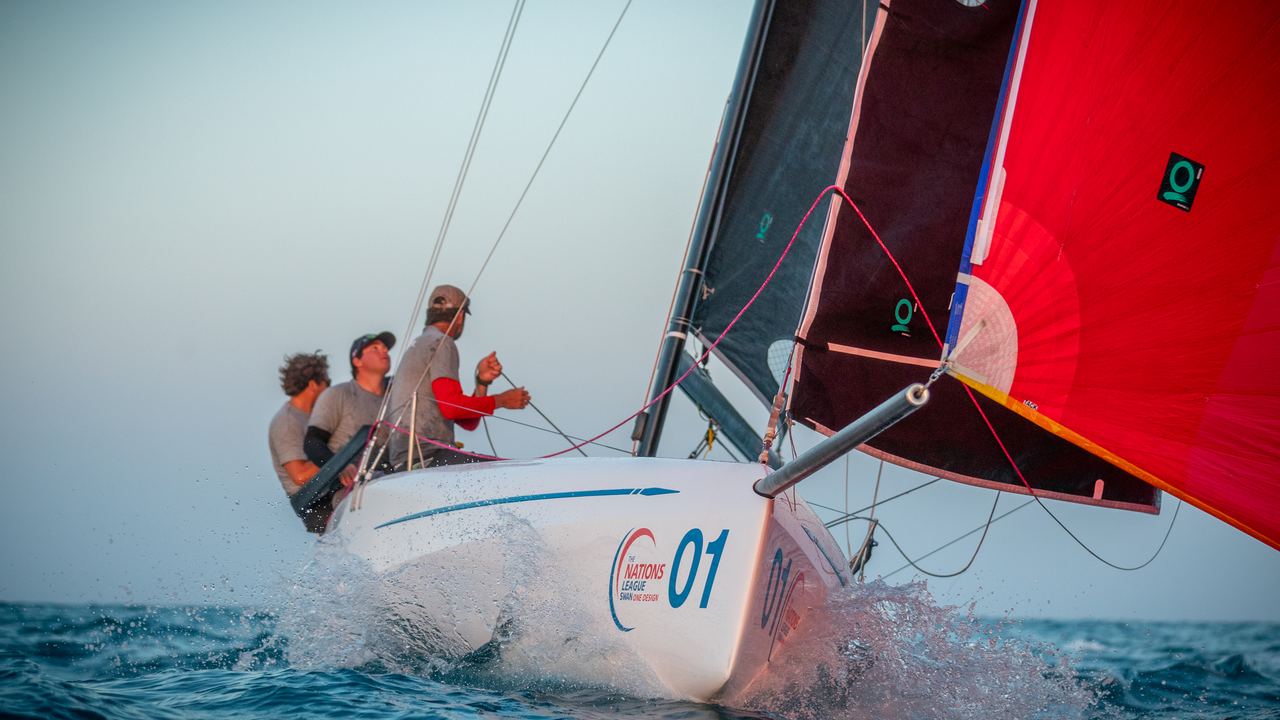
ClubSwan 28 is a compact one-design designed by Juan Kouyoumdjian for a crew of four. The length of the hull is 8,50 meters, but the value out all inclusive of bompresso reaches 10,70 meters. Nautor Swan developed it as an entrance into its sports range, with fiberglass construction, carbon tree, lifting keel and a system dedicated to the recovery of the carrier sail. This analysis does not attribute results of a test: reads the boat as a set of configuration, adjustment plants and declared operating procedures.
What defines ClubSwan 28
The most important feature is the one-design bond. Exhaust, appendix, rig and sails work within a controlled configuration, while class rules delimit what crews can change. The aim is to make comparison depend mainly on preparation, adjustments and maneuvers. For this reason the boat should be interpreted less as a small cruiser and more as a complete sports platform.
The project was launched in summer 2024. Nautor Swan indicates a team of four people and a well in which he races with his legs inside. It is a choice that differentiates the ClubSwan 28 from many sports drifts and boats that require very external straps or positions. Safety does not become automatic, but the posture of the crew remains contained in the perimeter of the cockpit.

Main dimensions and reports
The hull measures 8.50 meters, the bay is 2.50 meters and the declared fishing is 1.80 meters. The displacement is 1,264 kilograms. The bompress bears the total length to 10.70 meters, given useful to understand the encumbrance with the prodiera equipment in place. The boat is therefore light compared to the size, but should not be defined by an unpublished report or by unmeasured speed.
The beam of 2,50 meters is also significant for road logistics, while the lifting keel reduces the difficulties of alaggio and transport. Nautor Swan specifies that the armo and disarmament can be performed in a few hours. Concrete time however depends on team, lifting equipment and local procedures.

Exhaust and covered in fiberglass
The material declared for hull and blanket is fiberglass. The tree is carbon. This separation is consistent with a one-design that has to control costs, repeatability and weight distribution: the glass composite for the larger components and the carbon fiber where the rig stiffness directly affects the shape of the sails.
The template card does not allow to deduce unspecified laminations, souls or fiber percentages. For the shipowner and technician, the controls must focus on the really accessible points: hull-cover joint, appendices attacks, hardware locations and surface conditions. In one-design, even a repair must comply with class requirements.

Liftable keel and logistics
The lifting keel is central part of the ClubSwan 28 system. It reduces the vertical footprint for transport and handling and makes it easier to move the fleet between different locations. It should not be confused with a device to use freely during the race: operations, positions and interventions are subject to class procedures and manufacturer instructions.
Before each transfer it is best to control lifting mechanism, fixing points, trolley supports and pin protection. After the launch, it is necessary to confirm that the keel is in the planned operating position and that the locking devices are installed. An error in the logistics sequence can produce damage well before departure.

Carbon tree without paternity
The rig employs a carbon tree and does not provide patrol. The absence of the stern cable frees the passage of the frog and reduces a manoeuvre, but requires a coherent geometry between tree, tailors and attacks. The shape of the tree and the tension of the straw therefore become variable to manage with the system provided by the project, not with arbitrary additions.
Before the exit you must inspect tree foot, crucifixes, terminals, tailors, drizzes and points of attack. In a one-design fleet it is essential to record the adjustments in a repeatable way. Carbonistics do not eliminate maintenance: shocks, crushing and abrasions must be carefully evaluated and, when necessary, by the manufacturer or a qualified technician.

Hydraulic rig adjustment
Nautor Swan declares a hydraulic system of adjustment up and down, used to intervene on the curvature of the shaft and the tension of the straw. It is an important technical function because it directly connects the command to the shape of the sails. It is not a generic comfort system: it is used to reproduce different settings in relation to allowed conditions and team settings.
The verification sequence must include losses, fittings, useful stroke, return of command and correspondence between the indication and real position. Pressure and operating modes must be taken from the documentation of the class and the manufacturer, not estimated. Each crew should retain an internal table with trim, observed wind and boat response, without turning it into an unruly change.

Said sail plan
The total area declared of frog and bow is 49,25 square meters: 30,25 square meters for the frog and 19 for the bow. The asymmetric spinnaker reaches 87 square meters. The difference between boline sails and carrying sail explains the importance of issata, strambata and recovery maneuvers. On a four-person boat, each role must be defined before the sequence.
Class rules regulate sails and employment. The document 2026 specifies, among other things, that the carrier sail is set with the dedicated straightness, which remains connected to the pen while the sail is lifted, and that cannot be reduced or wrapped. They are operational requirements that affect the preparation of the tops and the management of a problem during the manoeuvre.

Kite retrieves and bow door
The ClubSwan 28 uses a carrier sail recovery system associated with a sliding bow door. The function is to quickly carry the sail inside and reduce the free volume on the bridge during the lowering. For functions, top recovery, points of passage and sail must be prepared without twists or overlaps.
Before departure you have to open and close the dry door, check that the top runs, check the connection to the point provided on the sail and simulate at least one recovery. Salt, sand or cross top can increase friction. The system makes the maneuver ordered only if the preparation is as ordered.

Well and distribution of the four roles
The well is designed for four people with internal posture. In practice, rudder, frog, bow and bow must be coordinated without overlapping the paths. The lightness of the boat also makes the longitudinal and lateral position of the crew relevant, but the modes must comply with the applicable rules and safety.
An effective distribution arises from explicit tasks: who confirms the straightness, who frees recovery, who controls the rock and who keeps the course. The reduction of the number of people does not reduce the actions; it makes them more dependent on the sequence. Briefing, agreed words and abnormal management are therefore part of the configuration as much as sketches and strokers.

ClubSwan 28 Technical Table
| Parameter | Summary |
|---|---|
| Length hull | 8,50 m |
| Length with bompress | 10,70 m |
| Maximum | 2,50 m |
| Fishing | 1,80 m |
| Dislocation | 1.264 kg |
| Project equipment | 4 people |
| The Week | 30,25 m2 |
| Chocolate | 19,00 m2 |
| Fairy tale | 49,25 m2 |
| Asymmetric Spinnaker | 87,00 m2 |
| Material hull and blanket | Fiberglass |
| Material | Coal |
The values are used to prepare place, trolley, lifting and inventory of sails. They do not indicate speed or stability alone. The real weight ready to race must be managed according to class; the length with bompress must be considered in the handling spaces; the fishing of 1,80 meters is valid with the keel in operational configuration.
verification sequence before the launch
Before the launch, check the hull, blanket and appendix to identify shocks or repairs to be checked. The keel must move with the device provided and rest on the correct supports. Timone and hardware must be intact. Shaft, tailoring and terminals must be arranged in assembly order, avoiding carbon components poggino on edges or be tightened improperly.
It is useful to prepare a signed inventory: sails, drizzes, rocks, recovery top, mandatory equipment for safety, admitted spare parts and tools. In a controlled class, the inventory also helps not to mistakenly introduce unallowed elements.
check sequence before departure
With the armed boat, the sequence includes checking pins and keel locks, rudder control, rig inspection, hydraulic test and confirmation of the initial position. The drizzes must flow without crossings; bow and frog must be armed according to the prescriptions; spinnaker, recovery and hatch must be tested.
Safety and communication follow: personal devices, floor for man at sea, words for hexed and lowered, procedure in case of blocked top. The crew of four people does not leave redundant roles, so each has to know what function to assume if a companion is engaged in a problem.
Checks after the race
After arrival it is advisable not to bend the sails. Fresh water where appropriate, door inspection and recovery, control of peaks at friction points, visual verification of tree and attacks, and annotation of anomalies create continuity between a day and the next. The adjustments used should be recorded while still clear.
The lifting keel requires special attention before transport. The load must pass on the intended supports, not on random areas of the hull. Every shock or variation in the operation of the mechanism must be resolved before a new cycle of alge.
To whom ClubSwan 28 is intended
It is intended for owners and teams looking for fleet races with comparable boats and accept the discipline of one-design. The reduced crew contains the number of people to coordinate, but requires precision. The lifting keel and the possibility of arming the boat in a few hours favor a traveling program; they do not transform the logistics in an improvised operation.
It is not the choice for those who want cabins, cruise plants or freedom of customization. It is consistent for those who value circuit, quality of training, repeatability of adjustments and access to a class community as parts of the product.
Concluding technical evaluation
The ClubSwan 28 concentrates in 8.50 meters of hull a complete sports system: lifting keel, carbon tree without patrol, hydraulic regulation of rig, carrying sail from 87 square meters and dedicated recovery. The crew of four people and the inner cockpit define a precise way of using the boat. The value is not in an isolated speed, but in the repeatability of comparison.
To achieve that repeatability, methodical controls are required. Transport, assembly, rig, hydraulics, sail inventory and crew coordination are parts of the same project. When treated as a single sequence of checks, ClubSwan 28 clearly expresses its function: offering a compact, transportable and technically refined one-design platform, in which preparation and conduction remain at the centre.