
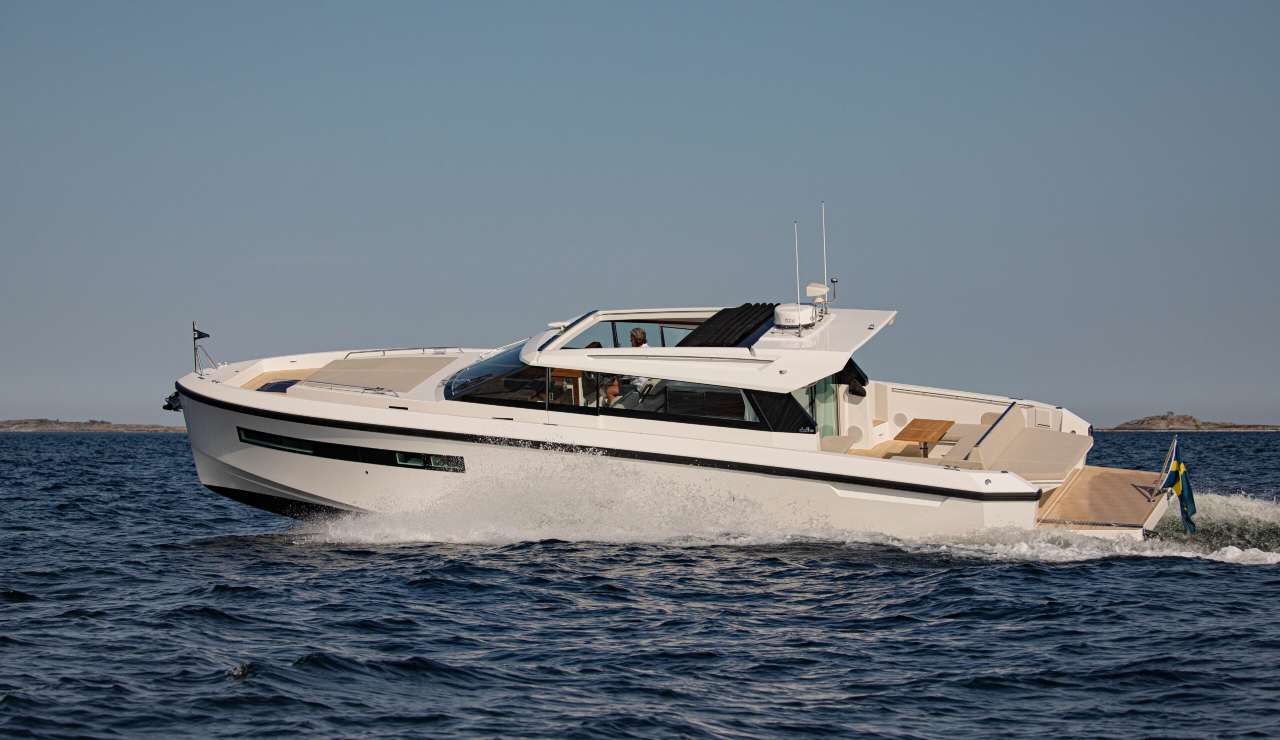

Technical introduction to the model
The Delta Powerboats 48 Coupé (LOA ~15 m) is a sports hard-top with three cabins, made of carbon sandwich with vacuum infusion techniques. Structural lightness allows two propulsive approaches: diesel inboard with Volvo Penta D6 (pod or axis line depending on the layout) and an installation outboard with pair of Mercury Verado V12 600, emphasising the modularity of the project.
The performance declared and verified in different tests at sea places the 48 Coupé in the top dial of the segment: maximum speed between 42 and 50 knots depending on motorization and load; cruise typical in the surrounding area 28–32 nodes; autonomy up to 500 miles (optimised setup and top-efficiency trends), with specific consumption that gravitate around 2.5–3,0 l/nm 30 knots for D6 configurations
In-depth technical analysis
Dimensions and naval architecture
- Length outside everything (LOA): ~15,03 m / 49’4”
- Baglio max: ~4,0 m / 13’1”
- Fishing: ~1,0–1,2 m (depending on setup)
- Dislocation: content thanks to full carbon (variable data for setup)
- Cabins/Ospits: 3 cabins, 2 bathrooms (standardlayout)
The hull brings the characteristic traits Mannerfelt: V of deadrise supported aft for comfort on the wave, central sections optimized for portanza to cruise regimes and chine marked to contain dynamic sprays and roll. The longitudinal profile shows a relatively fine bow that opens in a moderate glare—balance between wave penetration and interior spaces. The baricent is designed to accommodate two propulsive philosophies (pod/inboard vs outboard) without compromising the setup.

Materials and construction
The 48 Coupé is built in carbon fiber (hull & deck) with closed cell souls in sandwiches and infusion processes that reduce vacuums and resin dispersions. The engineering benefits are triple:
- Weight/rigidity ratio high: lighter hull at equal flexional/torsional resistance.
- Load reduction on joints, bulkheads and secondary structures, with positive effects on fatigue.
- Propellent efficiency at equal wet surface thanks to the lower displacement.
Inside, the exhibition follows the lexicon “Scandi”: natural woods, satin surfaces, clear palettes. The adoption of the carbon allows extensive windows and a tuga with large windows without penalizing the structural inertia of the rigid roof.
Motors, propulsion and transmissions
The project accepts two main plants:
- Volvo Penta D6 diesel inboard (typical powers 2×440–480 hp) with joystick integration, autopilot and DPS systems. Depending on the market, transmissions are planned pod IPS or installation in line of axis on foot poppieri. Electronic integration is native with glass cockpit.
- Outboard Mercury Verado V12 600 (2×600 hp): high weight/power ratio solution, integrated “steerable gearcase” steering wheel two-speed transmission typical of the V12 Mercury, with gain in push to the bass and noise contained. Particularly suitable for warm-water markets and for shipowners who prefer simplicity of access to the machine room (here replaced by technical gavones).
The system joystick for handles and the DPS/Skyhook for the position hold are key elements in the management of the ray medium and in crowded ports.

Performance: speed, cruise, autonomy, consumption
- Maximum speed: 42–50 kn (depending on engines, load, trim and conditions) .
- Typical Cruise: 28–32 kn (D6); 35–40 kn in more push versions.
- Indicative autonomy: up to ~500 nm with optimized trim and gait.
- Specific consumption (D6): ~2.5–3,0 l/nm at 30 kn (estimated VMG; variable with sea and load).
The tests on open sea have also highlighted a stretch “from timoniere”: the 48 Coupé is silent, filtered and with excellent 360° visibility from the driving station, merit of the advanced central rudder and large glass surfaces.
Onboard systems: electronics, home automation, navigation
The command bridge integrates a glass cockpit multi-display with autopilot, joystick and function Dynamic Positioning (DPS/Skyhook). Onboard domotics allows centralized management of lighting, pumps, fridge, air conditioning and openable roof (depending on the installation). The sensors is declined on the state of engines, levels, battery management and predictive diagnostics provided by propulsive systems.

Interior design and architecture
The line of the 48 Coupé is sharp: soft bow, high sides with protective falchettes and a glazed tuga that flows in continuity with the windscreen. The signature is unequivocally Mannerfelt: textured surfaces, net fittings and a very generous “glass/volume” relationship. The internal layout standard provides:
- Shipowner's cabin to the bow with dedicated bathroom, useful height and optimized boots.
- Two guest cabins at the center of the boat (double solutions or twin beds according to the specification).
- Second bathroom with separate shower box.
On deck, the air-conditioned room is modular: disconnect transformable, kitchen island linear with equipped floor, sliding doors to the well and a large telescopic stern table to expand the lounge area (detailed solution in sea tests).

Innovation and research: efficiency, consumption reduction, stability
Innovation on 48 Coupé lives in the combination of material (carbon), shape (hydrodynamics signed Mannerfelt) and systems (propulsion with active control functions). The reduced mass translates into smaller powers necessary for a certain speed, with direct impact on consumption and CO2. In addition, the electronic management of the assembly and dynamic positioning systems reduce waste during waiting, fishing or scraping.
Depending on the specific shipowner packages are available active comfort (e.g. stabilization) and software updates of onboard systems; the platform is designed to accommodate future developments (new protocols and sensors).
Life on board and comfort
The 48 Coupé stands out for viability e ergonomics—elements not always discounted on boats of a highly sporty setting. Thehard-top closed guarantees protection in cold or rainy climates, but maintains a strong connection with the outside thanks to the openable roof and the large windows. The horizontal surfaces of the cockpit (with sun deck and the already mentioned telescopic table) optimize the use in satin. Under deck, three cabins allow a family cruise habitability or for two couples, without giving up privacy and boots.
Navigation performance: feedback of commanders and experts
The published evidence shows prompt response to the rudder, neutral trim and ski control also on sea formed, merit of the combination of deep V hull and contained mass. The passage on the wave takes place with impact angle useful to limit vertical shocks. The visibility from the helm, underlined in the reviews, facilitates night routes and landing manoeuvres.
Layout: upper bridge and lower deck


Market and competition
Positioning for price and segment
The 48 Coupé is in the segment of the fast cruiser between 14,5 and 16 m with strong accent on advanced materials. Market quotas for new vessels —variable for installations, VAT and markets — are located well the million dollars/euro, with lists and requests that, in international brokerages, range from “price on request” to ticket indicative over 1.5 M$.
Direct competitor analysis
Pardo 50 (Cantiere del Pardo) is an open/luxury walkaround among the best sold, with continuous bridge architecture and large platform aft. Typical engines: Volvo IPS 600/700/800; LOA ~16,25 m; bay ~4,95 m; tanks ~2000 L. It is the reference “Mediterranean” for design and life on deck, but traditional GRP construction.
Solaris Power 48 Open it favours efficiency on the entire speed envelope (displacement and planing), with GRP faucet optimized for comfort and consumption. Typical data: LOA 14,86 m, bay 4,87 m, cruise 23–26 kn, top 34–36 kn; D6 IPS600/650 engines. Premium positioning for construction quality and finishes.
Fjord 44 Coupé offers a “arc-saloon” glazed setting with strong stylistic identity; top speed declared ~36 kn with 2×Volvo IPS600, LOA 13,45 m. It is a reference for those who prefer design, modularity and ease of use.
C47 is an italian hard-top from 14,27 m with three cabins and two bathrooms; comfort-oriented setting, range iPS engines and sophisticated setups.
Technical Benchmark: where the Delta 48 Coupé is located
- Weight/rigidity: the full carbon delta is the distinguishing element compared to the GRP of direct competition, with effects on acceleration, trim and consumption.
- Benefits: larger operating window (42–50 kn max) compared to the most touristy rivals, while remaining comfortable at 25–30 kn.
- Cover philosophy: less “pure walkaround” than Pardo/Solaris; more climate protection and usability four seasons thanks toarc-saloon.
- Propelled flexibility: unique in the segment the option v12 outboard next to the D6 boards
Target customer
- Private owners who want a sporty but comfortable means for medium-range cruises and fast weekends.
- Luxury boutique charter in the Mediterranean and North Europe: three cabins, two bathrooms and air-conditioned lounge extend the useful season.
- Representative companies e corporate hospitality: the closed room guarantees usability with any weather.
Results and awards
The 48 Coupé was among the new protagonists in the 2023–2024 series (including the Fort Lauderdale International Boat Show 2024), with extensive editorial coverage and dedicated video tours.

Engineering Comparison (Synthetic Card)
- Delta 48 Coupé (carbon) – 3 cabins/2 baths; 42–50 kn; outboard option V12; large glazed salon.
- Pardo 50 (GRP) – 16,25 m; IPS 600/700/800; focus life on deck and poppiera platform.
- Solaris Power 48 Open (GRP) – 14,86 m; 34–36 kn; high multi-regime efficiency.
- Fjord 44 Coupé (GRP) – 13,45 m; ~36 kn; “arc-saloon” brand icon.
- Sessa C47 (GRP) – 14,27 m; 3 cabins; comfort and italian style.
Future prospects of the construction site and industry
Delta continues roadmap founded on advanced materials and efficient hydrodynamics: two dimensions in which the 48 Coupé acts as an industrial opener in a segment in which the GRP still dominates. The prospects for the sector are moving towards cleaner propulsions (hybrid/light hybrid) and increasingly software-driven control systems. The choice of open and up-to-date electronic platforms and the use of light construction processes (carbon) are asset that accelerate the adoption of new technologies also on medium-sized boats.
Engineering: NVH, TCO and operational management
To complete the technical photography of Delta Powerboats 48 Coupé, we propose a transversal deepening on three axes often underestimated in the product cards: NVH (Noise, Vibration, Harshness), T (Total Cost of Ownership) and operational management. These areas have a decisive impact on the quality of use in the medium-long period and the residual value of the vessel. The carbon composite frame, system architecture and electronic integration are not only performance plus; they are, in all cases, tools to reduce loads, consumption, noise and unproductive times, maximizing comfort and reliability.
NVH – Rumor, vibration and perceived “harshness”
The structural platform in carbon sandwich allows you to address the NVH theme on two fronts: lowering of sources and managing noise transmission. On the springs, the 48 Coupé benefits from engines and axis lines (or pod/gearcase outboard) aligned with bearings and elastomeric supports with controlled stiffness, which reduce the transmission of microvibrations to the shell. On the transmission, the greater rigidity of the composite limits the “pumping” of the panels and raises the natural frequencies of the surfaces, reducing resonances in audible band. The practical result, in the bridge and in the living room, is a soundscape less fatigued: less structure noise, less aerodynamic smooth offset by glass and quality seals, perception of “solidity” in the hits on the wave.

Energy efficiency and TCO – From lamina to liter
TCO is not only the purchase price: it includes fuel, ordinary/foreseen maintenance, programmed replacements, software updates and residual value at the time of resale. The reduced mass and the hydrodynamic efficiency of 48 Coupé produce a direct benefit on consumption at equal mission profile. At equal tank capacity, this results in several miles traveled or, alternatively, in the possibility of reducing supplies in a season. The glass cockpit with integration of engine and trim data also allows a “data-driven” conduction: keeping pace within the best performance platform, optimizing trim and propellers, has a measurable impact on cost per mile.
Maintenance, refit and upgradeability
The modular philosophy of the 48 Coupé facilitates a targeted refit: ordered technical rooms, numbered cable passages, inspectable panelling and service loops for critical components. This speeds up troubleshooting and preventive replacements (power, HVAC, electronics). Optics future proof, network architecture provides gateways and protocols that allow the insertion of new generations of display, sensors and automation modules, preserving the initial investment. A proper maintenance program – low friction antivigetative, periodic verification of mass points and bolts on load attacks – maintains performance and consumption within project ranges, avoiding drifting progressive due to dirty wet surfaces or disalignment.
Conclusions: positioning and value
The Delta Powerboats 48 Coupé is a case studies of how the advanced composite can change the energy balance of a boat of 15 meters without sacrificing spaces, housing and comfort. With three cabins, closed glazed lounge and differentiated propulsive options, the 48 Coupé combines performance e versatility of use. In comparison with European competitors, it stands out for lightness, speed and design consistency: it is the sportsman who does not have to compromise, and offers a competitive advantage measurable in consumption e autonomy.
Image gallery


