
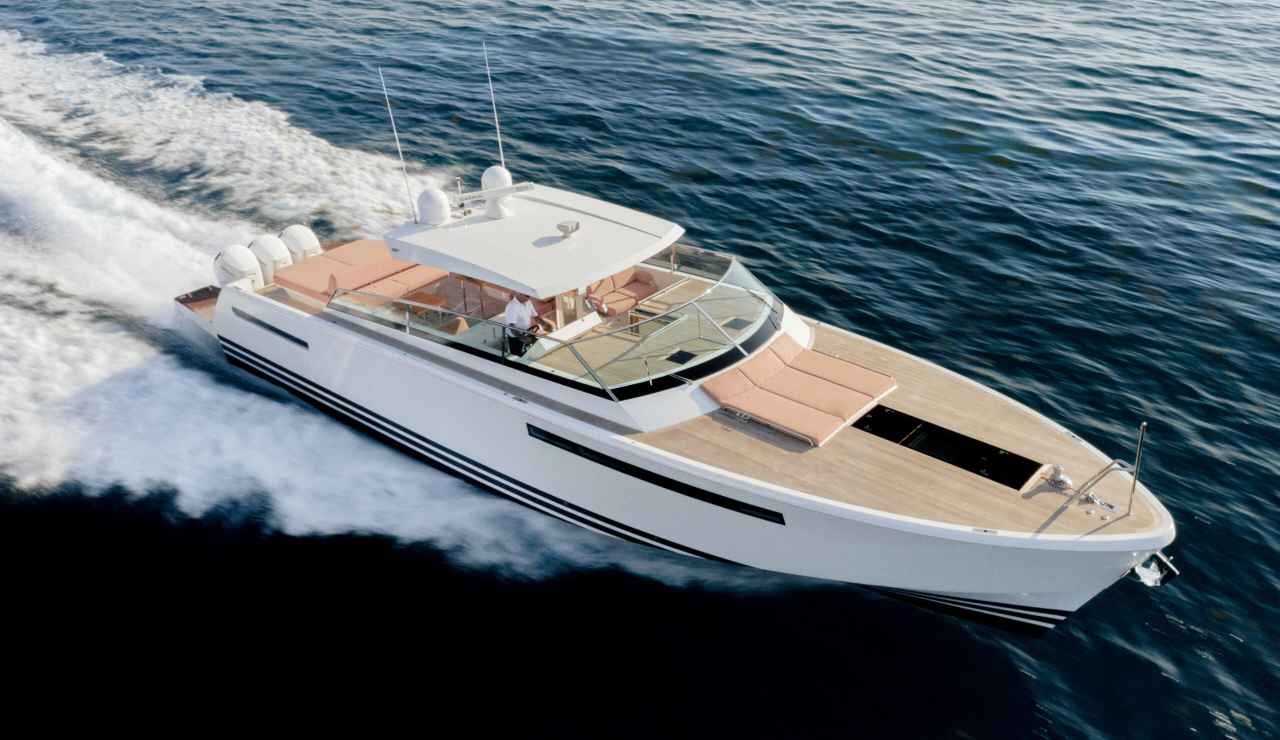
The Delta Powerboats 60 Open belongs to the restricted category of open beyond 18 meters designed with integral logic engineering before that stylistic. The choice of carbon fiber composite for hull and superstructure, the coupling with the volvo Penta IPS drive and the development of famine volumes place it among the references for those who want to combine high cruising speed, content consumption and simplified management. This article deeply analyses the platform, with attention to structural implications, onboard systems and real performance, to achieve a clear picture of its competitive positioning in the mediterranean open premium market.
The construction site — Origins, method and reputation
A culture of the project born in the North
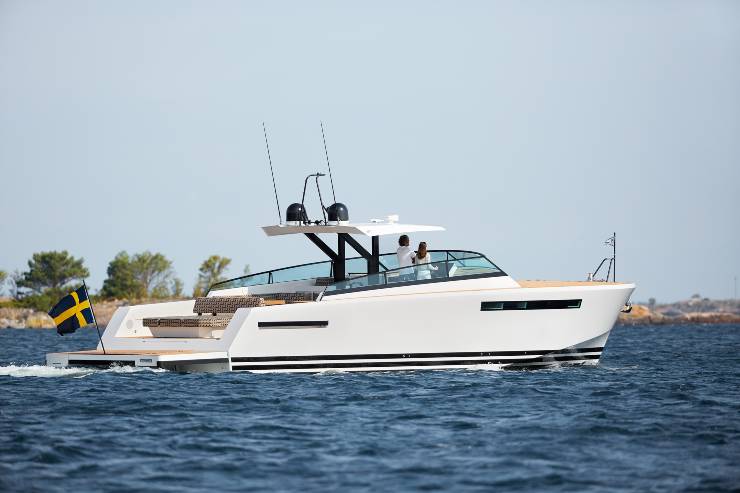
The mark Delta Powerboats was born in Sweden with a very concrete approach: starting from loads, weights and objectives global efficiency to define each design decision. Philosophy is “function that governs form”: pure lines, essential surfaces, structural choices derived from an analysis of the trade-off between mass, stiffness and maintenance. In less than two decades, Delta has cut out fame pioneer in advanced lamination, introducing carbon fiber on series units with a rare consistency for the leisure segment.
Process and quality control
The production process is based on vacuum infusion, use of closed-cell souls and selected epoxy resins. Management of care cycles, traceability of materials and non-destructive controls (ultrasounds and tap test) are part of a quality protocol that aims to guarantee real weights consistent with the calculations and a high repeatability among specimens. It comes from an industrial product that preserves a marked artisanal figure in the finishes, but that behaves like an engineered system at every point.
Technical analysis — From the hull to the electronic bridge
Dimensions, volumes and naval architecture
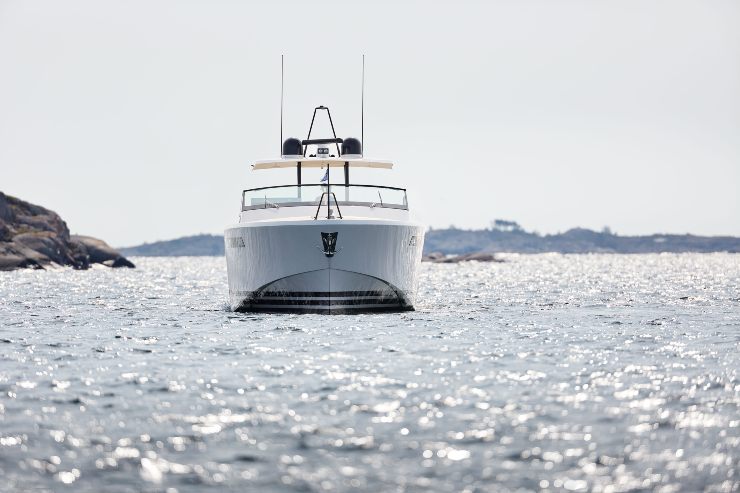
The 60 Open develops on one LOA of about 18.2 meters, with maximum beam close to 4.6 meters and a fishing in the order of 1.4 meters. The famine presents deadrise moderate aft, longitudinal skates and a free edge designed to limit sprays in accelerations. Weight distribution is the key to: battery services, fuel tanks (approximately 2.900 liters) and heavy plants are concentrated below and close to longitudinal centerpiece to generate minimum beaking moments. From a dynamic point of view, the displacement/length ratio (DLR) is very much content for the class, favoring the graft of the bridge with relatively small powers compared to heavier hulls.
Materials and stratigraphy
The differential value of unity lies in structural carbon adopted extensively on hull, bulkhead, tuga and T-Top. Fiber skins are coupled with souls in foam calibrated density according to loads, with local reinforcements on attack points, bases of the mounts and areas with high stress (shoes, openings, plants). The result is a flexional and torsion stiffness superior to traditional fiberglass, with a reduction of transmitted vibrations and a better response to ♪ on the short format typical of the Mediterranean. On board, coatings prefer teak selected for soft-touch paglioli and finishes, combining perceived comfort and acoustic damping.
Propulsion and transmissions
The most widespread coupling provides two Volvo Penta IPS 800 (600 hp each) with adjustable pod and electronic management EVC. Free thrust propellers (not disturbed by the flow of the hull) increase propulsive efficiency, while the directionality of pods allows millimeter maneuvers in port through the joystick. The key features include Dynamic Positioning System (DPS), which maintains position and bow by compensating wind and current: a plus in shaves, bunkerage or approaches in narrow spaces. The adoption of automatic interceptors and, on request, gypsies of stabilisation, it contributes to keeping the arrangement constant even in variable sea conditions.

Performance: curves, trims and consumption
In standard configuration and clean hull, the 60 Open expresses a peak speed around 36–39 knots, while the area of greater efficiency is located in the corridor 28–33 nodes, where the boat offers a trim natural, light rudder and ready-to-hand response. Specific consumption benefit from the package reduced mass + IPS, with an autonomy that, under optimal conditions, can approach the 500 miles to the fast cruise. The influence of antivigetative, loads and sea status is of course significant: the added value of carbon is precisely the ability to save performance also to increase the operational displacement.
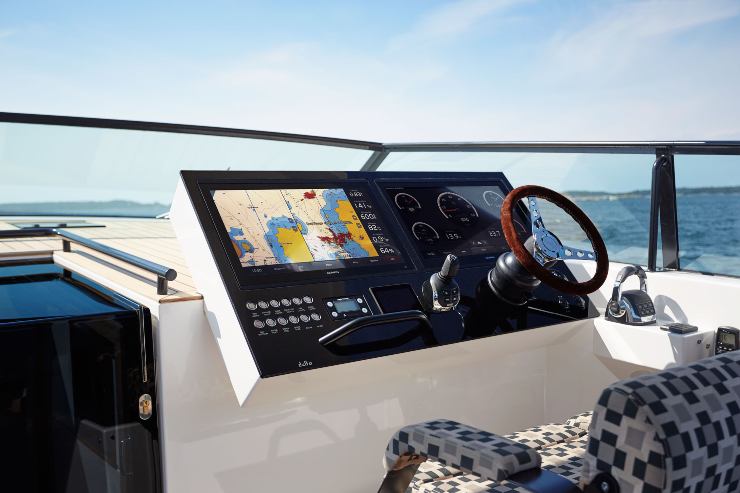
Electronics, domotics and board network
The bridge is organized as a glass-bridge with dual chartplotter, motor control, autopilot and monitoring of services on a unique interface. The domours governs lighting scenarios, pumps, air conditioning and utilities through dedicated panels and remote controls. The 24V/230V electrical system with inverter and soundproof generator guarantees margins for intensive use of household appliances without constantly resorting to the dock. The configuration includes rationalized cabling, inspectable channels and predictive maintenance spaces.
Design and organization of spaces
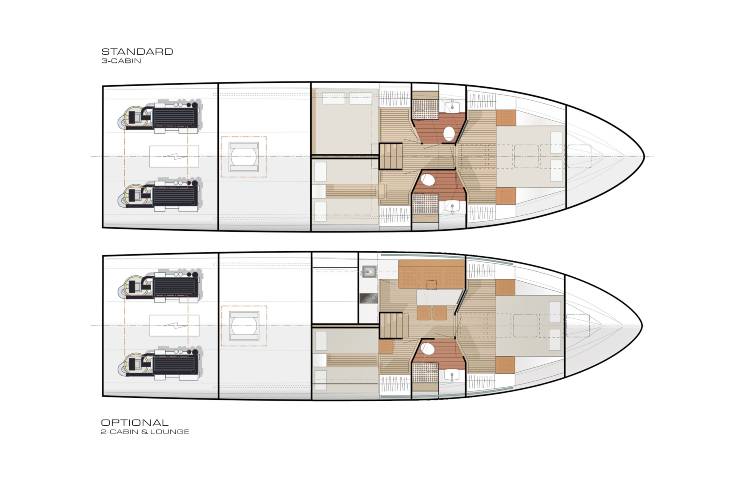
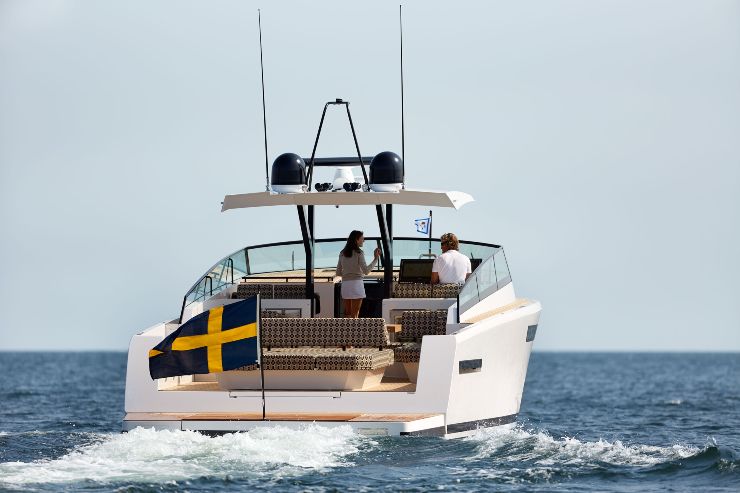
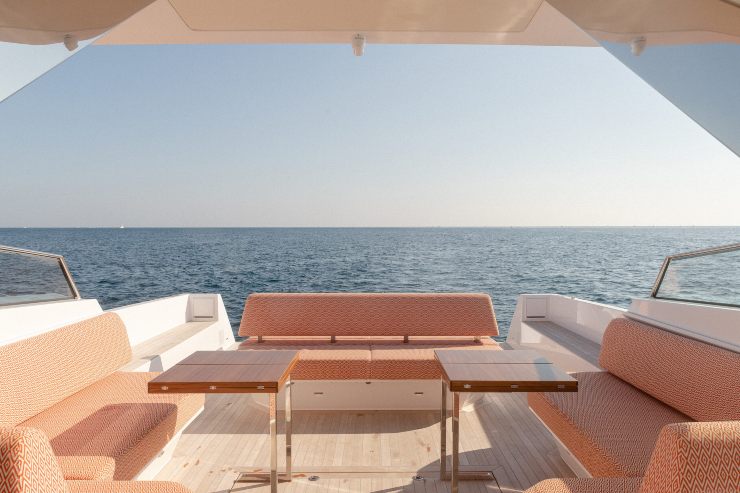
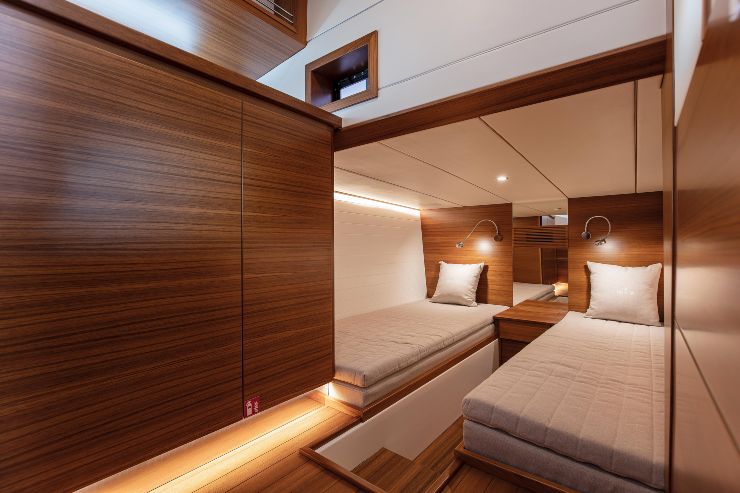
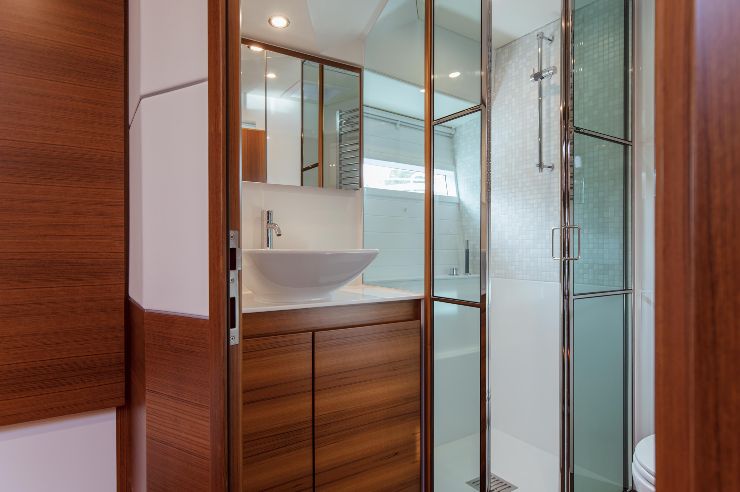
The main bridge is designed to maximize the outdoor livability. In the bow, a deep sun area; in the middle, a modular dinette alternating lounge and dining configurations; aft, the hydraulic plank that turns into a small beach club for water access and management toys. The carbon T-Top creates extended shading without adding perceptible mass and integrates the handrails structurally. Undercover, the typical layout proposes three cabins for six guests (owner with private bathroom, two doubles in the middle of the boat) and a second bathroom. Useful heights and natural light, conveyed by studied openings, are above average for an open of this size.
Research, innovation and sustainability
The 60 Open shows how innovation is not an additional module, but a ecosystem of consistent choices. Construction full-carbon does not only reduce decibels or do marketing: it is the condition that makes it possible to adopt installed powers compact in front of higher cruising speed. Integration with predictive systems stabilization and flow control instruments (interceptors) lead to a reduction in emissions per mile, because at the same pace the boat requires less energy. Architecture is ready to host hybrid components service (climate, auxiliary) and solutions energy management for shaving life.
Life on board and layout
In navigation, comfort depends not only on upholstery and finishes, but on vibration control of the entire hull-overstructure system. Carbon raises its own frequencies beyond the band to which the human ear is more sensitive; the result is a less fatigued environment 30+ knots. In satin, channelled air conditioning, wide modulation LED lighting and generously sized outdoor kitchen turn the 60 Open into a platform hospitality for 10–12 people per day. In the cabin, privacy is guaranteed by targeted insulation solutions and high-level storages that eliminate visual disorder.
Sea tests and behaviour
The acceleration response is progressive, with ready-planned input and neutral trim between 25 and 30 knots. In virata the radius is gradually compacted, without sudden transfers of load; the boat remains dry and allows for consistent closing angles, confirming a setting fast cruiser more than pure sports. In maneuver, joystick and DPS lighten management in reduced crew, making life easy in crowded ports and narrow spaces. The overall effect is control even when the sea grows, with a perceived solidity that makes you forget the speeds in play.
Systems and plants — Efficiency and maintenance
Fuel and autonomous
Reservoirs (complexes ~2.9 m3) are positioned near the baricentre, made of aluminium or composite with anti-slosh wallpaper to reduce the effect of free surface. The circuit includes biphase filters and water separators, with precise indicators on the bridge. With cruise to 30–33 knots, real autonomy approaches 500 nm in a clean trim, a parameter that enables crossings typical of the western basin (Ligure–Corsica–Sardegna) without intermediate stops.
Electric and air conditioning system
The 24V network feeds onboard utilities, tools and actuators; the 230V alternator is guaranteed by soundproof generator and power inverter. Banques AGM or LiFePO4 managed by dedicated monitors allow long-term supports in rada. The system HVAC channeled distributes air in all living areas with room-by-room adjustment, optimizing loads and reducing perceived noise.
Fresh, grey and black water
Fresh water tanks in the order 700–900 liters, silenced autoclaves and active carbon filters ensure pressure and quality. The grey and black water tanks are separated, ventilated and equipped with sensors, with controlled discharge possibilities according to regulations. Maintenance is facilitated by direct access to valves and pumps.
Market — Prices, competitors, trajectories
Segment and positioning
The 60 Open takes over the area of open premium 18–19 meters high external usability. It caters to a public who wants performance from sports yachts, but with cost of ownership rational: less fuel at equal pace, ordinary mechanical maintenance simplified thanks to pods, more autonomy with the same tank volumes. On the list, the boat is placed in the band upper tier of the segment, consistent with the materials used and onboard components.
Competitor direct
The natural competitors are the open Mediterranean between 56 and 65 feet, often in advanced fiberglass and with a strong lifestyle setting. Compared to these, the 60 Open proposes lower mass, more rigid structures and a plant package focused on simplicity of use. In practice: less aesthetic ornaments, more technical substance; a transformable plank extending beach without aggravating the profile; and a command bridge pointing up ergonomics and legibility more than on scenic effects.
Industry trends
The main trend of the sector isintelligent lightening: more effective composites, optimized sandwiches and propulsion architectures. In parallel the demand for modularity (transformable dinettes, structural T-Tops, beach club integrated) and systems that return confidence to the owner: joystick, dynamic station, telematic monitoring. Efficiency is no longer a hub: it is the competitive differential that separates boats designed to “make number” from those intended to maintain value over time.
Customer and use
The target includes private shipowners demanding, interested in moving fast between bays and islands without numerous crews, and charter companies focusing on daytime experiences for 10–12 guests with fast transfers and high comfort. The 60 Open is also a great platform for corporate hospitality: immediate movements, fluid spaces, technological image without excess.
Recognition and feedback
During its commercial life, the 60 Open collected positive reviews for construction quality, ease of conduct and performance. The specialized press often cites it as a successful case of technology transfer from the racing and aeronautical world to the diporto, with tangible results on consumption and comfort. Professionals (comandants, expert technicians) also appreciate the accessibility of technical premises and the clarity of plant schemes.
Perspectives — Expected developments of the platform
The future trajectory passes through a incremental electrification services, the adoption of battery banks with higher density with more advanced thermal management and integration of predictive functions in stabilization (sensoristics and more refined algorithms). On the architectural level, you can expect further work on flow control under hull and on surfaces of the T-Top to cut ulteriaria aerodynamic resistance to the supported gait. DNA remains that: reduce friction, exploit carbon not as “gadget” but as spine of the project.
Technical data — Main data
- Length outside everything (LOA): ~18,2 m
- Length of hull: ~16,6 m
- Maximum garlic: ~~6 m
- Fishing: ~1,4 m
- Dry dislocation: ~12,8–13,5 t
- Full load dislocation: ♪
- Fuel tanks: ♪
- Fresh water: ~700–900 l
- Motorization: 2 × Volvo Penta IPS 800 (600 hp cad. )
- Cruise speed: ~28–33 kn
- Maximum speed: ~36–39 kn
- Indicative autonomy: ~500 nm @ fast cruise
- Cabins/Baths: 3 / 2
- Construction: composite full-carbon infusion
- Stabilization: active interceptors; opz. gyroscope
Photo gallery

Engineering assessment — Strengths and compromises
What is really good
- Global efficiency: reduced mass, high rigidity and IPS pod maximise performance at real usage speeds.
- Maintenance: joystick and DPS minimize stress in port and lower the need for numerous crews.
- Liability: upper deck designed for sociality; rational, luminous, acoustically well isolated undercover.
- Performance quality: consistent finishes with the premium band, technical accesses designed for maintenance.
Where to take account of compromises
- Input cost: the extensive use of carbon and integrated systems is reflected in the final price.
- Structural repairs: important damage to the sandwich requires specialist skills and NDI controls.
- Invasive refit: structural lightness and integration of systems delimite plant repositioning operations.
Suggested Use — Operational scenarios
The 60 Open is ideal for high radius day-cruising, fast weekends between islands and bays with return or continuation in rada. In charter, simplicity of government allows format “captain + hostess” maintaining high standards of safety and service. For the private shipowner, the value is in being able to travel often to 30+ knots with comfort from larger yachts, but with rational management charges. The dashboard and the modular dinette increase the usability for families and diversified guests.
Video
Conclusions — Because the 60 Open counts in its segment
The Delta Powerboats 60 Open is not simply an open well finished: it is the demonstration that a project led by engineering criteria can offer speed, comfort and ease of use without excessive compromise. Construction full-carbon allows to install targeted powers, keeping fast cruises with consistent consumption; i pod IPS transform the harbour management into an intuitive gesture; the external and internal spaces respond to an idea of contemporary hospitality that puts the quality of time at the centre on board. If the goal is to own an open of 60 feet capable of “milling miles” in safety and silence, with programmable maintenance the 60 Open is one of the most solid choices on the market today. Its real merit is coherence: every decision — from material to geometries, from systems to domotics — contributes to a single result, perceptible efficiency in every minute of navigation.