
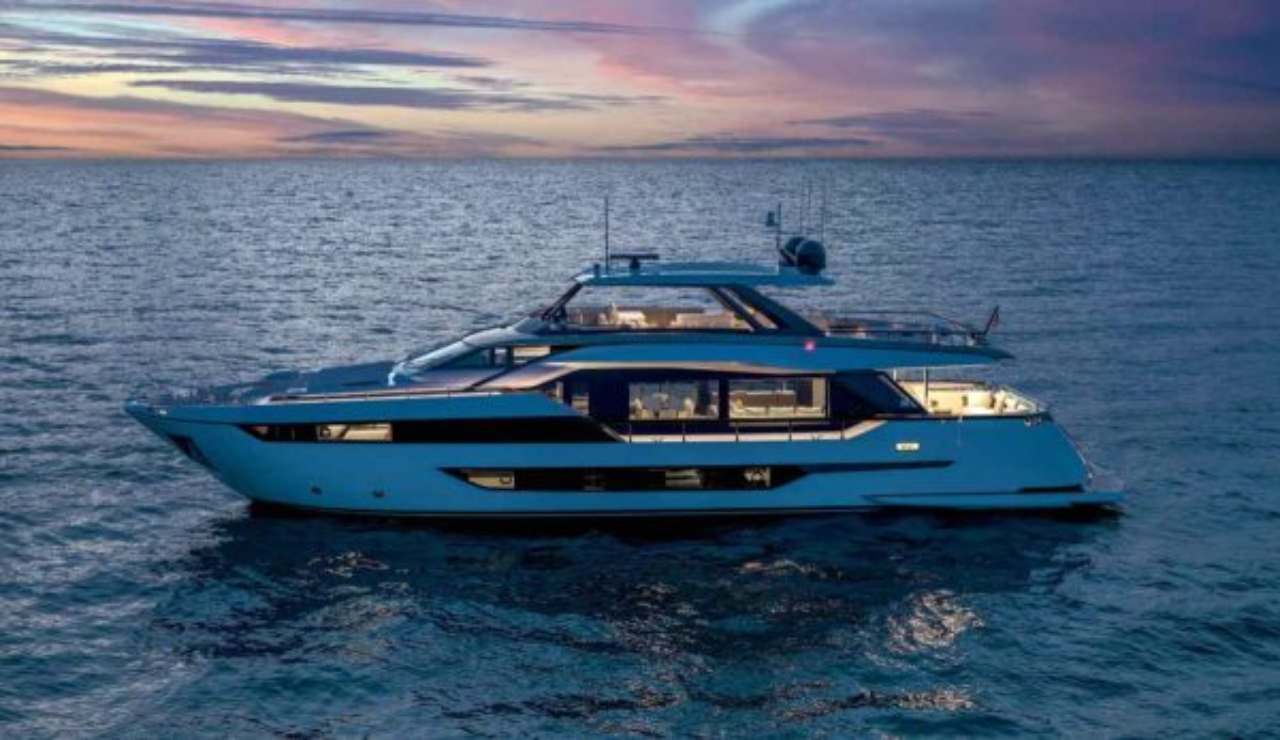
The Ferretti Yachts 940 “New” represents the contemporary declination of the concept widebody applied to a flybridge of about 29 meters, with emphasis on internal volume, viability and visual continuity between environments and sea. The design setting favours full height stained glass surfaces, five cabin layout with shipowning on the main bridge and external spaces configurable, confirming the vocation of the brand to combine crocieristico comfort and industrial quality of high level.
From the dimensional point of view, the 940 is located at the entry threshold of the “superyacht” world in composite: LOA 28,97 m, max 6,76 m e fishing 2,30 m, with displacements (dry and full load) reflecting a solid boat, capable of long and comfortable navigation. The propulsive package provides double motorization MAN V12 2000 (option V12X 2200 indicated as preliminary data), for reference speed in the order of 25 kn maximum e 21 kn cruise.

Profile of the yard
History and positioning
Ferretti Yachts is one of the leading brands of Ferretti Group, Italian conglomerate that brings together sigles like Riva, Pershing, Itama, Custom Line, CRN and Wally. The tradition of the brand was born on the Romagna Riviera and developed around an industrial vision with strong vertical integration: engineering, lamination, equipment and quality control follow unified standards within an ecosystem ranging from composite boats to full-custom steel and aluminium constructions (through dedicated brands). Approach and philosophy: comfort from “house on the sea”, sober-contemporaneous style, reliability of use and post-sale support capillary.
The 940 “New” testifies to the renewal of range in the segment 90–100 feet, a strategic area to alternate generous volumes to the handling required by private shipowners and charter reality.
In-depth technical analysis
Dimensions and naval architecture
- Length f.t. (LOA): 28,97 m
- Maximum garlic: 6,76 m
- Fishing: 2,30 m
- Dry dislocation: 85.000 kg (indicative)
- Full load dislocation: 98,000 kg (indicative)
- Design category: A
- Classification: RINA B + F + A1 (Sound Emission)
The carena with important glare height, combined with the bow “full volume” typical of the concept widebody, maximise the internal volume by advancing the master section and allowing the insertion of the shipowner on the main deck. The geometry of the hull, in composite, is optimized for an efficient cruise around 20–22 knots, with gradual transitions of bearing and a weight balance designed to reduce beaking and wired during acceleration.

Construction materials
The 940 “New” uses GRP (vetroresina) for hull and superstructure, with differentiated layers for areas and reinforcements located in the areas with greater load. The composite construction allows:
- Weight control at equal rigidity, with positive impacts on consumption and performance;
- Formal freedom for “soft” lines and continuous volumes;
- Simplified maintenance compared to metal alloys for hulls under 30 meters.
The interior uses selected natural essences, soft-touch finishes, leathers and technical fabrics to attenuate rumbling and vibrations, as well as pannellations with phono-insulating couplings. The “full-height” glass surfaces are made of laminated and tempered crystal, with frames and joints optimized for rigidity and seal.
Engines, propulsion and transmission
- Engines: 2 × MAN V12 2000 (opz. MAN V12X 2200 — preliminary data)
- Transmission: axis lines in conventional configuration
- Fuel tanks: ~9.000
- Fresh water tanks: ~1,320 l
- Posts on board (oplogation): 20
The choice of the axis line favours efficiency to cruise regimes, reliability and simplicity of intervention. With well stiffened composite hull, elastic supports of thermal groups and dimensional joints, the noise perceived in the salon and the cockpit is contained, with direct benefits on the quality of life in navigation.
The MAN V12 2000 package with diameter and step-by-step propellers for the boat allows a cruise regime at 21 kn with typical loads from “big cruise” and 25 kn of maximum point (official indicative values). Operating tolerances are related to loads, background status, carena cleaning/assis/eliche and weather conditions.

Performance, autonomy and consumption
The official speed data (25/21 kn max/cruise) allow you to build realistic user profiles: at 21 kn, the estimate of autonomy around 300–320 nm reported by YachtBuyer is consistent with a cumulated time consumption exceeding 350–400 l/h, variable depending on load and sea. At displacement speeds (10–12 kn) autonomy grows considerably, with reduced engine load and consequent acoustic benefits.
Onboard systems: electronics, home automation, navigation
The bridge resumes the “glass cockpit” setting with integrated instrumentation (radar, multichannel echoline, AIS, HD cartography, motor monitoring systems and plants) on high-definition screens. The domours manages lighting, air conditioning, screens and multi-zone entertainment; the onboard network is segmented on subsystems with dedicated gateways. The wiring follows differentiated beams power/data with flame retardant capitulates.

Gyroscopic or fin stabilizers (on request) attenuate rollio to anchor and transfer; the bower thruster (and optional stern thruster) promotes maneuverability in reduced spaces. Security systems: fire detection with automatic extinction in machine room, redundant exhaust pumps, UPS for critical services, fire-fighting and compartmentalization according to RINA.
Interior design and architecture
The stylistic signature privileged horizontality of the lines, slender pulpits and ungraved superstructure from visual encumbrance. The main deck host living room with full-height glazing and direct access to the well; the kitchen can be “separated” with technical passages dedicated to the crew towards the bridge, to guarantee privacy to the owner (solution also highlighted by the international press). The shipowning cabin is at the bow of the main bridge, with en suite bathroom and wardrobe, exploiting the maximization of volumes guaranteed by the widebody setting.
External spaces and ergonomics
The cockpit of about 32 m2 (according to print previews) can be configured with fixed furniture or free glass stern wallpaper preserves visual continuity. The beach dialogue with the hidden tender garage (can accommodate a boat ~4,1 m), while the flybridge offers lounge areas, wet-bar, sunbathing and — on request — a second bridge. Large passways and mooring stations near springs simplify maneuvers.

Undercover, the guest area accommodates four cabins (doubles with flanked or double beds, depending on the specifications), each with bathroom. The area crew is typically at the bow of the machine room, with separate access to kitchen and technical bridges, so as to minimize interference with the shipowning/hosts.
Innovation and research: efficiency, stability, safety
- Famine/propulsion optimisation: controlled coupling between axis line, helix profile and axis inclination to maximize yield to 18–22 kn.
- Reduction of emissions/consumption: choice of Euro Stage engines complying with current regulations; predispositions for power management efficient (department of electrogenic groups, inverter, AGM/LiFePO4 counters on request).
- Dynamic comfort: stabilizers (pinne/gyro) to break down the roll; elastic shock absorbers on motor supports and sound insulation in sensitive compartments.
- Active security: integrated sensors (smoke, flame, CO, flooding), fail-safe on key systems and second class RINA emergency protocols.
Life on board and services
The edge layout is thought for prolonged stays: living room with contrasting sofas to favor fluidity of passage, central dining table, professional fencing kitchen, abundant storage areas and technical premises easily inspectable. Bathrooms with separate shower, vanity and stone finishes; DALI LED lighting with preset scenes for different moments (day, dinner, cinema). Multi-zone entertainment: Dedicated DSPs and integrated speakers.


Navigation performance: test notes and feedback
Sea tests spread by the main warheads and media channels of the yard describe behavior progressive and predictable, with consistent response to the rudder corrections and a constant order on the cruise. The sound footprint is contained in the lounge and the cockpit, while on the flybridge the aerodynamic noise remains within comfort thresholds up to ~20–21 kn. The readyness of planata is suitable for installed power and displacement, with better yield to clean hull and balanced loads.
Market and competition
Segment, price and positioning
The 940 “New” guards the band 90–100 composite feet, in which the shipowners seek widebody light and cabins equivalent to higher sizes without switching to more expensive metal solutions (construction, management and mooring). The positioning of Ferretti Yachts combines brand value, service network and consolidated resellability. Although the lists vary for specification, optional and setups, the 940 is among the “upper” proposals of the segment, with strong hold of the value on the secondary market thanks to global distribution and building standards.
Competitor direct
- Azimut Grande in the 90–100 foot band (design and volume orientation);
- Princess Y95 e Sunseeker 90–100 (focus lay-out and composite performance);
- Sanlorenzo SL96/SL102 as an alternative to strong customization;
- Custom Line (brand “sister” in the Group, but with different positioning and upper size/ semi-custom approach).
The competitive advantage of 940 lies inshipowning on the main deck cinematic spaces (internal/external) and in the capillarity of post-sale support. The performance, although not extreme, is consistent with the DNA of the brand: comfortable and safe cruise, avoiding performance drifts that would penalize consumption and acoustic comfort.
Industry Trend
- Bright widebody: full-height windows, indoor–outdoor continuity, privacy for the owner;
- Energy efficiency: reduction in consumption through carena/propulsion optimization and hotel load managed with smart logic;
- Anchor stabilization: on board as “must have” for the comfort in satin;
- Digital refit: update of plants and infotainment in the life cycle of the unit.
Target customer
- Private owners with mediterranean cruise programs and seasonal crossings;
- Luxury Charter requiring five cabins, master on the main deck and “instagramable” lounge spaces;
- Representative companies interested in brand visibility and international market appeal.
Results, awards and roadmaps
The launch of the first unit (15 January 2025, Cattolica) and public presentations to follow have strengthened market attention around the concept “home on the toilet”, with broad coverage on international sector media. The previews emphasize flexibility of cockpit, the poppiera vetrate and the use of main deck as key points of differentiation.

Future prospects
The 940 “New” indicates the design management ferretti Yachts in the segment below 30 meters: more perceived volume without excessive length increase, greater natural light, rationalized plants and predisposition for updates. The focus on reduction in consumption does not pass (today) by a push hybridization of the propulsive system, but by a “integrated” package that includes hull, axis lines, propellers, stabilization and intelligent management of the loads on board. For evolutionary purposes, further refinement is expected on:
- energy management (evolutionary battery banks and enhanced charging strategies);
- hVAC systems high efficiency and thermal recovery;
- composite materials with less impact and greater recyclability.
Final evaluation and positioning
The Ferretti Yachts 940 “New” is a project centred on livability, light and privacy, with a proven technical platform and consistent performance with the real use of a 95 feet composite: comfortable cruise at 20–21 kn, adequate autonomy and manoeuvrability at port. The strength of the product does not reside in the absolute number of knots, but in quality of living, inplant integration and in support network of a large industrial group. For shipowners and charter operators looking for a “house on the sea” modern, with five cabins and shipowning on the main bridge, the 940 represents a solid and already mature proposal.
Technical data (resume)
- Manufacturer: Ferretti Yachts
- Model: 940 “New” (widebody)
- Material hull/overstructure: GRP (vetroresina)
- LOA: 28,97 m
- Maximum garlic: 6,76 m
- Fishing: 2,30 m
- Dry / loading extension: ~85 / ~98 t
- Engines: 2 × MAN V12 2000 (opz. MAN V12X 2200, preliminary data)
- Transmission: axis lines
- Maximum speed/cruise: 25 / 21 kn
- Fuel/water: ~9.000 l / ~1,320 l
- Cabins: 5 guests (master on the main deck) + crew
- Classification: RINA B + F + A1 (Sound Emission)
- Category CE: A
Image gallery


Final summary and purchase recommendation
The Ferretti Yachts 940 “New” confirms a project centered on habitability and quality of life at sea, with a proven technical platform and a plant setting designed for the real use of a 95 feet composite. The choice of axis lines, the wide work on insulation and vibrational damping, the availability of last generation stabilization and the domotic management of the “hotel” loads return a unit that favors comfort, predictability and reliability.
On the architectural level, the widebody concept and the stained-glass windows design brightly flooded environments, increasing the volume perception without running out of scale lengths. The functionality of the routes – in particular the independence of the crew and shipowner – emerges as a real differentiating factor in the high-end charter and the long-term family cruises. The GRP setting, consistent with size and cost/management targets, combines formal freedom, maintenance simplicity and a good value hold thanks to the capillarity of the Group’s after-sales network.
- For those who are ideal: private shipowners and charter operators that favor comfort, privacy and brightness of the interior compared to peak speed.
- Strengths: master layout on the main deck, plant integration, advanced stabilization, global support network.
- Areas to be evaluated: customization of technical equipment (HVAC, power management, battery packs) and stabilization options based on the prevailing wave profile.
In summary, the 940 “New” represents a contemporary “house on the sea” with a strong Ferretti identity: sober in the lines, solid in the engineering choices, welcoming in the life on board. For the owner looking for a balance between style, functionality and after-sales support, it is a credible and complete application in the 90–100-foot range.