
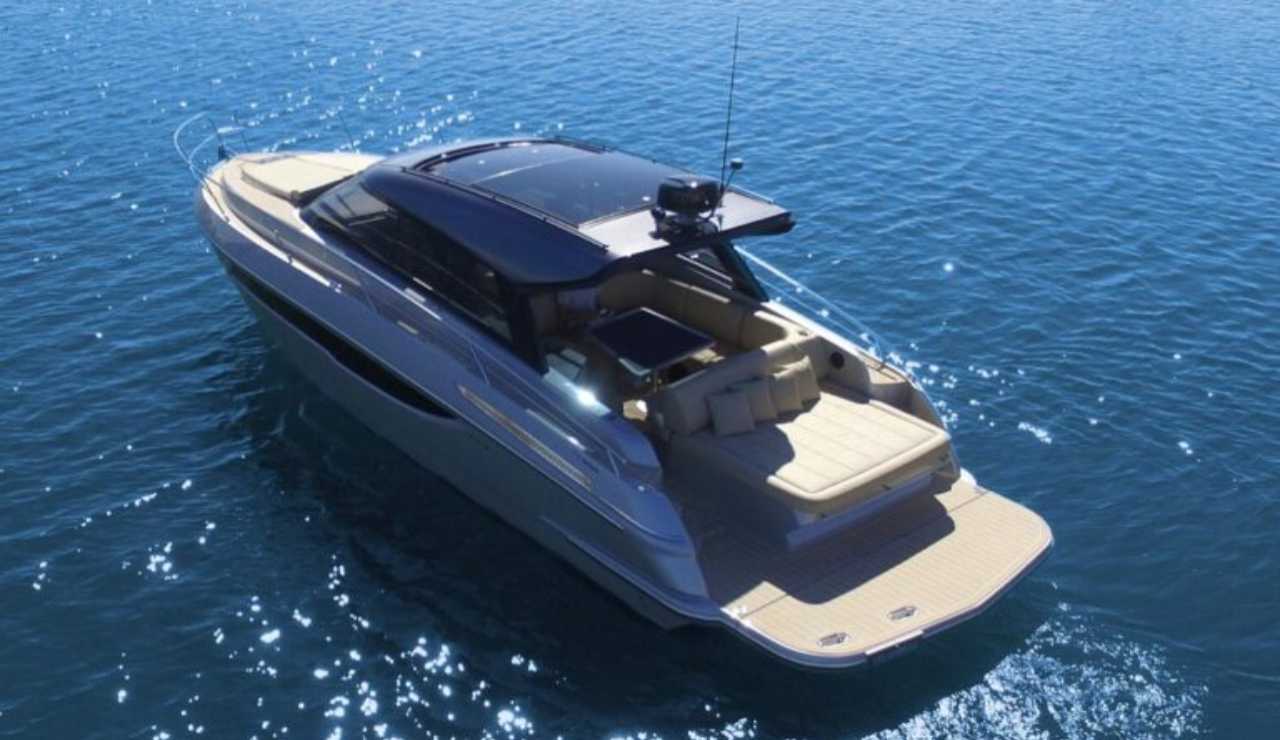
In the segment of the 11 meters planant, Focus Power 36 is located in a very precise technical area: it is not an extreme dayboat, but not even an tamed “mini fly”. It is, rather, a modern cruiser sport with hard work, generous glazing and setting walkaround, designed to offer reference point speed (up to 50 knots based on motorization), without sacrificing two real cabins and a blanket setting designed to live the sea with continuity: from lunch in rada, to coastal transfer, until weekend with overnight stay.
The strength is not a single “feature”, but a total engineering balance: deep-V reinforced hull for tightness and softness on the wave; mass and calibrated volumes to maintain responsiveness; inboard propulsions with counter-rotating propellers for efficiency and grip; external layout that favors true safety and side steps; interior illuminated by mural windows and skylights, capable of perceiving the unity as greater than its 36 nominal feet. In addition, the idea of a highly configurable platform—also in premium key with advanced set-up packages—responds to a market that wants semi-custom product without entering into the complexity of a real custom.

Profile of the construction site: Focus Motor Yachts, identity “boutique” and culture of quality
Origins, positioning and building philosophy
Focus Motor Yachts presents itself as a European manufacturer with a “boutique” vocation: concentrated range, non mass production, emphasis on finishing and customization. The brand's narrative explicitly recalls an imagery of car culture and high-impact design, but—from the technical point of view—what matters is the approach: artisanal construction, quality control along the entire cycle (from lamination to final assembly), and attention to the hold of value over time, a central theme for a unit that, for performance and equipment, speaks to a demanding audience.
In terms of market reputation, Focus is perceived as a growing reality, with a proposal that aims to combine recognizable style e naval architecture signed, supported by an international trade network. It is an industrial model different from the large volumes: the boat is not “standardized” to the millimeter to reduce variants, but it is born to be configured with a range of aesthetic and plant choices that can move towards an almost sartorial level.
Project partnership: the imprint of naval architecture
Key element is the collaboration with a carene designer known for the pragmatic approach to performance: the goal is not to pursue a maximum speed number “from brochure”, but to obtain a consistent platform throughout the envelope: stable plan, clean transitions, angles of predictable bar, and “sea” behavior also with formed wave. This approach emerges in the choice of deep-V, weight distribution and care for bow volumes, essential to reduce impacts and preserve comfort and structure over the long term.

Size and naval architecture: why deep-V really makes the difference
Main geometry and proportions
Focus Power 36 plays on proportions studied: a total length around 11 metres, glare about 3,49 m and dry mass in the order 6,5 t. They are numbers that, read together, tell a lot: it is not an ultralight object from the lake, but a boat that brings structure, plants and real habitable volumes. The design category EC (when respected in the preparation) is a technical message: the platform was born for a “real” sea, not only for the summer flat rada.
The hull is declared reinforced and of type deep-V: in simple words, it means that the hull cuts the wave with a more pronounced angle than many cruiser sports “moderate V”. The advantage is a softer passage and greater directionality; the cost is the need for power and a good set-up not to pay in consumption. The Focus Power 36, thanks to a wide choice of engines, can be “taken” on the profile of the shipowner: faster, more economical, or more balanced.

Hardtop and glass surfaces: aesthetics, but also comfort engineering
The hardtop is an integral part of architecture: not a simple roof, but an element that affects baricent, aerodynamics and viability. The adoption of a roof opening and large side windows have two technical effects: it increases natural light (reducing dependence on artificial lighting) and improves internal spatial perception; at the same time it imposes attention to rigidity, sealing and drainage. On fast drives, moreover, the quality of the seals and the management of the vibrations become decisive to avoid noise and infiltration in the long term.
Construction materials: composite, finishes and robustness strategies
Exhaust and superstructure in GRP: what really means “handcrafted”
The basic material is the composite fiberglass (GRP), standard choice in the segment for relationship between cost, rigidity and freedom of forms. The difference is not in the material “in itself”, but in as is laminated and controlled: quality of the cycle, repeatability, care in reinforcements, attention to the hull-cover couplings and critical points (catches of the tientibene, bases of the hardtop, bulkheads, supports motor, stern mirror with poppieri feet).
In a 36 feet that can exceed 40 knots, structural stress is not a detail: repeated impacts generate impulsive and cyclic stress. A well-designed lamination does not only serve to “not break”, but to maintain stable geometries, reduce creaks and preserve the alignment of plants. The result perceived by the shipowner is an object that, after seasons of use, does not “age” acoustically and does not lose the feeling of solidity.
Equipment and finishes: from painting to sellerie
The boat is highly configurable also in the finishes: integral paints, stainless details, saddles with seams and automotive materials. Here the technique meets the luxury: the durability of the saddles depends on density of the foam, UV protection, quality of the seams and ventilation; the rendering of the paints depends on preparation of the bottom and correct cycles. It is not only aesthetic: a well applied paint, on fast hulls, reduces micro-porosity and facilitates maintenance, indirectly contributing also to the hydrodynamic yield over time (a clean hull “val” knots and liters/hour).

Engines, propulsion and transmission: the technical heart of Focus Power 36
Outerbord and foot poppieri: because the choice is consistent with the performance
Focus Power 36 adopts drive infuoribordo with poppieri feet. The logic is clear: compared to traditional axis lines, the foot allows for a more fine management of the assembly and a better performance at high speeds, thanks to optimized transmission geometries and often propellers counterrotating (duo-prop). This results in faster accelerations, better “grip” in virata and a more efficient planata.
From the point of view of the shipowner, the poppiero foot requires careful maintenance (anodes, bellows, periodic controls), but repays in dynamics. On a boat that declares up to 50 knots, the transmission cannot be “secondary”: it must hold high pairs, load variations and repeated maneuvers without degrading precision and reliability.
Engine range: high performance diesel and hybrid option in development
One of the most interesting aspects is the breadth of the range. Depending on versions and markets, two-motor diesel configurations with powers are available that can go from about 540 hp total up to about 740 hp. In practice, the shipowner can choose from a more balanced set-up (good cruising speed, more contained consumption, more rational purchase cost) and a set-up “high performance” capable of bringing the boat to the threshold of the 50 knots.
It is also significant to focus on hybrid drive: the idea, in this size, is not so much to do long full-electric navigation, how to add a silent mode at low speed, improve the torque to maneuver regimes and reduce emissions/noise in sensitive contexts (ports, channels, protected areas). In engineering terms, the hybrid on sterndrive requires accurate integration: masses (battery), ventilation, heat dissipation, electrical safety, and above all a control architecture that makes the transition between modes transparent.
Performance: speed, cruise, autonomy and consumption (technical reading, without marketing)
Speed: from the “real” cruise to the peak from 50 knots
The most mentioned data is maximum speed that, with the most powerful motorizations, can reach about 50 knots. It is an important value because it places the Focus Power 36 in a small sub-segment: many cruisers of 36-38 feet, at equal internal volumes and displacement, stop between 30 and 40 knots. Here the boat is proposed as “driver’s boat”: a platform that doesn’t live only in shady comfort, but active navigation.

The cruise speed more sensible, from the technical point of view, tends to place itself in the range where the hull is stable in planata with efficient trim (typically half-two-thirds of the maximum power regime). At that point, the boat “fits” on the skates, reduces the wet surface and works with more favorable trim corners. The result is a cruise that can be fast without becoming economically punitive.
Autonomy and consumption: how to read numbers with realism
Fuel capacity is in the order 550 litres, consistent with displacement and a “fast coastal cruiser” philosophy. This means that autonomy depends in a marked way on: motorization chosen, load (people, water, tender), weather-marine conditions and carena cleaning. In practical terms, the technical shipowner should reason on a profile of use: rapid transfers between ports (average-speed connections), alternating with days of shaving with marginal consumption (generator if present, air conditioning, plants).
The water tank can vary (depending on the equipment) in a range that allows to modulate life on board: from the day with quick showers to the most autonomous weekend. It is a choice that reflects the configurability of the model: the boat does not impose a single style of cruise, but offers solutions for different shipowners.
Onboard systems: electronics, home automation, energy and safety
Plane and navigation: ergonomics and legibility
On a 36 feet that can run, the bridge is not a style exercise: it must ensure visibility, control and reduction of cognitive load. The typical layout includes pilot/co-pilot sessions, large-format controls and multifunction displays. The correct ergonomics is measured in detail: position of the handcuffs, support of the wrist, inclination of the display (reflection), immediateness of the alarms, logic of grouping of the switches.

Digital integration solutions (onboard networks and centralized control) allow you to govern lights, services and monitors with a unique interface. It is an important step: more plants means more complexity; centralization does not serve to “make scene”, but to reduce errors and improve diagnosis and maintenance.
Monitoring and management: from remote control to fault prevention
Adoption of systems monitoring (boat monitoring system) has two concrete advantages: safety (reception alarms, batteries, intrusions) and predictive maintenance (tensions, battery cycles, abnormal absorption). On premium boats, this type of architecture is becoming an almost mandatory element, especially for those who use the charter boat or leave it in the marina for long periods.
Maintenance: thruster, trim and operational visibility
The maneuver in port is often the moment when a boat “judging itself” really. On this size, a bower thruster well sized and a transmission set-up with counter-rotating propellers make the maneuvers cleaner, especially with wind at the cross. The opening hardtop also allows, when necessary, to govern standing with better perception of the encumbrance: it is not a detail, it is a real operating advantage.
Design and architecture of the spaces: sports blanket, continuous usability and walkaround safety
Pozzetto: true sociality, not “decorative”
The Focus Power 36 works on a precise idea: compact but functional well, with a large sunbathing area and a U dinette, plus an external kitchen that is not limited to the “wet bar”, but proposes a real area of preparation and service. This choice is smart because it moves daily life above deck, where the boat expresses its summer vocation to the fullest.
The presence of wide side walks and solid tientibenes is a theme of safety: on many sports boats, the search for volume of the cockpit sacrifices the percorribility; here, instead, the boat remains usable in navigation, with sensible passages even when the sea moves or when on board there are non-expert guests.

Area “beach” and platform: relationship with water
The contemporary trend is to transform the stern into a “beach” space: extended platforms, easy access to the sea, support for water sports. On this boat, the platform can become a real operating hub, especially if configured in an evolved way (for example with hydraulic movements, when planned). In engineering, the important thing is that the structure of the mirror and reinforcements are dimensioned for dynamic loads (people, dinghy, repeated actions of ascent/descent), without premature fatigue.
Interior and life on board: two real cabins, natural light and weekend features
Housing diagram: two cabins + dinettes, with actual beds
Below deck we find a classic but well exploited configuration: bow cabin with generous double bed, cockpit all glare (or almost) with longitudinal bed and volumes exploited under the cockpit, plus a dinette that can help to complete the capacity of overnight stay. In concrete terms, the boat is credible for 4 people (and, in some configurations, a fifth “optional” guest).
The perceived quality depends very much on light: mural windows and higher openings reduce the typical “caverna” effect of many compact cruisers. It is an important design element because it increases comfort and, indirectly, the stay on board: a bright boat lives better, especially in port or in shave during hot hours.

Kitchen and services: well-sized essentiality
The internal kitchen, integrated with the external one, responds to a realistic use: breakfasts, quick lunches, light preparations, without claiming to be the galley of a 50 feet. The bathroom, with shower, follows the typical compromises of the size: the point is not chase the luxury from superyacht, but offer clean, good materials and proper ventilation to avoid condense and smells.
Navigation performance: dynamic behaviour and “harmful sense”
Stability, virate and control: what we expect from a 6.5 t from over 40 knots
The combination of deep-V and well-separated poppieri feet should result in a boat capable of clean vines and expected support. At sustained speed, quality is measured in progressiveness: entrance into curve without uncertainties, absence of side bounces, and ability to maintain trajectory even when the sea is not perfectly regular.
A “to drive” setting implies that the boat is not a floating living room: it must return feedback, but without becoming nervous. In this sense, the dry mass is not an enemy: if properly distributed, it helps to “demorse” and to give solidity of behavior, provided it has the power necessary to support the planata and maintain margin in acceleration.
Feedback of commanders and losers: the boat is designed for active navigation
Those who climb on a cruiser sport like this look for two things: emotion e control. The Focus Power 36 tends to favor just this: high driving position, improved visibility with superior opening, and a blanket that remains functional even while proceeding. It is a boat that, by setting, invites you to grind coastal miles with rhythm, alternating fast rada stops transfers, without the feeling of “forzare” the platform beyond its role.
Layout

Synthetic data sheet (main data)
- Model: Focus Power 36
- Length f.t. (LOA): 11,00 m
- Length of hull: 10,67 m
- Maximum garlic: 3,49 m
- Dry dislocation: about 6,5 t
- Fuel: 550 L
- Fresh water: 140–280 L (depending on setup)
- Capacity: up to 10
- Cabins + living room: 2 + 1
- Beds: 4 + 1
- Design category: EC
- Naval Architecture / Design: Tony Castro
- Typical Propulsion: bi-motor entrofuoribordo with foot poppieri (variable configurations)
- Indicative performance: about 35–50 knots (based on motorization)
Innovation and research: hybrid, lightening and advanced quality packages
Hybrid: impact reduction and new “silence” usability
Hybridization, in this class, is not a hub: it responds to more stringent regulations, environmental sensitivity and an increasing desire for acoustic comfort. The possibility to proceed at low speed in electric mode (or assisted) can improve the output/entry experience from ports and areas to limit, reducing vibration and perceived noise. The engineering challenge is to integrate the system without penalizing the center of gravity and without introducing ingestible complexity for the shipowner.
Quality and lightening: when “premium” is also structure
Advanced setup packages, with improvements on lamination, materials and equipment, must also be read in structural key: a smart lightening (not randomly) can increase reactivity and reduce consumption, but must maintain rigidity and safety margins. If made with criterion, it is a double benefit: better performance and feeling of unvaried solidity (or superior).
Market and competition: where the Focus Power 36 really stands
Segment and price: between industrial production and “semi-custom”
The positioning of the Focus Power 36 is hybrid even commercially: it does not play on the attack price from large series, but also on the “extreme boutique” typical of ultra-limited brands. The variability of configurations and fittings makes the lists very elastic: the unit can start from “entry” levels for the category and climb significantly with top engines, full-paint finishes, advanced plants and premium packages. The correct approach is to consider the boat as a platform: the price is a direct function of the shipowner’s ambition.
Direct Competitor: what changes compared to the “big” of 36–38 feet
In technical comparison, the Focus Power 36 stands out especially for the combination of peak performance e weekender inhabitability. Some typical competitors in the 36–38-foot perimeter offer excellent layouts and brand equity, but often with higher speeds. Others, however, pursue high speeds but renouncing real interiors or favoring open configurations as well.
A reasoned comparison may include:
• Jeanneau Leader 36: longer and with similar fuel capacity, excellent usability and wide engine range; typically it favours balance and comfort from cruise rather than the search for the “50 knots”.
• Bavaria S36: sport cruiser rational, often more oriented to quiet coastal cruises, with typically lower maximum speeds; strength is the “value for money” approach of a great builder.
• De Antonio D36: modern open setting and very rated at day-boating, with important speeds; it focuses on image and outdoor spaces, often with different propulsive solutions and a more “Mediterranean” layout.
• Fjord 38 Xpress: walkaround from the premium day cruiser setting, often with outboard and high speeds; more “open lounge” philosophy, less “weekender with two cabins” in traditional reading.
In summary: Focus Power 36 aims to be faster than many “class” cruisers e more habitable than many dayboats as well. It is a crossroads that today has a real market.
Industry Trend: Customization, Digitization, Efficiency
The direction of the segment is clear: more customization (materials, colors, layout), more digitalization (monitorage, onboard networks, command integration) and greater attention toefficiency, also by means of lightening, optimized caresses and first forms of hybrid. The Focus Power 36 intercepts these trends without sacrificing the substance of the bridge boat: hull, power, stability, safety in navigation.
Extra Images


Target client: who really speaks this boat
Focus Power 36 is not “for everyone”, and this is good. Talk to three main profiles:
1) Private sports owners, who want to drive, make quick transfers and have a reactive boat, but they demand two real cabins for family or guests.
2) Use “Premium weekend”: marina-to-marina, daytime rada, night on board, with attention to design and finishing.
3) Coastal Luxury Charter, where performance and image count, but also serves a credible habitable base (cabines, bathroom, shadow areas, functional outdoor kitchen).
Results, awards and presence: signs of project maturity
An interesting signal is the presence of the model in the shortlists and in the applications to awards sector: for a manufacturer not “volume”, entering these dynamics means being evaluated not only by aesthetics, but by design substance. In addition, the ecosystem of versions and packages—with more careful editions and high-level equipment—is often an index of a product that is evolving and consolidating its identity on the market.
Video
Conclusions: future positioning and prospects
The Focus Power 36 is a boat that interprets the concept of sport cruiser in a modern way: does not sacrifice navigation on the altar of furniture, but it does not fall even in the extremism of the dayboat without compromise. The deep-V and the poppieri foot propulsions make it technically credible for those who want to go strong and well; the hardtop, the windows and the undercover layout make it liveable beyond the daily trip. In a market where many boats tend to resemble each other, its value lies in coherence: recognizable design, performance platform, real configurability. If the construction site continues to invest on hybrid digitalization and (where sensible) maintaining structural quality, the Power 36 can become a stable reference between the 36-foot premium high performance.