
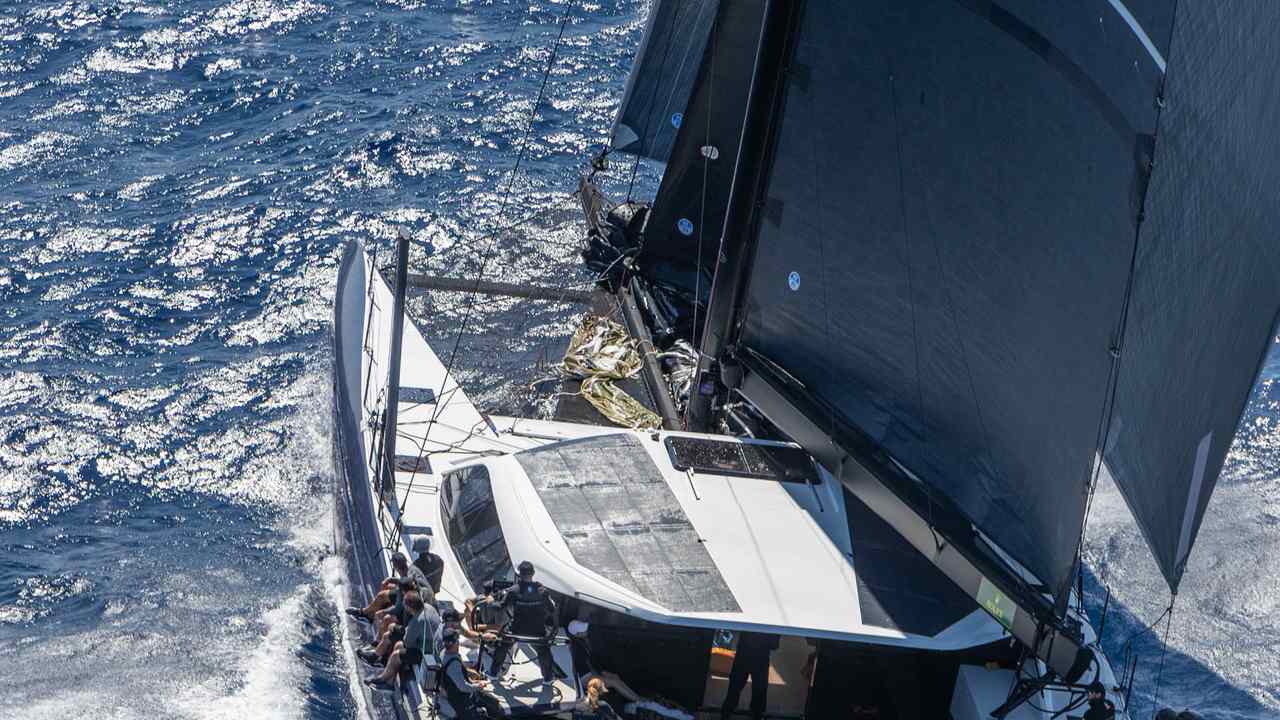
The Gunboat 80 must be configured and tested as a custom system. The Agave exemplar offers a concrete technical framework: two 110 hp diesel engines, 25 kW generator, 2.3 kW solar, two 700 litre diesel tanks and two 750 litre water tanks. It also has hydraulic manoeuvres, asymmetrical daggerboards and retractable T timones. This data is not automatically the standard of each Gunboat 80. The series page warns that specifications are still in final control and has different values for size and displacement. The verification sequence must therefore start from the number of hulls, separate signed and configuration actually installed.
Identify the version before checking the plants
The series includes a cruise-oriented configuration and a regatta version, as well as a large customization margin. Agave is the second unit, designed for high-performance family cruises; the first unit was optimized for regattas. Common structure does not mean identical systems. Motors, rigs, appendices, kitchen, cabins and energy can change. The delivery report must report building number, approved drawings, list of variants and serial components. Without this base, even a correct measure risks being attributed to the wrong boat.
Agave configuration summary
| System | Summary | Practical check |
|---|---|---|
| Engines | 2 × 110 hp diesel | Models, transmissions and access |
| Generator | 25 kW | Load, cooling and unloading |
| Solar | 2,3 kW | Regulators and actual output |
| Gas oil | 2 × 700 l | Challenges, levels and interceptions |
| Water | 2 × 750 l | Quality, pumps and useful volume |
| LOA | 24,65 m | Effective swallowing |
| Baglio | 10 m | Mooring and mooring |
| Maximum load | 34,000 kg | Updated weight log |
Separate motors in the two hulls
Two engines offer physically separate devices, but require installation and maintenance symmetry. The verification sequence records model, hours, transmission, propellers, alternators, supports, filters, discharges and sea sockets. Access must allow control of levels, impellers, belts and consumption components. In test there are regimen, temperatures, pressure, vibration and response of controls for each side. The 110 hp data belongs to Agave; another unit can have different specification. Autonomy cannot be deducted from the power without measured consumption and documented conditions.

Ventilation and safety of local machines
The lightness of the project does not reduce heat to be evacuated or the need for fire protection. Air outlets and exits are controlled, separation from living rooms, sensors, fire extinguishers and accessibility of the locks. Cablings and pipes must be supported and protected by rubbing. It is useful to simulate the replacement of filters and the insulation of a line, because a seemingly large compartment can become unpractical with stocks and optional. The emergency procedure must indicate how to stop motor, fuel and ventilation without entering a dangerous place.
Oil tanks twins
Agave declares two 700 litre tanks. The total capacity is not equivalent to the usable volume nor to a guaranteed distance. We need to know position, material, internal bulkheads, inspections, vents, returns and power logic. The distribution between hulls influence thirsty and must be controlled during consumption. Indicators must be compared with known supplies and valve access occurs. The test of consumption records mass, regime, wind, wave and famine status. The results remain specific of the boat and do not become universal performance of the series.

Fresh water and balance
The two 750 litre tanks produce an important variable mass. The verification sequence checks pumps, filters, accumulators, vents, inspections and possibility to isolate each side. An unbalanced consumption can change the transverse immersion; the procedure must explain how to manage the tanks. Capacity does not measure autonomy, which depends on people and programs. If the exemplar includes water, model, flow, quality, absorption and maintenance, they must appear separately. Agave does not attribute a dessalator or a flow not explicitly documented.
25 kW generator
The Fisher Panda 25i generator declared for Agave must be tested with realistic loads. They control continuous power, cooling, exhaust, ventilation, supports, sound insulation, filters and access for maintenance. Switching between generator, dock and inverter must be clear and protected. During the test there are voltage, frequency, temperature, alarms and response to load variations. The nominal value does not say how many hours it is necessary to use it: this evaluation requires the energy balance of the specimen, including kitchen, air conditioning, pumps and navigation equipment.

2.3 kW solar and real production
Agave declares 2.3 kW of solar panels. It is a peak power, not a continuous availability. Shading of sails and rigs, orientation, temperature and regulators change production. The verification sequence contains number of panels, connections, protections, setigation and accessibility. Compare readings of regulators and monitoring system under known conditions. The budget must distinguish daily energy from instant power and predict unfavorable days. Solar integrates generators and alternators, but does not eliminate the need to manage loads and store reserve.
Batteries, inverters and monitoring
The Agave page does not publish capacity and voltage of the service counter, so it is not correct to invent them. The distinction must indicate chemistry, nominal capacity and usable, load and discharge limits, BMS, fuses, setigation and ventilation. Inverters and chargers must be associated with loads allowed. Monitoring must show tensions, currents, charging status and alarms with calibrated sensors. The test includes simulated loss of a source and verification of the continuity of essential services. Manuals and spare parts must be available on board.

Hydraulic maneuvers: circuit map
Agave uses HydrauNautic hydraulics with pressure sensors and quick release for frog, Cunningham, outhaul, cart, daggerboard and walls. The verification sequence requires schema, pressure, accumulators, pumps, valves, pipes, purging points and manual modes. Each command must be labeled and associated with limits. Loss or unexpected movement can generate dangerous loads; stop and release are tested according to the manufacturer's procedure. The crew must know what functions remain available after electrical or hydraulic failure.
Sixteen commands for each post
Gunboat describes sixteen hydraulic buttons at each of Agave's two stations. The number does not guarantee simplicity. The verification controls correspondence between command and movement, priority between stations, protection from accidental activations, readability in the sun and response of alarms. It is defined who controls appendices and sails during each maneuver. A duplicate function must produce the same result and clearly indicate the state. The delivery procedure includes practical training, because the system becomes safe only when the crew includes sequences and limits.

Daggerboard: location, guides and end of race
Asymmetric daggerboards vary from 1.3 to 5.82 meters. Sensors and indicators must agree with the real position. Tables, guides, self-aligning supports, arrests, circuits and surrounding structural areas are inspected. The verification sequence provides controlled test of ascent and descent, verification of noises, games and pressures and procedure in case of blocking. The navigation plan must remember that a table lowered changes minimum depth and impact risks. Limits of speed or load during handling must be taken by the exemplary manual.
T-rudder liftable
Agave's retractable T-shirts add mechanisms and bearings to normal government functions. They control alignment, games, seals, sensors, blocks and access to parts. The simulations mentioned by the site for the reduction of the beaking do not replace the test or operating limits. It is essential to know in what conditions to lift, lower or block appendices and what happens after pressure loss or power supply. Each shock requires a defined inspection procedure, not an external observation.

Custom Layout and accessibility
The bridge lounge connects front and rear cockpit and the series allows choices on kitchen, internal government and cabins. Light furnishings must remain fixed and allow access to paintings, pipes and structures. The verification sequence runs through each panel with tables, boxes and objects in a position of use. They are considered, edges, ventilation, escape routes and disassembly. A successful custom layout is not limited to satisfying a design: it allows ordinary interventions without demolitions and preserves a clear separation between guests, crews and technical functions.
Kitchen and loads of edge
The kitchen represents a configuration, not a universal standard. Devices, power supplies, powers, ventilation, discharges, deductions and storages occur for the specimen. Doors and drawers must remain closed in navigation. The energy balance includes contemporary loads and inverter or generator capacity. Also mass of food and utensils enters the weight register. The path between the kitchen and the tables should not block panels or passageways. Each device must have manual and accessible interception.

Sea trial and performance data
The performances published for Agave refer to that boat and its program. The test of another Gunboat 80 must record wind, sea, sails, displacement, appendices and configuration. They control engines, hydraulics, government, tools and alarms, without chasing a speed tip outside the agreed program. Every relief must be related to conditions. The verification sequence also includes noise, vibration, temperature, infiltration and operation of the systems during maneuvers. The defects are inserted in a list with manager and new verification.
Acceptance and final documentation
The final package must contain specific as-built, weight logs, electrical schematics, hydraulics and fuel, manuals, certificates, serials and maintenance plan. Appendixes and maneuvers require normal and degraded procedures. Tanks, engines, generator and solar must correspond to the distinct. It occurs that the two control sites, panels and alarms describe the real state. The Gunboat 80 is a sophisticated and variable platform: acceptance is complete only when construction, configuration and training of the crew are consistent and documented.