
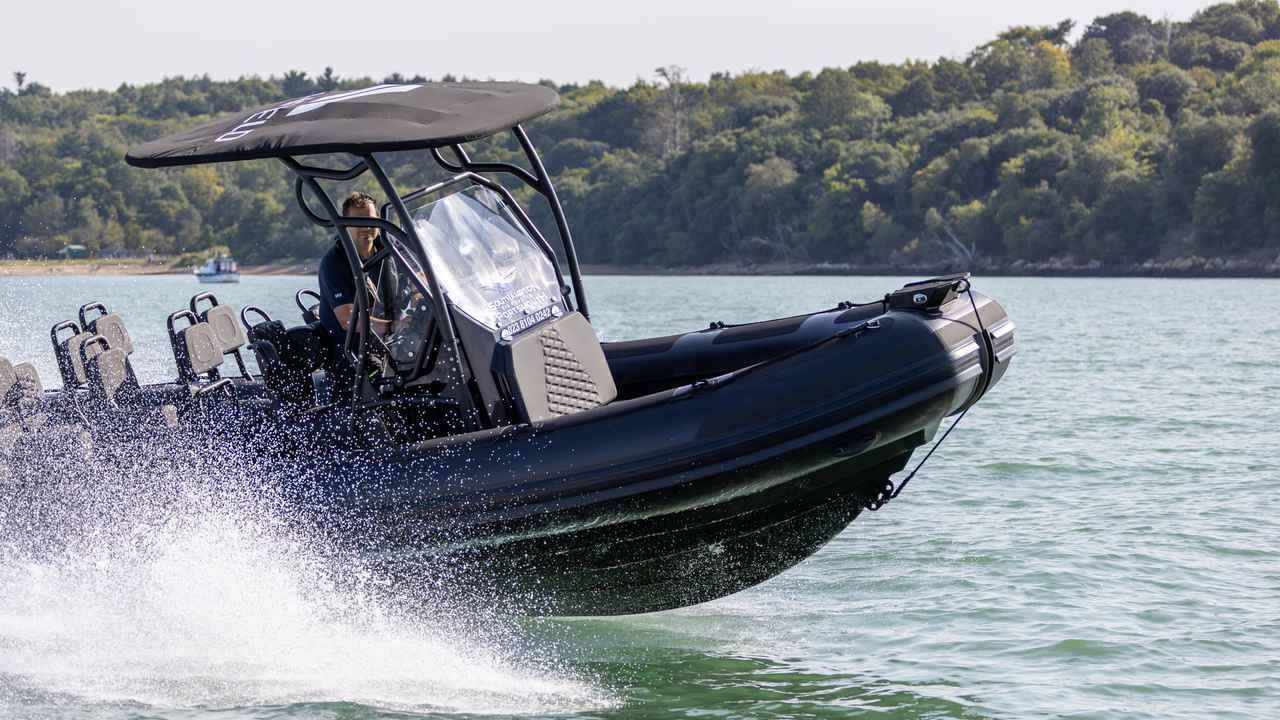
Configuring Highfield Patrol 760 means making decisions that involve both engines, seats, plants and project category. The RIB measures 7.64 meters, employs an aluminum hull with deadrise of 26 degrees and can receive a single outboard up to 300 hp or two units up to 150 hp each. The fuel capacity is 285 liters, the ORCA Hypalon tubulars have six rooms and the layout offers jockey or bolster options. This guide separates standard and optional equipment, then translates the declared data into a sequence of concrete verifications by order, testing and delivery, without inventing speed or autonomy.
First choice: defining real employment
The Patrol 760 can be set up for private use, event support, diving or activities requiring free surface and storage. The mission must be written before selecting accessories: habitual number of people, duration of transfers, materials, need to work on aft and expected conditions determine the rest. An order built only on the maximum number of places is likely to produce a crowded bridge. A mission card instead allows to evaluate seats, corridors, hooks, open stern or bench and position of the equipment with verifiable criteria.

Check dimensions and steps on the general design
The inner length is 5,79 meters and the useful width 1,65 meters, opposite 7,64 for 2,82 meters out everything. The console proposed by the manufacturer is 970 mm wide. These values must appear in the design of the ordered variant along with seats and gavones. The check sequence requires width of the steps, complete opening of the lids, distance between the steering wheel and the seat, reachability of the tientibene and path from bow to stern. A nominal measure is not enough: T-top, roll bar, controls and accessories can create interference that emerge only on the complete composition.
Single motor: 300 hp limit and XL stem
For single installation Highfield declares maximum power of 300 hp, maximum engine weight of 300 kilograms and XL stem. Brand, model, version, weight, ratio, propeller, controls, instrumentation and approved assembly share must be distinguished. The maximum limit is not an automatic prescription and does not allow to deduct a speed. During testing, start-up, gear insert, complete steering, inclination, interference with blanket and proper operation of alarms occur. Each result applies to the engine and the load actually tested.
Double engine: two units up to 150 hp
The alternative is a pair of outboards up to 150 hp each with L stem. The overall maximum power remains 300 hp, but they double many components: power supply, controls, tools, wiring and maintenance points. The double installation reduces the central space on the mirror and changes the weight distribution. The verification sequence must include distance between motors, contactless stroke, access to fixes, separation of power supplies where planned and procedure to isolate a circuit. Possible redundancy and added complexity should be evaluated together, not as slogans.

Steering and posting of government
Flyer, carbon-finished dashboard and electric boat and console packages are standard. The card does not give the model a universal electronic kit. The capitulate must therefore define steering compatible with the propulsion, gas control, emergency stop, engine tools, navigation, communication and electrical protection. Sitting and standing, the pilot must reach each command while maintaining the visual. The test includes steering from bar, game verification or losses, return of controls, readability in the sun and accessibility to the back of the bridge.
Jockey, bolster or cushioned seat
Consoles and alternative seats fall among the options; the seat with cushioning is indicated separately. The jockey files organize individual and flat places, while the bolsters can leave more continuity to the blanket. The verification sequence does not assign a winner: it records number of protected places, distances, supports for feet, possibility to stand, opening of the gavones and edge security. Each session must be fixed and inspectable. If the program provides for many hours, the driver's position should be tested with real clothing and equipment, not only observed on display.
Poppiera bench or open area
The rear bench can accommodate four people and create a large compartment; the manufacturer also contemplates the open aft for commercial or charter applications. The choice influences passage towards the engines, storage, distribution of passengers and recovery of material. In delivery you control fixings, hinges, closures, drains and opening with the occupied blanket. In the open version there are deduction points, protections and work path. In both, the inclination of outboards and complete steering should not meet sessions, structures or equipment.

Integrated tank of 285 liters
The undercover fuel tank is standard and has declared capacity of 285 liters. Before the launch, we identify vents, vents, pipes, filters, valves and inspection points; then we feel the absence of losses according to the procedures applicable. Capacity is not equivalent to autonomy. To build a reliable plan you need measured consumption on the ship delivered, to regimes and recorded loads, with a prudent reserve. The check sequence also notes the weight of the fuel landed, because full and distribution influence mass and thirst.
Electric packages: what must be documented
Highfield includes an electric package for the console and one for the boat, but the general list does not allow to assume scheme, capacity of batteries or specific appliances. Delivery must include updated design, battery position and detachment, protections, cable sections, utilities and circuit identification. It tests each command individually and then with more active loads, checking voltage, alarms and absence of overheating. Cablings under console and blanket must be supported, protected by water and reachable without dismantling.
Patrol 760 configuration table
| Element | Value or choice declared |
|---|---|
| Length out all / internal | 7,64 / 5,79 m |
| Width out all / internal | 2,82 / 1,65 m |
| Deadrise | 26° |
| Tubes | 54 cm, 6 rooms, ORCA Hypalon |
| Boat mass | 1.060 kg* |
| Maximum load | 1.440 kg** |
| Persons | 12 in B; 18 in C |
| Fuel | 285 l |
| Single Propulsion | max 300 hp, stem XL |
| Double Propulsion | max 2 × 150 hp, stem L |
| Maximum single motor weight | 300 kg |
| Project category | B or C |
*Back, console and standard seats. **Equipment and material, excluding motors, fuel and water.
Ready to go: do not stop at 1.060 kg
The value of 1.060 kilograms covers boat, console and standard seats. It does not automatically represent the mass with engines, fuel, water, T-top, electronics, batteries and equipment. The maximum load of 1.440 kilograms includes crew and material, but excludes engines, fuel and water. For trolleys, cranes, supports and remittance, a complete computation or a weighing is required. The check sequence attaches weights of installed components and permanent load position. The standard lifting points are used only according to the scheme and limits of the specific configuration.

Category B or C and maximum number of persons
The Patrol 760 can be declared in category B or C. The published capacity changes: twelve people in B, eighteen in C. In delivery you check the tag, documents and correspondence with the ordered variant. The maximum number does not coincide with the places suitable for each condition and does not replace the load limit. The verification sequence records actual sittings, sticks, distribution of people and boarded material. For usual use, a crew must be defined consistent with spaces, missions and conditions, without assuming that the highest figure is always practicable.
Tubes, valves and pressure
Six rooms, diameter of 54 cm, ORCA Hypalon material and non-return valves are declared data. Surfaces, joints, patches, studs and contact points are inspected before delivery. Each room is identified and controlled according to the pressure provided by the documentation of the boat; here is not a universal value not published in the card. Instruments, temperature and time of verification are noted. Accessible valves, repair kits and standard pumps must be present and explained to the user.
Drainage, gavones and blanket washing
The self-dreaming bridge is standard, while the indoor washing system appears among the optional. It's two distinct functions. The first requires free discharges and verified behavior with representative trim; the second adds pump, socket, pipes and electrical absorption. In the test, water is poured in controlled quantities in the zones provided, observing the outflow without improvising tests incompatible with the plant. Gavoni and large prodier compartment must open, drain and close properly. The storing material should not obstruct any waste, cabling or technical access.

Roll bar, T-top and total height
Roll bar with ladder and T-top are optional. They must appear in separate fixtures, materials, lights or cablings actually installed. They add vertical encumbrance and can change access to engines, cover, storage and transport. The check sequence measures overall height, controls locks, cable passages, edges and possible interference with people or equipment. They do not attribute to the T-top devices not identified in the capitulate. After the first period of use, the structural fixings deserve a control according to the maintenance plan associated with the unit.
Bottle holder and underwater activities
The bottle holder is listed among the optional. If selected, it must be evaluated as a deduction component, not as a simple accessory. Number of cylinders, mass, diameter, straps, drainage and position enter the load balance. The handling should not cross seats without a defined path or leave free items on deck. The test sequence test insertion and removal by boat, check that the fixings remain accessible and check the relationship with ladder, stern and engines. Every specific activity however requires own procedures and equipment.
Standard equipment to check one voice at a time
The list includes ORCA Hypalon tubulars, treated aluminum hull, integrated mirror supports, self-dreaming bridge, steering wheel, undercover tank, lifting and towing points, anti-slip surface, barrel, keel protection, dashboard, electric packages, stern scale, prodier cushion, bag, pump, remi and repair kit. Every voice should be identified physically and compared to the distinct. “Standard” does not mean that engine, navigation, radio, batteries or mandatory safety equipment are included: all that is not explicit must be defined separately.

Try in water without numbers transferred from other boats
The test uses fuel, people and representative equipment. Engines, propellers, load, conditions and trim are recorded; then start-up, command response, visual, steering, alarms, drainage and seat stability occur. The current card does not publish a unique performance to impose on each Patrol 760. Any measures are therefore valid for the test specimen and must be kept in the minutes, not transformed into a general promise. Anomalous behavior requires diagnosis before acceptance, not informal compensation of the pilot.

documental delivery verification sequence
The delivery is closed only when tag, category, freshmen, manuals, schematic, distinct and engine data coincide with the boat. They attach configuration weights, keys list, tools, spare parts and accessories, as well as test results. The owner receives instructions on tubular, fuel, batteries, drainage, lifting and maintenance intervals. Pictures of installations and position of the devices facilitate subsequent controls. A well configured Patrol 760 is not the one with multiple options, but the one in which each choice is documented, accessible and consistent with the declared mission.