
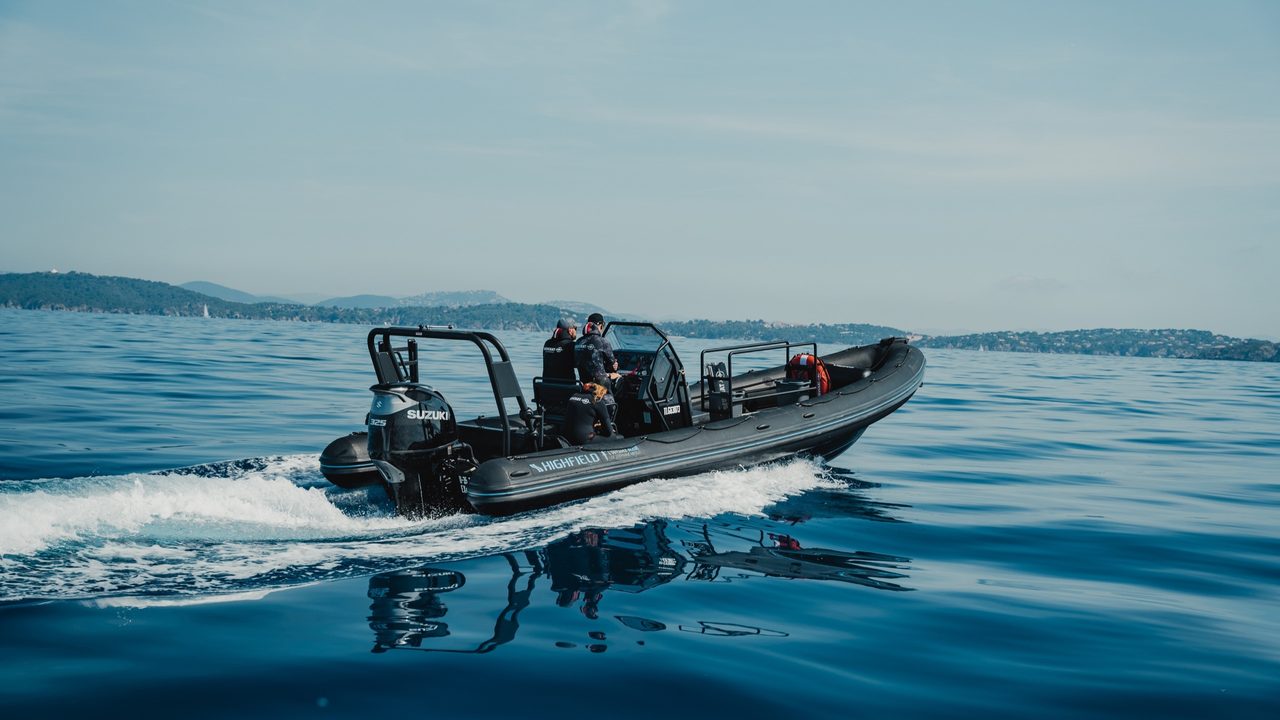
The Highfield Patrol 860 is an 8.71-metre RIB with aluminum hull, six-room tubular and configurable blanket. The board allows a single motorization up to 450 hp or double up to two units of 300 hp and declares 430 liters of fuel. Flexibility is its main character, but requires a method: seats, consoles, plants and loads must be defined as a single configuration. This guide translates the model data into operational controls, without attributing unmeasured navigation results on the individual unit.
First choice: defining the mission
The Patrol 860 can be set up for diporto, transfers, assistance or professional use. Before ordering seats and accessories you should describe people, equipment, habitual distance and mooring mode. The same blanket cannot maximise seats, free surface, storage and technical access.
An application card avoids random additions. For each activity they indicate crew, material, fuel provided and areas that must remain free. This base allows you to compare jockey, bolster and back bench, evaluating not only comfort but also baricentro, corridors and maintenance.

Measures that condition logistics and place boat
The length outside everything is 8.71 meters and the inside 6.76 meters. The maximum beam reaches 3,05 meters, while the internal width is 1,88 meters. The 58 cm tubulars explain a part of the difference between the outer encumbrance and the surface actually available in the blanket.
These numbers enter the planning of mooring, storage and lifting. Accessories, motors and appendages can increase the footprint of the single unit. Before delivery it is best to record real measurements and lifting points, also obtaining the full weight of the equipment: the metric field of the boat weight published on the current page is not consistent with the corresponding imperial value and must be clarified in writing.

Aluminium Carena: specific controls
The aluminum frame requires attention to protections, anodes and contacts between different metals. It is not enough to observe the outside: bilge, fixings, passages and zones under consoles and seats must remain inspectable. Stagnant water and improper electrical connections can compromise a material otherwise suitable for intense use.
The check sequence identifies alloy and expected finishes, anod position, condition of painting and insulation of accessories. Any subsequent modification must use compatible components and procedures. After shocks or alaggi, deformations, abrasions and visible welds are controlled, entrusting the structural diagnosis to qualified personnel.

Modular cover and load distribution
The view from the top shows a deck that can change considerably with the number and type of seats. Each module adds weight and occupies surface. Before the installation you need to check the passageway, access to the gavones, view of the pilot and possibility to reach emergency equipment.
The maximum published range is 1,600 kilograms. People, fuel, motors and materials must be read according to the definitions of the unit documentation. The ordinary configuration should preserve margin, avoiding transforming the theoretical maximum into a usual load.

Deadrise of 26 degrees and thirst
Highfield declares 26 degrees deadrise. The data describes a deep V in the stern section, but does not authorize to deduct universal speed or comfort. Engines, propellers, mounting height, people and equipment change trim and response. The configuration must therefore be evaluated in its entirety.
During delivery there are regime, trim, weight distribution and behavior with the expected load, following the manufacturer's procedures. The purpose is not to pursue an absolute value, but to build references for one's own unity. Subsequent changes in seating or material require a new reading of the arrangement.

Consoles, cablings and seats
The console is 970 mm wide and has to accommodate steering wheel, handcuffs, tools, switches and equipment chosen. The pilot must read the alarms without losing sight and reach the controls in a stable position. The large handles provided by the model help those traveling near the station.
Behind the panel you need labels, protections and space to intervene. Cables and pipes should not be compressed from the seats or cross wet areas without protection. Jockey, bolster and bench respond to different uses: the choice must be tried with real clothing and with different stature people.

Motorization: single or double
The board indicates up to 450 hp with single motor and up to two 300 hp units in the double configuration. The maximum declared weight for the single engine is 458 kilograms. Power and installation must match the approved specification, without transferring limits between different configurations.
The dual propulsion adds two power, start and control circuits, as well as greater service requirements. It offers different maneuvers management but does not eliminate the need for an emergency plan. The single solution reduces the number of components without making superfluous battery controls, cooling, fuel and rudder.

Government posting and essential arrests
Driving must be recognizable ignition, emergency stop, engine alarms, fuel indication and circuit protection. The final configuration can add navigation, communications and equipment dedicated to the task, but essential functions must maintain a clear hierarchy.
Before use you try flying, handcuffs, trims and switches, checking games and response. The safety cord should be handled by hand. A photo list of the delivered dashboard, accompanied by the patterns, reduces ambiguity when devices are added or replaced tools.

Fuel and prudent autonomy
The declared tank contains 430 liters. The capacity is not equivalent to autonomy, which depends on engines, regime, load, sea and reserve. The operating plan must start from the consumption detected on the actual configuration and maintain a proper margin for deviations and expectations.
The check sequence includes a vent, vent, indicator, pipes, filters and taps. Any smells or traces of loss are observed before starting. After interventions on the circuit, the estate must be verified by competent personnel. The fuel load changes the setup and must be included in the total distribution.

Access to water and procedures with outboard people
The Patrol 860 can support activities in which people enter and rise from water. The poppiera area must remain free from tops and materials. Engines, rudders and accesses must be managed according to a shared sequence, with a manager that maintains visual contact.
Scaletta and outlet points must be tested by those in the water. No one should approach the propellers with active propulsion. Equipment, cylinders or operating material require dedicated restraint systems and cannot block the recovery path.
Six-room boats
The declared diameter is 58 cm and the compartment includes six rooms. The subdivision limits the area affected by a loss, but does not replace inspections. Valves, fabric, joints and rubbing points must be checked regularly.
Pressure and temperature are connected: a reading must be performed under the conditions indicated by the manufacturer, with suitable instrument. Parabords and peaks must avoid abrasions against docks and hardware. Repairs and cleaning products must be compatible with the tubular material.
Electrical system and additional equipment
Engines, pumps, navigation, communications and lights must be collected in an electrical budget. Each additional luminaire requires protection, cable section and consistent mass point with aluminum hull. Improvised connections can create breakdowns and corrosion problems.
The configuration must separate the circuits according to project and preserve energy for start-up. Batteries, battery and fuses must be accessible and ventilated as expected. The final documentation shows position, capacity and utilities, so that a technician can intervene without rebuilding the plant.
Persons, categories and limits
The current table shows up to 15 people in category B and up to 20 in category C. The numbers do not describe the same scenario: category, employment area, load and tag of the specific unit must be read together. Numerous equipment also requires proper sitting and cladding.
The commander defines a distribution that preserves visual, passage and operational stability. Before departure, it communicates positions, use of handles and behavior during maneuvers. The published limit does not replace a prudent assessment of the conditions and experience on board.
Highfield Patrol 860 technical table
| Parameter | Summary |
|---|---|
| Length outside everything | 8,71 m |
| Internal length | 6,76 m |
| Maximum | 3,05 m |
| Internal width | 1,88 m |
| Deadrise | 26° |
| Tubular diameter | 58 cm |
| Air chambers | 6 |
| Maximum capacity | 1.600 kg |
| Persons declared | 15 in category B; 20 in category C |
| Fuel | 430 l |
| Maximum single power | 450 hp |
| Maximum double power | 2 × 300 hp |
| Maximum single motor weight | 458 kg |
The metric weight of the boat only shown on the current page is not reported because it does not coincide with the conversion of the associated imperial value. For lifting, trailer and load balance, you need the confirmed weight of the specific configuration.
check sequence before departure
Documents, tags, weather, people and cargo are checked. They follow tubular, valves, visible famine, drainage, seats, gavones and peaks. The console features rudder, handcuffs, stop, tools, alarms and communications. The fuel is compared with route and reserve.
Material and equipment must be fixed without covering technical access. It communicates to guests where to sit and how to move. Before leaving the mooring, the area around the propellers is observed and it is confirmed that each mobile component is in the expected position.
Return and maintenance checks
After use in salt water, cleaning and inspection are performed according to manuals. Pressures, abrasions, anodes, drainage and operation of plants are recorded. Engines and components follow the ranges of their respective manufacturers, without replacing them with generic deadlines.
The areas under consoles and seats must be able to dry and be controlled. Deformations, corrosion, losses, rudder games or electrical anomalies require qualified technicians. A regular log makes conditions comparable and helps to identify changes before they become part of everyday use.
Concluding operational evaluation
The Patrol 860 offers a flexible base thanks to aluminum hull, compact tubular and modular blanket. The possibility of choosing between single and double motor expands the programs, but increases the importance of a specific contract. There is no better equipment: there is the one consistent with mission, people and maintenance available.
To use the model well you must preserve passages, accesses and load margins. The verification sequence does not only serve to avoid forgetfulness, but to maintain readable a complex platform. With confirmed weights, documented installations and aluminium controls, the Patrol 860 can be configured with rigor for advanced pleasure or operational activities.