
Configuring a Lagoon 46 requires distinguishing Heritage from the new 46 Iconic and transforming a long list of spaces, sails and plants into a verifiable distinction. The official card declares 14,50 meters out everything, 7,96 of bay, 16,3 light tons, two 57 horse engines, 1.040 liters of fuel and 600 of water. These numbers are the starting point, not the complete description of each specimen. The following guide orders configuration and testing without inventing unpublished features, marks or performance.
Identify template, year and layout before optional
The site page warns that Lagoon 46 illustrated is the previous version of the Iconic. Before asking for quotes or spare parts you need to note number of hulls, year, market, layout and history of interventions. The correct name avoids ordering components or attributing the solutions unit presented on the next generation.
The configuration is built on four documents: contract or original invoice, separate of optionals, manual owner and declaration of conformity. Photographs and ads are useful for orienting, but do not replace codes, serials and installed quantities.

Use plans to really count environments
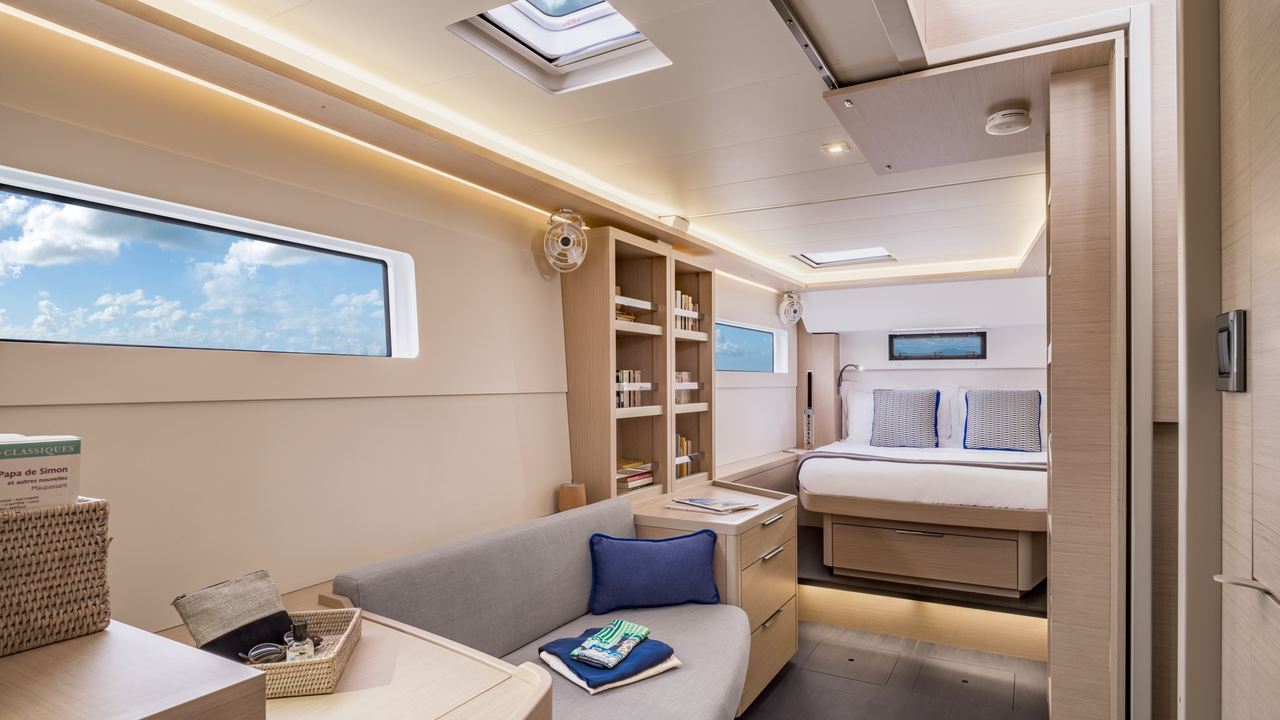
The site shows three and four cabin floors; at the same time the general summary indicates four to six cabins and six to twelve beds. Before describing the boat you must then read the specific design. The count can depend on how locals and crew places are classified.
Each cabin must be associated with bathroom, ventilation, storage and technical access. A subsequent change can change doors and furniture without automatically updating plants, capacity or certification. The verification sequence records photographs, measurements and real function of each compartment.

Four cabin version and onboard flow
In the four cabins the hulls distribute more separate environments. The verification involves passages, privacy, openings and possibility of reaching valves or panels without invasive disassembly. The number of people must remain consistent with CE category and mandatory safety equipment.
On a unit intended for intensive use, mattresses, hinges, locks, obscuring and ventilation undergo frequent cycles. The test is not limited to the appearance: each door is opened with the powered boat, every proven light and every inspection made accessible.

Shipowner's cabin and access management
The three cabin version devotes more continuity to one of the hulls. The quality of the configuration depends on the relationship between bed, passage, storage and service premises, not only on the surface. There are also exit routes, openings and possibility to intervene on the surrounding plants.
Coatings and furnishings may vary. Colours and fabrics visible in official images should not be assumed as standard. Finish code, sample and distinct must coincide, especially when an specimen has been updated.

Square, kitchen and electric loads
The square is presented as a wide and functional space, but the public page does not list refrigerators, oven, air conditioning or standard electric powers. Each appliance must therefore be invented with brand, model, voltage, absorption and protection circuit.
The test starts from individual utilities and continues with contemporary loads. Protections, voltage drop, ventilation and access to connections are controlled. A generator, inverter or additional batteries are not considered present until they are identified and documented.

Dining area and configurations
Table, chairs and kitchens must work both during rest and in everyday movements. Drawers and doors are open and closed; steps must remain free. Ventilation must be verified in the real configuration, without deducting flow rates or luminaires from the photograph alone.
The verification sequence associates each user with a valve, protection and access. This simple scheme makes it quicker to search faults and shows any unintegrated additions. Manuals are collected in updated format and connected to the serial number.

Sleeps and night ventilation
The yard declares from six to twelve beds. The data must be crossed with the plan, with the transformations of the square and with the certification of the unit. For each place we control air exchanges, obscuring, light, sockets and exit possibilities.
Condensation and humidity are not evaluated in a few minutes. They inspect edges, jaws, mattresses and areas close to the porthole, looking for consistent traces. Fans or air conditioning installed should be tested without attributing them to the basic equipment.

Loading, documents and network
The carding station must bring together documents, commands and tools in a legible way. The public card does not indicate a standard electronic brand: displays, sensors, autopilot, radio and data network must then be listed one by one.
Software, serial, license, settings backup and connected devices are recorded. Each instrument is turned on cold and verified compared to its sensor. A working display does not show that depth, wind or position come from a correct source.

Bathrooms, fresh water and drains
The plans show different distributions of the premises, but the type of WC, pumps and capacity of the collection tanks are not detailed on the page consulted. The actual configuration is read on manuals and pipes. They identify sockets, valves, vents, pumps and inspection points.
The test uses clean water and observes pressure, pump cycles, sealing and discharge. Persistent odours, hardened tubes or impossible access are recorded. No valve should remain labelless or hidden behind a non-removable element.

Showers, ventilation and maintenance
Mixers, drains, pumps, seals and ventilation are controlled in wet premises. The photographed finish can vary between versions; what counts is the correspondence between present materials and maintenance instructions. Aggressive products can damage surfaces and seals.
A full test bathes the shower plate, measures the evacuation time and inspects the compartment below. After testing you look for residual water, filters occur and you check that moisture does not reach furniture or electrical steps.
Round, self-tapping bow and sail inventory
The declared boline surface is 127 square meters. The flooding frog measures 76,5 and the auto-viral bow 46,5. The inventory must report sail, year, fabric declared by the sailor, number, state, sticks, reductions and winding systems.
The self-driving bow simplifies some sequences, but requires control of rail, trolley, snout and stop. The test test is set, turned, reduced and lowered with assigned roles. There is no speed from the surface.
Square top, Code 0 and wrapable boma
The optional square top is indicated in 80,5 square meters and the optional Code 0 in 105. The construction site also has a rollable boma for Lagoon 46 and 51, with visible mechanism to control reduction and winding. None of these solutions should be considered installed without distinction.
For each option attacks, compatibility, manual, limits and emergency procedure occur. The test must be able to be stopped safely. A richer configuration also increases spare parts, adjustments and crew training.
Flybridge: commands, visuals and communications
The flybridge integrates transformable sunbeds and a complete government station. The check sequence separates rudder, engines, tools, communications and security. Each command must have a consistent label and response; any repeaters must be compared to the main source.
Blind sectors, prue visibility and cockpit control occur. A communication system between those who govern and those who work in the bow or stern is part of the procedure, even when it is not a fixed plant.
Double propulsion and comparison between sides
The standard declared equipment is 2 × 57 horses. Brand, model, relationship, propellers and hours belong instead to the single unit. The technical configuration must list separately straight and left, including serials, batteries, filters and interventions.
The test compares start, regimen, temperature, charge, vibration and response. The manoeuvres with differentiated motors are tested in safe area. Anomalous differences are not normalized: they receive a diagnosis and verification after the remedy.
Fuel and water: capacity does not mean autonomy
The site declares 1.040 liters of fuel and 600 liters of water. In order to use them in planning, the number and position of the tanks, usable quantities, precision of the indicators and recorded consumption are required. A nominal capacity does not guarantee that each liter is available in the same conditions.
The check sequence follows a vent, vent, reservoir, valve, filter and user. During refuelling, returns and odors are checked; indicators and symmetry are observed during use. The reserves are defined by explicit margin.
Lagoon 46 configuration table
| System | Published | To be confirmed on the unit |
|---|---|---|
| Version | Lagoon 46 Heritage | Year and number of hulls |
| Layout | 3 or 4 cabins shown | Actual plan and premises |
| Sleeps | 6–12 | Transformations and security |
| Engines | 2 × 57 HP standard | Brand, serial, propeller |
| Fuel | 1.040 L | Tanks and indicators |
| Water | 600 L | Pumps, filters and valves |
| The Week | 76,5 / 80,5 m2 | Standard / square top |
| Chocolate | 46,5 m2 | State and equipment |
| Code 0 | 105 m2 optional | Sailing and Attack Points |
| EC | A12 / B14 / C20 / D30 | Plate and manual |
delivery controls in four stages
Dry controls identity, hulls, appendices, thymeans, propellers and sea sockets. Energy, water, pumps, lights, tools and utilities are tested in the dock. Government, motors and maneuvers with noted conditions occur in navigation. When you return, you are looking for anomalous and alarms.
Each relief contains photography, location, priority, responsible and closing date. Delivery only ends when the remedy was verified, not when it was promised. Manuals, keys, codes and spare parts enter the final inventory.
Configuration-based maintenance plan
Before each exit, levels, bilge, essential valves, government and safety are controlled. Monthly examines charge, accessible filters, pumps, drainage and maneuvers. Manufacturers' deadlines govern engines, batteries, sails, electronics and appliances.
Every year the difference is updated: what is added changes consumption, weights and spare parts. The activities performed are recorded with hours, materials and serials. A generic plan loses value as soon as the boat departs from the original configuration.
Operational evaluation
Lagoon 46 offers a complex platform: flybridge, large cockpit, more layout, double propulsion and an articulated sail plan. The quality of use arises from the consistency between these systems, not from the optional number.
The best configuration is that documented and manageable by the crew. Identify the generation, delete ambiguity on the layout and try each circuit turns a promotional card into a legible boat. This is the criterion that reduces surprises in delivery and makes maintenance sustainable over the years.