
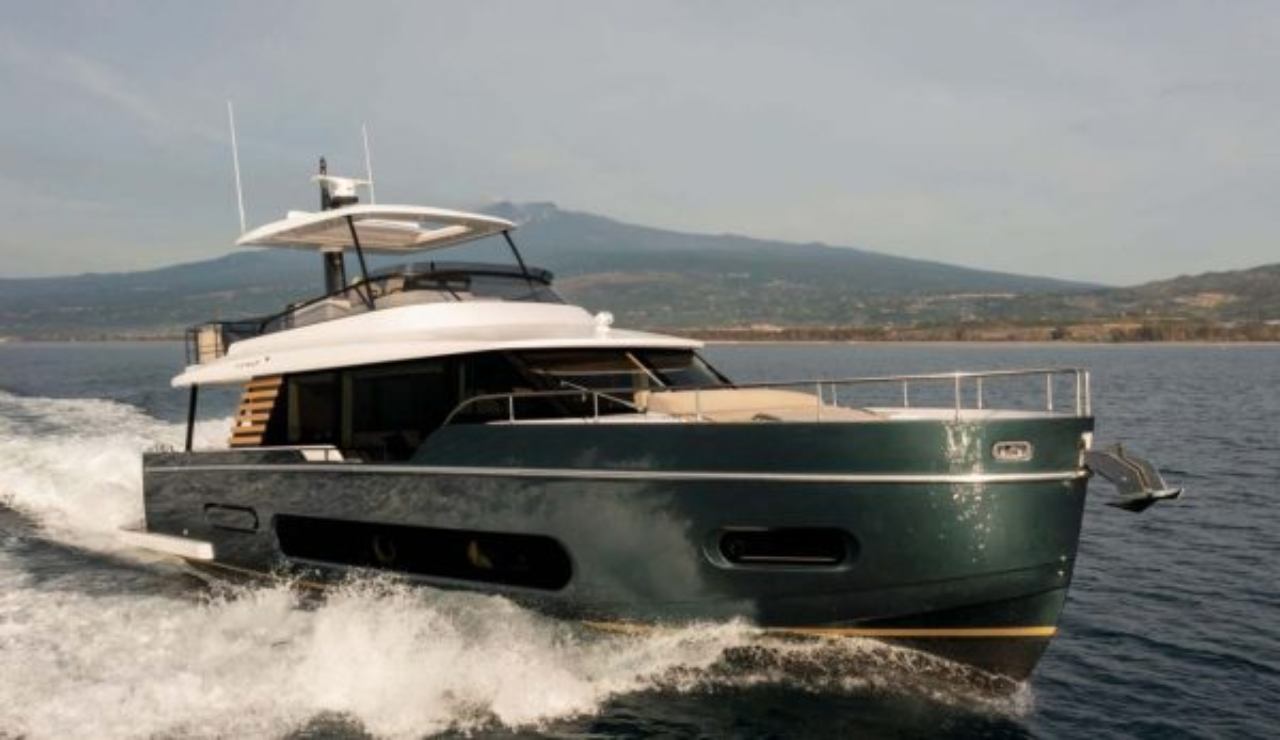
THEAzimut Magellano 60 is the meeting point between two worlds: that of long-range shuttles and that of planant yachts voted for rapid transfer. The technical trait that defines it is Dual Mode Hull, a semi-planning hull optimized to offer a wide “efficiency window”: economic navigation to a number of knots with flat order and predictable consumption, and, when needed, brilliant cruises around 18–22 knots with spikes that, depending on the specifications and load, reach the order of 26 knots. A kit, motorizations MAN I6 730 up axis line, gyroscopic stabilization on request, internal layout designed for prolonged stay and, last but not least, the possibility to use biofuels HVO already in phase of testing and delivery, in accordance with the path of decarbonization of the yard.
Site profile: history, philosophy and reputation
Solid roots and industrial vision
Azimut Yachts born in 1969 on pulse Paolo Vitelli and, in a few decades, evolves as a global charter operator in the construction of composite yachts, to acquire Good in 1985 and compose the group Azimut|Benetti, world leader in superyachts over 24 meters. The company culture integrates R&D in-house, management control, structured collaboration with renowned designers and a pragmatic approach to innovation: weight reduction, hydrodynamic optimization and increased efficiency of hotel systems. Today the strategic route is guided by Giovanna Vitelli, focus on measurable sustainability, advanced materials and technical-scientific partnerships.
Applied research and sustainability
Among the pillars of the “low impact” strategy are reduced friction hulls, light laminations and the experimental/commercial adoption of HVOlution, biofuel supplied by Eni Sustainable Mobility. Magellano 60 was among the first models to benefit from the program, demonstrating compatibility with a solution that reduces the footprint well-to-wake compared to traditional fossil oil.
In-depth technical analysis
Dimensions, naval architecture and project parameters
- Length outside everything (LOA): 18,47 m (60’ 7”)
- Maximum garlic: 5,15 m (16’ 11”)
- Full load fishing: 1,37 m (4’ 6”)
- Full load dislocation: ~34,9 t
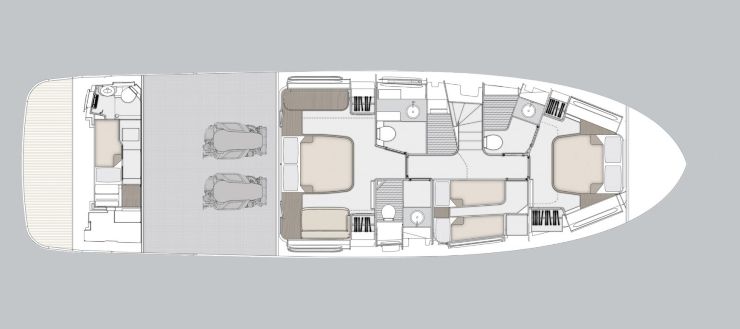
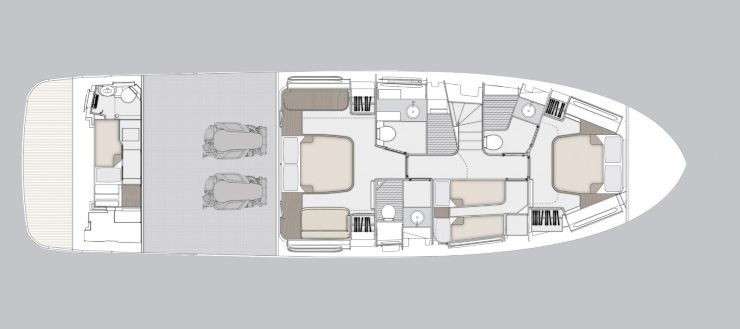
- Cabins: 3 + 1 crew | Bathrooms: 3 + 1 crew
- Project category: EC B; nMMA certification
The famine Dual Mode was born to guarantee two efficient operating regimes: displacement/semidislocating at reduced speed and semi-planning for supported cruises. Almost vertical bow, generous prora section and well distributed central volume improve portanza e shape stability, reducing the trend to beaking and mitigating the impacts on the short wave typical of the Mediterranean. In practice, the boat “stacca” less and preserves linear energy, translating itself into comfort and predictability.
Materials and construction: controlled lightness
Exhaust and superstructure are in GRP (vetroresin) with differentiated laminations and reinforcements located in areas of higher stress (longheroni, main bulkheads, machine bases). The use of composites and structural allows you to maximise natural light and open space without penalizing the torque stiffness or raise the center beyond the optimal threshold. The constructive logic is “light where possible, strong where needed”: where mass is needed to damp vibrations or play “sordo”, it is preserved; where it is possible to remove it, it works of engineering and layup.
Engines, propulsion and transmission
The choice of Magellano 60 privileges reliability and mechanical predictability: two MAN i6 from 730 hp combined with axis line with traditional propellers. This configuration, compared to pod systems such as IPS, maintains more linear handling to loads, offers global service ease and ensures stable trim to intermediate runs. The machine rooms are set with practicable steps, pre-size of sea sockets and oil filtration on two stages with water separators, for the benefit of operational robustness in the long cruises.
Performance, autonomy and consumption
- Maximum speed: ~26 kn (rehearsal and sea favorable)
- Typical cruise speed: 18 kn
- Indicative range of ≈ (9–11 kn): economic transfers with consumption at a figure of l/nm
- Indicative range at 18–22 kn: adequate autonomy for medium routes (isole, weekly cruises)
The resistance curve shows a minimum of locality in the “displacement corridor” (around 9–11 knots), ideal for delivery and fluid night navigation; going up to 18–22 knots the hull remains composed and “flat”, avoiding peaks of thirst and need for great corrections. The adoption of biofuel HVO does not alter consumption in real use but affects the carbon footprint along the fuel life cycle.
Onboard systems: navigation electronics and home automation
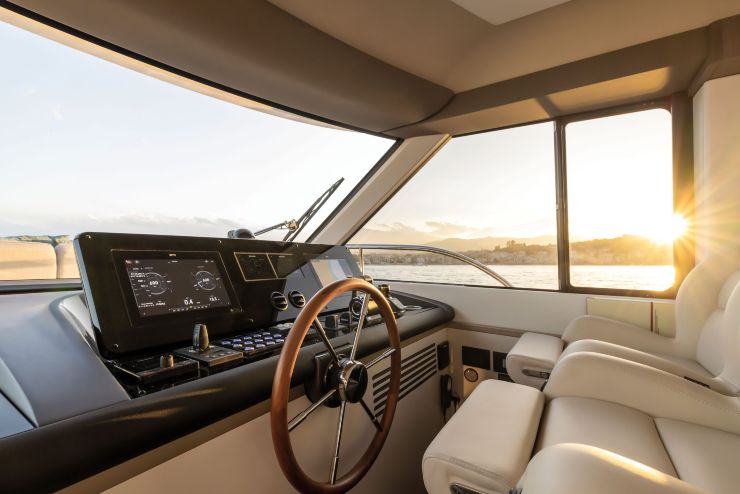
The bridge and the flybridge integrate MFD large format, solid-state radar, eco-scandaglio and chartplotter with updated cartography. Dialogue with MAN displays allows you to have fuel consumption, engine parameters and diagnostics always at your fingertips. Typical options include AIS active, onboard cameras, system monitoring for loads and lighting on dedicated bus, as well as wireless charging and independent audio stations for different areas.
Stabilization and maneuvers
The Seakeeper (typically SK9 or SK18 depending on the specifications) reduces the roll to the anchor and to low runs, transforming the use of outdoor spaces. In addition, bow and proportional stern thruster, remote station in the cockpit and, on request, dedicated joystick make the mooring less challenging even with wind to the traverse and dock fishing too close. At sea, the famine/axis line combination ensures clean trajectories and consistent response to the rudder: the boat always “explains” what it intends to do, avoiding nervous reactions.
Design and architecture: stylistic signatures, layout, ergonomics
External signature Ken Freivokh and “Infinity Terrace”
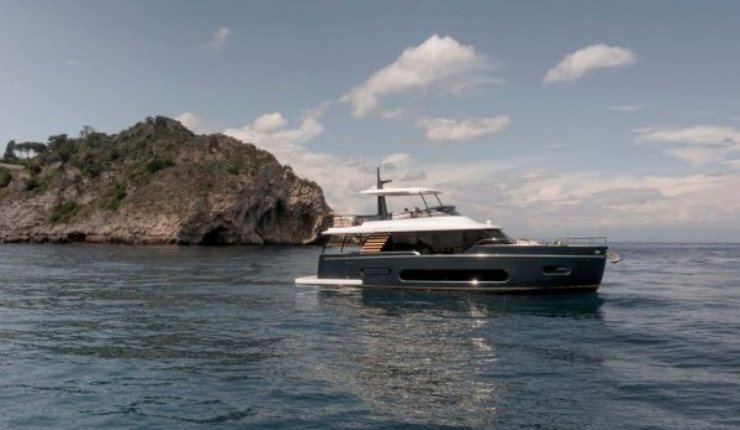
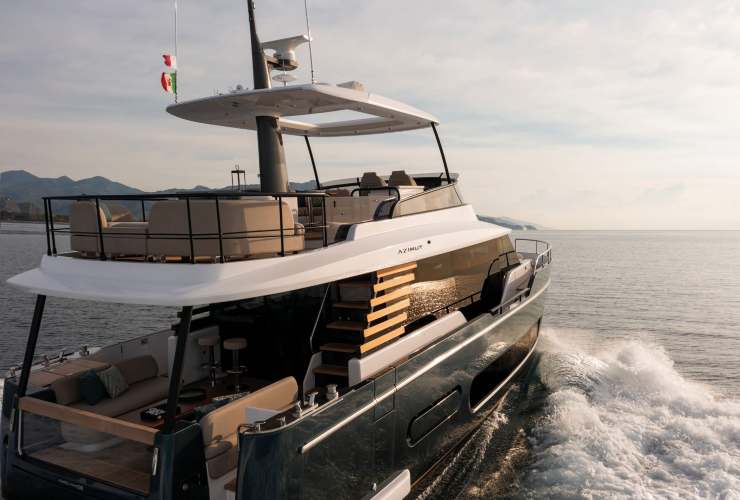
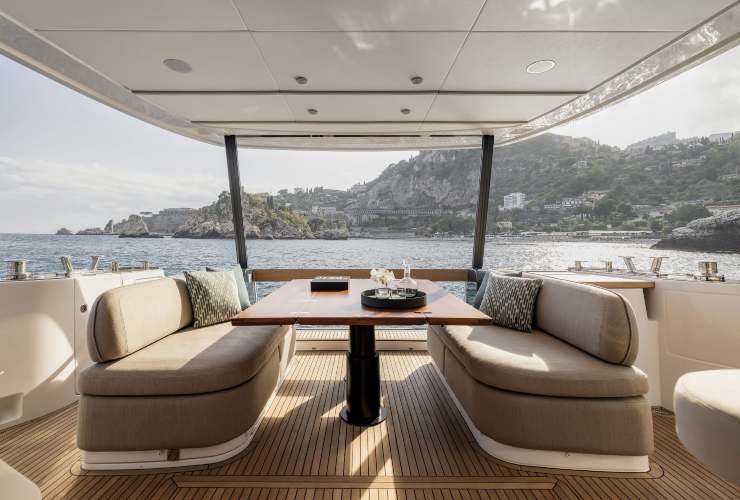
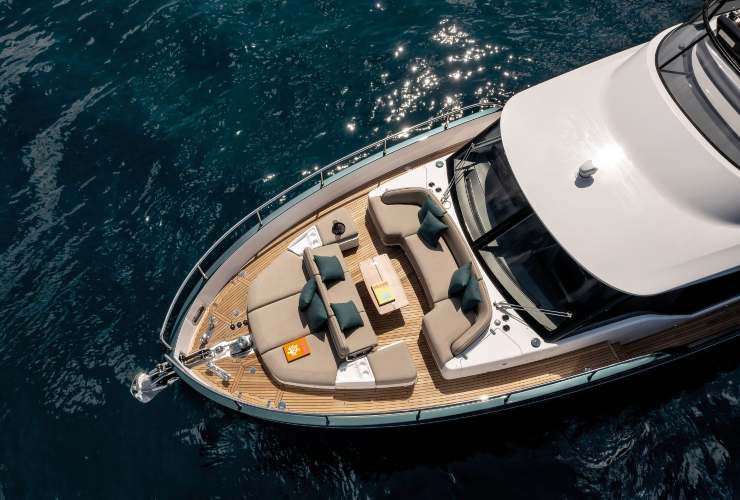
The external lines signed ♪ they play on full volumes and horizontal cuts, with an almost vertical bow and extended windows. The Infinity Terrace aft, with glazed parapet, dilated the perception of space: the sea enters the scene of the edge, without the visual filter of the typical high walls. The dark colour palette (the famous “octanium”) enhances the profile and tells the crossover vocation of the series.
Main deck: galley aft and continuity in–out
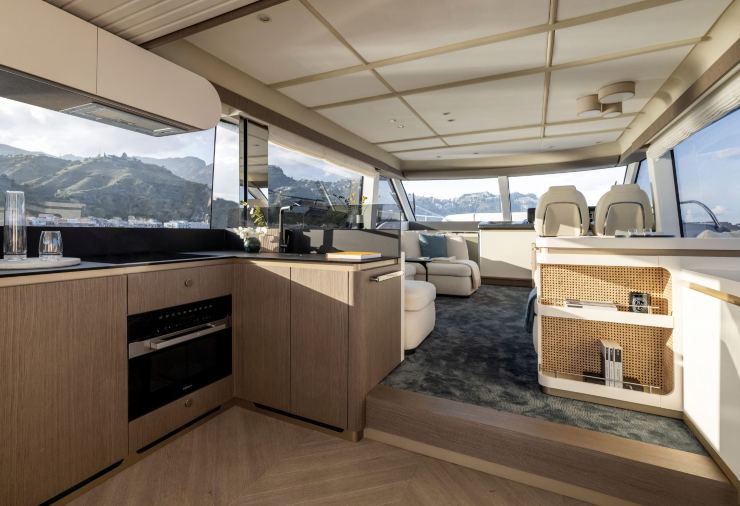
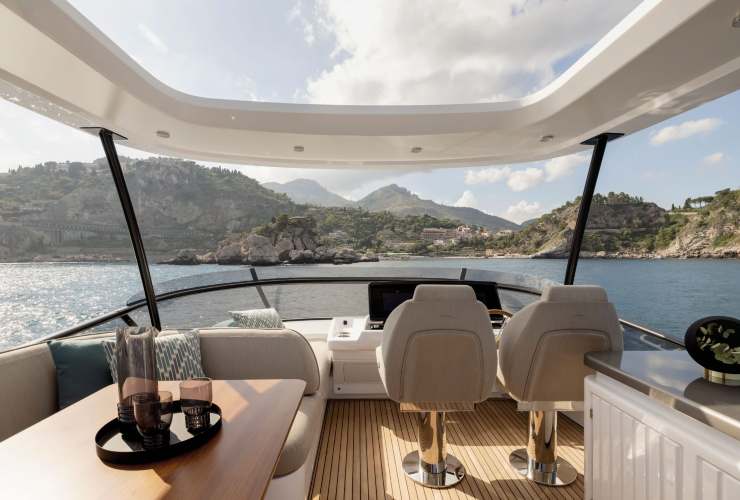
The retro kitchen (galley aft) is the functional heart of main deck: from shopping to midnight snack, all gravitated around a semicircular block connected to cockpit and salon. The stained-glass windows, low-mass visual furnishings and modular sofas create a “social” environment that lives both in the open and in the port. In front of it, the lower rudder is thought like that of a evolved trawler: correct sitting, windscreen with angles designed for minimum glare and triple console tools with immediate readings.
Lower deck: full beam shipowning suite and pragmatic layout
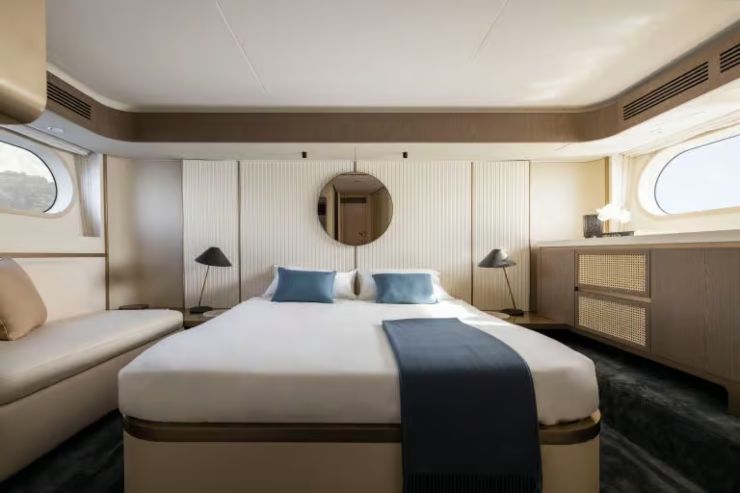
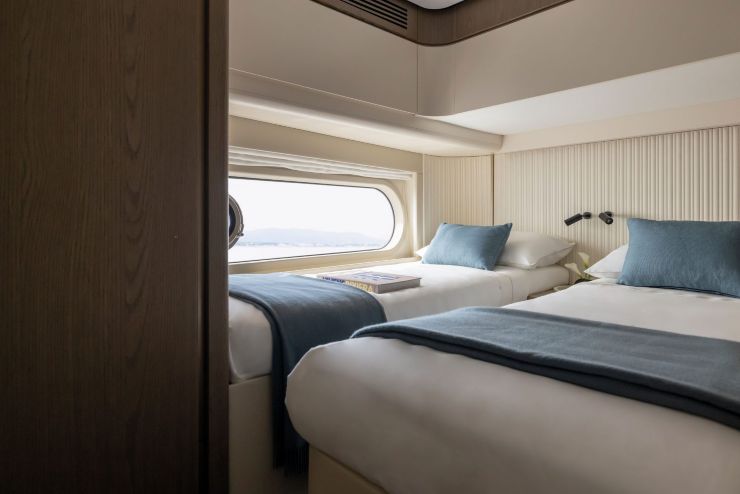
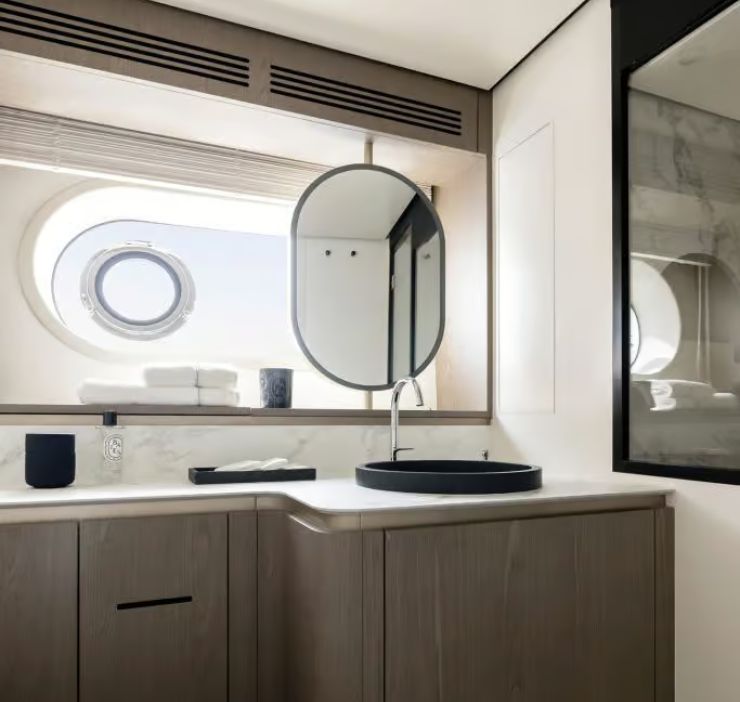
Coming down, the master full-beam at the center of the boat benefits from the most stable point of the boat: less beaking, greater natural sound insulation. The VIP bow enjoys remarkable vertical volumes, while the twin right adds flexibility for families, guests or additional crew. The bow bathroom with double access serves as day head. The focus on booting is long range: deep gavones, inspectable technical volumes, nautical level hinges and hardware, for a perception of solidity that holds over time.

Life on board and comfort: air, light, sound, temperature
Thermoacoustic comfort and plants
The air conditioning is dimensioned for the Mediterranean summer peaks: well distributed speakers, zone management and silent compressors contribute to a uniform microclimate. The acoustic treatment combines mass, elastic couplings and pathways of reasoned ducts to reduce transmissions. The result is a soundscape on board “soft”, which does not tire neither in navigation nor in dock. The service pumps are on independent circuits and the 230V/24V network is sorted, labeled and with differential protections where it serves: maintenance and diagnostics are simplified.
Galley, Cambusa and Hospitality
The kitchen block includes worktops in scratch-resistant materials, induction plate, combined oven and refrigerators marine grade of adequate ability to cruises of a week or more. There are wine cooler, icemaker and shockproof solutions for dishes and glasses. The table of the salon, possibly telescopic, allows to modulate the dining area according to the occasion: informal brunch with 360° view, formal dinner or simple play space for children during transfers.
Outdoor areas: flybridge and beach-club
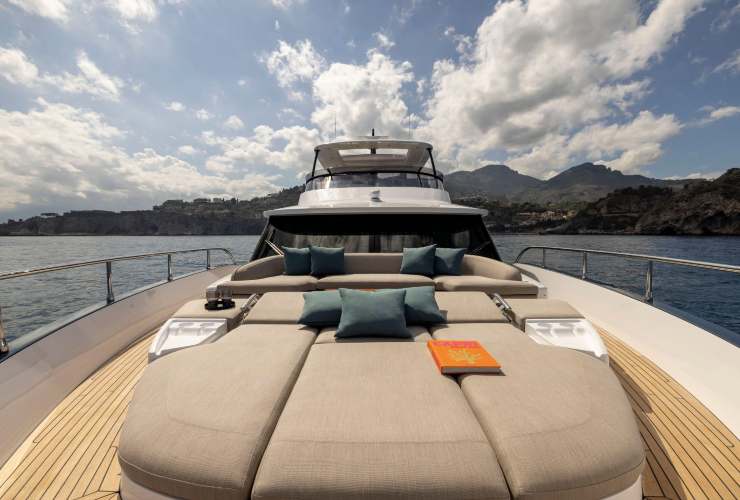
The flybridge welcomes a generous lounge with prodier sunbathing, wet-bar with grill and refrigerator, and possibility of curtains/shades brought on removable poles. The hydraulic poppiera platform serves as a beach club and as an operational area for launch and tender. In the “off-day” configuration, the platform becomes a natural extension of the Infinity Terrace, creating a sequence of extremely enjoyable water levels.
Navigation performance: extended test and dynamic behavior
Asset, response and wave shift
In the sea formed short (0.6–0.8 m) the Magellano 60 maintains a composite structure: the entrance of full bow avoids the impacts “dry” and the hull depletes the vertical accelerations, which are the main factor of fatigue for crew and guests. In acceleration the passage between displacement and semi-planade is progressive, without annoying “grades”: the boat takes turns linearly and leans on the hydrodynamic cushion with minimal increase of the muzzle.
Governance and seal
At wide turns (20–25° of bar) the trajectory remains clean, changes of debris are predictable and there is no tendency to oversteer. The rudder returns a “developed trawler” feeling: calm, legible, reassuring. The residual roll at anchor is effectively tamed by the gyroscope; in navigation, the masonry section and the central volumes naturally contribute to stability.
Perceived roughness and vibration
Without resorting to apodittic numbers, it can be said that salon and master benefit from a background noise content at cruising speed: the combination of insulation, engine elastic supports and installation position reduces resonance and sibilities. The result is natural conversation on board and less fatigue, especially during transfers of 2–3 hours.
Technology and safety systems
Electric, water and firefighting
The electricity is clearly organized, with legible labelling and oversized switches. I generators (typical sizes in the order of 17–19 kW) agilely cover hotel loads with margins for grill/induction and air conditioning simultaneously. The water system uses variable flow pumps to limit ON/OFF cycles and extend life, while the black/grey water circuit is simplified for access and maintenance. For safety, plant fire in the engine room and smoke/gas sensors in critical areas; bilge pumps redundant for compartments.
Domotics and monitoring
The central monitoring allows you to manage lighting, air conditioning and loads with dedicated pages on MFD or on secondary screens. This not only improves the user experience, but helps the commander to “read” the yacht and prevent unexpected with non-invasive warning logic.
Market and competition
Positioning and price
The Magellano 60 is located in segment 18–20 meters fast/crossover shuttles. New units with rich equipment (stabilizer, electronic packages, premium finishes) fall into a typical order of magnitude around €2.5–2.9 million depending on specifications and delivery times. On the international market the quotations reflect equipment and state of use, with listing that enhance stabilization, layout and aesthetic packages.
Direct competitor analysis
- Absolute Shuttle 58/62: extraordinary volumes and simplified manoeuvrability by Volvo Penta IPS. Comfort from “floating apartment”, but with feeling on the move that, at the same load, favours more the “static” comfort than the “cut” march typical of the Dual Mode.
- Bénéteau Grand Trawler 62: philosophy long range more push (range in the order of 1.000 nm to 9 knots), excellent acoustic comfort, but more limited transfer speed (maximum around 20 knots).
Target customer
Private owner with family who wants periods aboard several days/weeks, premium charter on mediterranean routes (7–10 days) and company of representation that require a reliable and scenographic yacht for corporate and hospitality activities.

Maintenance, technical accessibility and operational management
Access and service
The salt machines previse real steps: filters, water separators, sea sockets and valves are identifiable and reachable. The propulsion sets on elastic supports allow alignment without excessive disassembly. The the is ordered and with independent pipelines for “critical” and “comfort” services: a detail that simplifies diagnosis and minimizes downtime.
Cost management and value return
Live cost depends on geographical area, navigation program and insurance packages; in terms of residual value, the Magellano 60 benefits from constant demand for efficient and crossovers brand equity Azimut. Stabilizer, updated electronics and consistent service documentation are the three factors that typically make the difference when resale.
Innovation and research: Dual Mode, HVO and “light engineering”
Carena and materials
The Dual Mode Hull is a modern answer to the theme “a boat, two speeds of excellence”. Optimized laminates and structural stained glass are the philosophy of light engineering: to remove mass where it is not needed, to invest rigidity where dynamics requires it. The net effect is a more efficient, bright and usable boat for a long time without fatigue.
Biofuels and electrified future
IntroductionH in the tests and as an option to delivery opens the way to a concrete reduction of emissions without overturning infrastructure or operating habits. In perspective, the hybridization of hotel services and the optimization of generation/electric accumulation represent areas of potential evolution on which group research is already active.
Results, fairs and awards
The international press welcomed the Magellano 60 with positive reviews, rewarding the balance between design, efficiency and comfort. In the field of awards, the model has been reported as a reference in its category, testimony of a project maturity not common on boats of this size.
Future prospects: what Magellano 60 tells about the construction site
This 60 feet clearly anticipates the brand's route: measurable hydrodynamic efficiency, reduction of footprint with immediately adoptable solutions (HVO) and a design that combines comfort and enjoyment of the sea. The logic of Dual Mode famines and the intelligent use of materials are found in other product families, such as the recent attention to sustainability-oriented series. The Magellano 60 is therefore more than a model: it is a technical poster climbable on the older sisters.
Extra Images
Summary
- Project: Exterior Ken Freivokh; Interior Azimut Yachts
- Naval architecture: Profjord & Azimut R&D
- Material: GRP with structural stained glass; localized reinforcements
- Engines: 2 × MAN i6 730 hp, axle line
- Indicative performance: cruise ~18 kn; maximum ~26 kn
- Stabilization: Seakeeper (SK9/SK18 opz.)
- Electronics: Raymarine Suite with AIS, Solid State Radar, Multiple MFD
- Cabins/Baths: 3 + 1 crew / 3 + 1 crew
- Certifications: EC B; NMMA
Conclusions: a 60 feet “real”, able to make course
The Magellate 60 is, to all effects, one boat sailing. Not only for the ability to cover miles in the economy on the “displacement corridor”, but also for the solidity with which it faces more stretches when the agenda imposes it. The carena Dual Mode offers a double soul of use, the axis line guarantees reliability and predictability, theH puts a first concrete stamp on the emissions front, while the layout – with Infinity Terrace, galley aft and master full-beam – translates into practice the contemporary demand to live the sea without renunciation.
In a market where displaced trawlers point everything on the endurance and fast flybridges on the travel time, the Magellano 60 chooses a third route and the chair with engineering clarity and attention to detail. For theprivate shipowner seeking autonomy, elegance and mariality, and for those who work in premium charter in the Mediterranean, this 60 feet represents one of the most complete and consistent solutions available today.