
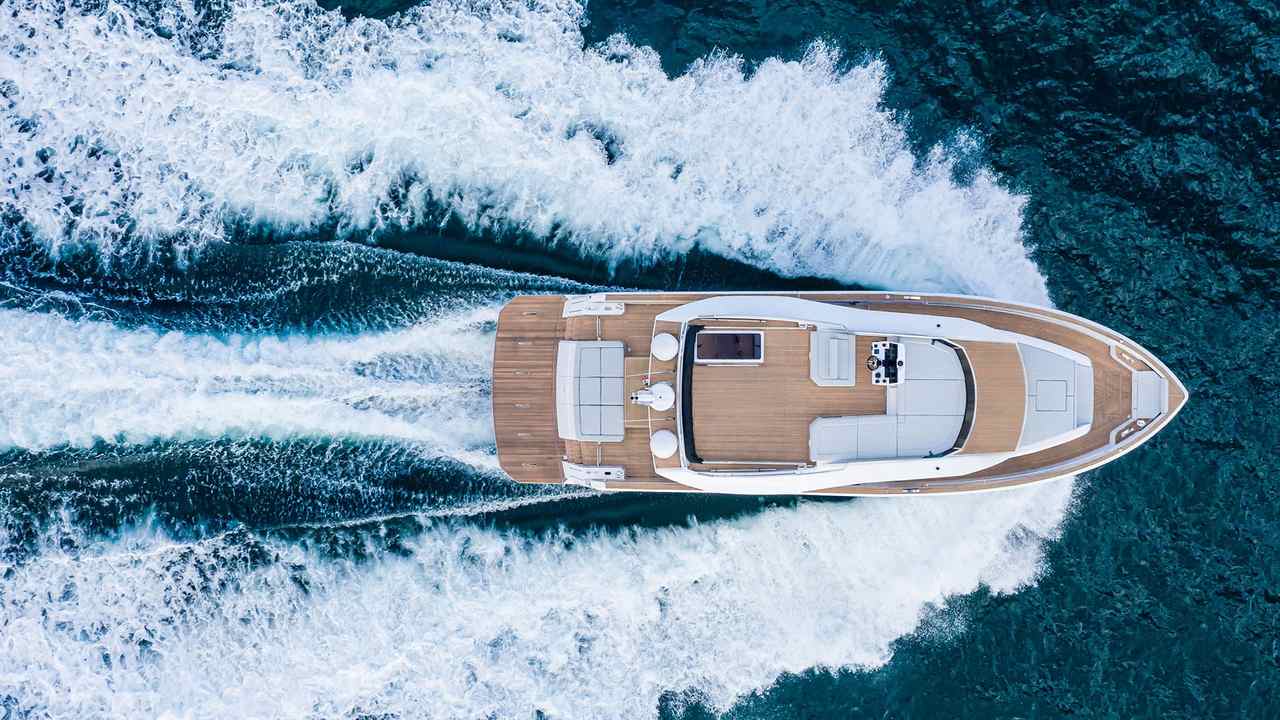
Configuring a Pardo E60 means deciding how they will have to work together 18,08 meters in length, 33,2 tons of approximate displacement, two IPS, three cabins and a stern capable of opening up to form a platform of 41 square meters. It is not enough to choose the finish of the wood or the most powerful engine: each option changes weights, absorbments, accesses and maintenance. The E60 is a night & day cruiser with Endurance vocation, with carena designed to proceed both in displacement and in planata and with predisposition for future hybrid solutions.
This guide adopts the point of view of who has to define a specification, test it and maintain it. The data indicated are those declared for the current model; speed, consumption and autonomy are not invented and must be measured on the single unit. Each accessory is treated as part of a plant: what is not explicitly understood in the chosen configuration must be confirmed by the yard and entered into contract with weight, power, interfaces and acceptance criteria.
Technical identity: Compact endurance, not enlarged walkaround
The E60 shares the reverse bow and direct relationship with the water typical of Pardo, but develops a different program from the open range. The flybridge remains in height, the lounge is protected and the lower deck offers three cabins with three bathrooms. The model must be able to support long transfers at controlled speed and, when necessary, work in planata. This dual mission influences famine, centering, sizing of tanks and choice of propellers. For the owner it means that the unit is to be tested on multiple regimes, not judged only for maximum speed or comfort in the dock.
Project roles: what to check in the specifications
Concepts and exteriors are attributed to Cantiere del Pardo, naval architecture to Davide Leone Yacht Design and interiors to Nauta Design. The capitulate should preserve this consistency by separating the performance of the hull, the ergonomics of the bridge and the realization of the interior. A modification to the furniture can move weights or subtract access to a plant; an antenna on the flybridge increases bulk and high mass; a different choice of tender influences the stern. Each customization must therefore be described with design, separate weights, power supply, drainage and maintenance mode.
Essential configuration card
| Voice | Declared configuration | Acceptance control |
|---|---|---|
| Length f.t. / hull | 18,08 / 16,43 m | Verify real encumbrances with appendixes and accessories |
| Maximum | 5,12 m | Travel lift and boat seat compatible |
| Dislocation | 33,2 t | Ask for weight condition and final distinction |
| Fuel / water | 2,400 / 700 l | Calibration levels and usable capacity |
| Standard motors | 2 × Volvo IPS 700 from 550 hp | Series numbers, diagnostics and testing curves |
| Optional engines | 2 × Volvo IPS 800 from 600 hp | Comparison with equal weight and conditions |
| Layout | 2, both Galley Up | VIP double or twin beds |
| Hospitality | 6 beds + 2 optional crew | Check ramps, ventilation and access |
| Capacity | B14 / C16 | Align collective equipment and means to use |
Real measures: first control before order
The length outside everything is 18.08 meters, while the hull is 16.43 meters. The difference should be kept clear in contracts, boat seat, transport and lifting. The 5.12-metre glare supports the large stern surface, but requires verification of the useful light of the travel lift and the geometry of the straps. The displacement of 33.2 tons is indicated as approximate: before delivery you need to know the condition to which it refers and receive the updated weight with engines, fluids and optional installed.

Different weights: the document that binds all options
The full of 2,400 liters of fuel and 700 liters of water significantly changes the mass compared to a light boat. People, galley, chain, dinghy, batteries, stabilizer and equipment are added. The distinction must indicate longitudinal and vertical position of the main components, because it does not count only how much an accessory weighs but where it is mounted. Massa aft influences the arrangement of the pods; mass on the flybridge affects the roll. Delivery controls should compare contract weight with actual configuration and record tank levels during testing.
Carena: displacement testing, transition and planing
The hull is described as suitable for both displacement and planing, with a light and low flybridge. The test must therefore cover at least three areas: low speed, transition and bridge cruise. For each point, regimen, speed, hourly consumption, mileage consumption, trim, visibility and noise must be noted. It should not be assumed that the slower regime is always the most efficient on distance. Loading, sea, wind, cleaning of the hull and configuration of the propellers must be documented, so as to make the test repeatable and useful for planning.
IPS 700 or IPS 800: a mission decision
The standard equipment includes two Volvo IPS 700 from 550 hp each; two IPS 800 from 600 hp are optional. The overall difference is 100 hp, but the serious comparison considers torque curves, final weight, yield and margin to the usual load. Those who navigate with tenders, equipment and tanks often full can prefer reserve; those who use the E60 at controlled speed must verify that the superior power produces a measurable advantage in their profile. The contract should fix propellers, software, instrumentation and acceptance test conditions.

Joystick and maneuvers: procedure before assistance
The swivel push of the pods makes many manoeuvres intuitive, but wind, inertia and lateral surface remain those of an 18 meters from over 33 tons. The verification sequence must include passage between the stations, response of the controls, alarms, cameras and communication with those who manage the tops and parabordes. The maneuver must also be tested without a single assistance, knowing the procedures provided for in case of anomaly. An efficient joystick reduces the workload; it does not automatically correct a wrong mooring plan nor replaces the knowledge of blind spaces.
Pod and underwater protection: dedicated maintenance plan
The IPS integrate steering, transmission and unloading into immersed units. The inspection includes propellers, anods, seals, seals, lubricants, games and shock signs. The deadlines depend on hours and calendar and must appear in the drive log. In case of contact with the bottom it is not enough to replace a shovel: geometry, alignment and diagnostics must be checked. Lifting and invasive must also respect pod-compatible points and distances. The owner should know in advance assistance center, availability of spare parts and typical stop times in his own navigation area.
Hybrid preparation: precise questions, no indefinite expectations
The E60 is described as predisposed to hybrid engines. The specification is not equivalent to saying that each unit can be converted without modification or that there is an already defined electric performance. Before order, you must ask which volumes, weights, cooling, steps and interfaces are reserved. The equipment added below must not occupy those areas. If you consider an effective hybrid system, you need electrical documentation, fire strategy, thermal management and clearly assigned integration responsibilities.
Fuel: calibrate 2,400 liters and plan the reserve
The nominal volume is distinct from the usable volume. Form of tanks, trim, non-fishing and tolerance of indicators can reduce the available fuel. Delivery must include calibration of levels and testing of alarms, possibly with multiple known filling points. The autonomy is calculated only after measuring consumption by mile in the real configuration and having taken away a coherent reserve with alternative routes, weather and ports. Recording supplies, hours and miles creates over time a more reliable curve than any generic value.
Machine room: check access before adding components
Filters, separators, impellers, belts, exchangers, valves and levels must be reached without dismantling foreign furniture or equipment. The verification is carried out by imagining an intervention with hot engines: lighting, ventilation, floor, tientibene and exit routes assume a concrete value. Generator, stabilization or additional accumulations should not block removal of the main components. Sentry sensors, fire detection, fixed extinction and fuel arrests must be proven and identified. Photos and diagrams of the delivered machine room help to recognize future changes.

Electric balance in three scenarios
The configuration should be verified in navigation, in radius and during a full night. For each scenario there are continuous, intermittent and precise loads: air conditioning, kitchen, refrigerators, pumps, electronics, entertainment and lighting. The generator must work without long load periods too low, while inverters and batteries must support the expected utilities without overcoming currents or temperatures. A lithium pack requires management system, drive, protection and compatibility with alternators and chargers. The nominal capacity does not replace a signed and verifiable budget.
Fresh water: 700 liters, hotel autonomy and dissalator
The 700 litres of water can be adequate or limiting depending on people, showers, washing and permanence in satin. The verification sequence must control levels, autoclaves, accumulations, boiler, losses and tank quality. A dissalator can be consistent with the Endurance mission, but its specific availability must be confirmed. If installed, you need achievable prefilters, a washing, storage and a proper drain. Main pump and spare must be easily replaceable, while the lines should be labeled so as to isolate a failure without interrupting the whole boat.
Black, grey and sea-mounted waters
Three bathrooms, kitchens and services produce streams requiring tanks, ventilations, indicators and reliable valves. Before delivery they fill and empty the circuits, they observe fittings and they control smells or returns. Sea sockets must be accessible, identified and operated with mounted furniture. Phases, passages and anti-freshing protections must be inspected at the hidden points. If there is a particular treatment or configuration, the manual must distinguish permitted modes and port operations, avoiding that the use depends on the memory of only one member of the crew.
41 square meters poppe: configuration and interlocking
The two lower terraces and the hydraulic platform form an area of 41 square meters in contact with water. The test must verify actuators, seals, closures, sensors, drains and interlocks, repeating cycles without people on mobile parts. The system should also be tested with dinghy and accessories in the planned position. Open terraces change paths and side protection: it is necessary to define when they can be used and who controls the area. An emergency manual procedure must be available and understandable, not only mentioned in the manual.

Hydraulic platform: tender, loads and dive
The platform is part of the living area and can participate in the handling of the tender, but the weight limit must be documented for concrete configuration. Length, width, motor, fuel and equipment of the tender must be considered together. The fixing points must retain the load in navigation without hindering walkways, accesses or discharges. The test includes ascent, descent, arrests, synchronism and emergency operation. A seemingly compatible accessory for size can be too heavy or excessively move the center towards the stern.
Flybridge: choice of accessories with quota limit
The flybridge can accommodate sofas, sunbeds, refrigerators and second driving station; a bimini is indicated as suitable. The availability and composition must be defined in the specifications. Mass, wind and vertical encumbrance must be calculated with installed antennas and covers. Shoe, non-slip surfaces, tientibene and access to the scale are wet. A refrigerator adds electric line and ventilation; a second dash requires data network and redundant power. The advantage of light flybridge is preserved by avoiding random overloads and non-certified furnishings.

Prua and passersby: sequence of safety checks in motion
The walkaround allows you to reach the prodiera area with seating, sunbathing and retractable table. During the testing, passers along with a sloping boat, controlling parapets, tientibene, steps, anti-slip and drainage. Bearings and tables should not prevent bitten access or psalm access. The chain range requires unloading, separation from the interior and possibility of manual intervention. The mass of anchor and chain is included in the centering; increasing it without verification can affect the assembly and ability of the psalm again.
Main deck Galley Up: kitchen, terraces and service routes
Both declared layouts keep the kitchen on the main deck. The large windows open to the walls and the folding door connect dinettes and wells, facilitating the service to the terraces. The test must control blocks of drawers and luminaires, ventilation, countertops, protected sockets and passages with guests sitting. Side openings require effective seals and drainage. Visual continuity with the outside is a value, but increases the solar load: curtains, glasses and air conditioning distribution must work together.

Internal bridge: side door and mooring management
The door next to the internal station allows the skipper to reach the passers-by during the mooring without crossing the spaces of the guests. It should be tried with sea formed and with the seat in the different settings, checking closure, drainage and absence of interference. Display, radar, AIS, pilot, motors and levels must present consistent alarms. The visibility is evaluated with bright light, active wipers and people in the prodier and poppier areas. The cameras are useful if positioned, illuminated and clean; they do not replace a well-designed direct view.
Layout A: VIP Double Room
The standard configuration is Galley Up, three cabins and three bathrooms, with a double bed in the prodier VIP. It is suitable for couples, but real use depends on access to the sides, height, storing and ventilation. The test is not limited to lying down: cabinets and panels open, the obscurity occurs, pumps and psalm still listen and you control escape routes. Mattresses and furnishings must be removed to reach the plants. The cabin remains part of a system, not a catalog photograph.

Layout B: VIP with two single beds
The second layout maintains high kitchen, three cabins and three bathrooms but has the VIP with two single beds. The choice changes flexibility for guests, family charter or additional crew, without changing the declared number of cabins. There is room controlled between the beds, access to the storages, width of the steps and possibility to use both places without interfering with the door. If you want a transformation into a double, it must be designed and included in the specification: improvised cushions or unfixed panels can become dangerous in navigation.
Shipowner's Suite
The ship's cabin is located in the centre of the boat, where it takes advantage of the maximum beam of more than five meters. The position can reduce vertical acceleration compared to the ends, but it should be evaluated together with noise and heat of the technical premises. During acceptance, air conditioning, obscuring, sockets, ventilation and services with active generators and pumps are tested. Sofa, vanity and cabinets must leave accessible inspections and valves. Large hull glass requires control of sealing, condensation and internal protection.

Optional crew cabin: real management autonomy
The declared capacity is six beds, plus two optional crews. The cockpit has separate external access and bathroom: a solution that protects privacy, but that must be evaluated for ventilation, safety and access under different conditions of the sea. If the owner personally leads, the compartment can still affect value and flexibility; it should not be turned into a deposit without checking loads and exit routes. Equipment, air conditioning and communication with the rest of the boat must appear in the specifications.
Sound comfort: try engines and services separately
The declared silence must be verified by distinguishing propulsive, structural, aerodynamic and plant noise. You can listen to cabins and lounge with multiple systems, so you repeat the test with generators, air conditioning, autoclaves and pumps. Elastic supports, joints and sound absorbent materials solve different problems. Anomalous vibrations may depend on propellers, alignments or panels; they should not be covered with additional insulation before diagnosis. The most useful measure is comparable and repeatable, with noted conditions, not a single value devoid of context.
Air conditioning and large glass surfaces
The openings and windows build the relationship with the sea, but increase the solar supply. Climate testing must take place with full sun, closed doors and occupied cabins, recording temperature, humidity, air distribution and condensation. Grills and filters must be accessible; seawater pumps and drains must be inspected. Curtains and shields reduce the load without adding power. An oversized but poorly distributed system can create short cycles and cold zones, while an undersized system remains continuously at its maximum.
Accessories: compatibility matrix before purchase
Stabilization, dissalator, lithium batteries, inverter, satellite communications, cameras, catwalk, tender and underwater lighting can be consistent with the E60, but must be confirmed as availability in the chosen configuration. For each item, weight, position, power, protection, cooling, drainage, access and spare parts are recorded. The stabilizer absorbs energy and volume; the dissalator requires filters and conservation; the tender grava on the stern; the antennas weigh up. The matrix avoids incompatibility and allows to update the electrical budget and separate weights before construction.
delivery controls: documents, dry, dock and sea
The minimum sequence starts from certification, manuals, serial numbers, schemes, separate weights and optional list. Dry controls hull, pod, propellers, sea sockets and finishes. There are batteries, generators, protections, water, drains, air conditioning, terraces and platform. In the sea there are cold start-ups, diagnostics, alarms, steering, maneuvers and table of regimes with known load. In the end, each defect receives responsibility, deadline and closing criterion; the simple correction promise does not replace a new verification.

Maintenance: planning for season and hours
The program combines D8, IPS, generator, batteries and hotel facilities. Oils, filters, impellers, coolers, exchangers, anods, seals, pumps and fire-fighting devices have distinct ranges. Terraces, platform, doors, seals and bimini require washing, lubrication and control of the fixtures. The log must include software updates and intermittent anomalies. Before a long process, spare parts, tools and service centers are controlled. Documented maintenance protects reliability and residual value, especially on a vessel rich in integrated systems.
Final judgment: the E60 should be ordered as a system
The Pardo E60 offers a precise setting: 18.08 meters, glare of 5,12, 33,2 tons approximately, two levels IPS, 2,400 liters of fuel, three cabins and a stern expandable from 41 square meters. The choice between double VIP and single beds makes the layout flexible without multiplying confused variants. Its potential emerges when weights, energy, dinghy, accessories and maintenance are decided together. The correct configuration is not the richest one, but the one that exceeds a measurable test and remains accessible, documented and sustainable for the owner during years of use.