
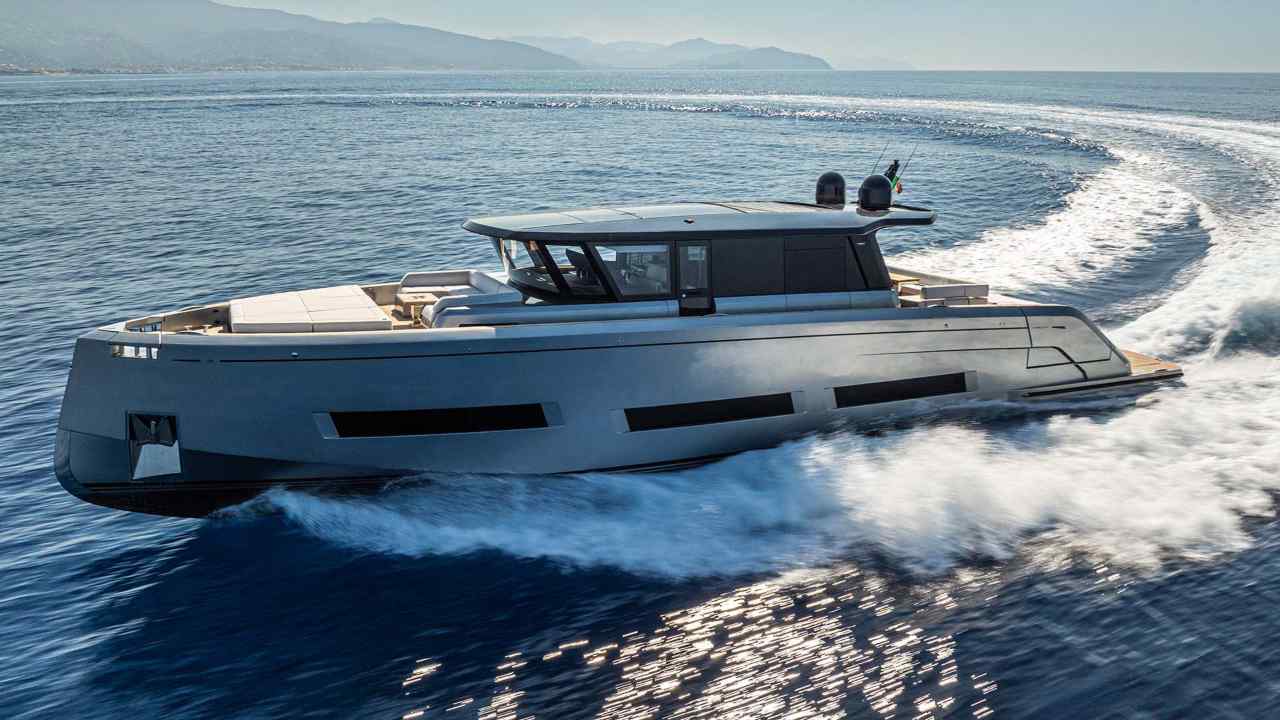
In the panorama of high-end express cruisers, the Pardo GT75 represents a step of scale and maturity of design: it is not only the new flagship of the GT series, but a technical poster that merges volumes from superyacht, ergonomies from “developed weekends” and a propulsive platform designed to be simple to govern even with reduced crew. The result is a yacht of almost 23 meters that interprets the fast cruise in a contemporary key: low visual center, pushed indoor/outdoor ratio, extended beach area and a carena optimized to work in symbiosis with architecture Volvo Penta IPS.
This technical review analyses the GT75 as an on-board expert: not only “how is it done”, but because it was so, which engineering compromises subdued and where it is placed compared to the direct competitors in the 70–80-foot segment.

Profile of the construction site: Pardo, culture of famine and industrialization “quality”
Origins and technical DNA
Cantiere del Pardo was born in 1973 with a clear vocation: building hulls capable of combining performance and usability, a tradition that has consolidated in the world of sailing (Grand Soleil) before extending in a structured way to the motor with the birth and expansion of the brand Pardo Yachts. This passage is not a simple “change of category”: it is the application to the engine of a typical know-how of the yards that grow with the sail, where the relationship between carena, weights, rigidity and behaviour on the sea is an integral part of the design process.
Constructive philosophy and market reputation
The reputation of the construction site is based on three pillars: recognizable stylistic identity (verse end, weaving lines, “low” superstructures), perceived quality (finish, materials, carpentry details) and an industrial setting that allows customization without losing control of processes. In GT75 this approach becomes evident: the model is offered with more layout and important alternative solutions (galley up/galley down, 2–4 cabins), but within a stable technical platform, designed to ensure repeatability and uniform quality standards.
Naval architecture and design: three signatures, one functional goal
Who signs what
The GT75 was born from a concept of Cantiere del Pardo, with naval architecture of Zuccheri Yacht Design e interior/exterior design by Nauta Design. This triple signature is not a simple label: it is the rational division of competences between those who optimize the famine and the drive integration, and those who govern the quality of space, light and ergonomics of living.
Family feeling Pardo, but with scale “superyacht”
The key stylistic elements (inverse bow, negative windshield, spindle and low profile) are not merely aesthetic exercises: they reduce the impact of the superstructure, lower the “visual mass” and contribute to that typical Pardo feeling of continuous proximity to the sea. In parallel, the walkaround layout is reinterpreted on 23 meters as a security and comfort solution: not only “for walking”, but for properly distribute flows between bow lounges, cockpit and poppiera area, avoiding bottlenecks during edge life and maneuvers.

Synthetic data sheet (main data)
- Length outside everything (LOA): 22,85 m
- Maximum garlic: 5,99 m
- Dislocation: 48,3 t
- Fuel tank: 4.300 l
- Water tank: 1.100 l
- Standard motorization: 3 × Volvo Penta IPS 1050
- Optional motorization: 3 × Volvo Penta IPS 1350
- Layout available: 5 configurations; standard Galley Up 3 cabins/3 bathrooms (+ crew)
- Beds: 4–8 (+ 2 crew)
- Transportable persons (EC): B20 / C24
Note: fishing can vary with loads and configurations; some industry communications indicate values around 1,65 m.
Dimensions and architecture: how to “disegnano” 6 meters of glare without losing sportsmanship
The glare: stability, volumes and cinematic spaces
A glow of 5,99 meters on 22,85 m of LOA is a choice that hangs directly on three aspects: stability, inhabitability e weight management. The initial stability benefits from the width, with an obvious contribution to comfort at displacement and radiant speeds; the habitability translates into a fully-glazed shipowning suite really “superyacht oriented”; weight management requires an accurate control of the high masses (hard-top, stained glass, furniture) not to penalize the dynamic behavior at the planing trends.
Low superstructure: aerodynamics and visual centerpiece
The absence of a “classic” flybridge is not only a choice of style. Technically it means: less exposed surface area (wind to the traverse in maneuver), lower weight in the top and possibility to have a more continuous main deck, where side openings and semi-open roof bring air and light without building “torri” over the belt line. The guide benefits: more neutral trim, less adjustment and a feeling of compact yacht compared to the real size.

Materials and construction: GRP composite and attention to detail “from Italian yard”
Exhaust and superstructure
In the segment, the most rational solution remains fiberglass composite/ GRP, with calibrated layers and reinforcements for torsion stiffness and vibration damping. Several industry data banks rank the GT75 as construction in fiberglass/GRP, consistent with the mission of the model: performance, finishing, manageable maintenance and durability in luxury charter.
The crucial point here is not so “what material is made”, but how quality is controlled: surface flatness, structural gluing, sound insulation in the machine room and attention to technical areas (accessibility, labelling, plant steps). These are aspects that determine the difference between a 75 feet “beautiful at the fair” and a 75 feet solid after 500 hours of motorcycle.
Interior: essences, tactility, maintenance
The Nauta language favours clear tones, legible surfaces and an amplified volume perception. The most successful approach of GT75 is the balance between material heat (extrusions, textiles) and practicality (protected surfaces, trampling areas, washable coatings, robust hardware). This is where the real vocation of the model is measured: not only “yacht from show”, but platform for long cruises and intensive use.

Propulsion and transmission: the choice of triple IPS as control architecture
Why three IPS (and what it entails)
The configuration 3 × Volvo Penta IPS is a technical statement: you are not only looking for power, but control. With three IPS axis lines you get: greater redundancy, more modulable thrust, ready accelerations and a maneuverability that, on 23 meters, radically changes the experience of the shipowner. The GT75 was born with IPS 1050 of series and IPS 1350 in option, consistent with a mission “GT”: fast cruise, quick transfers, and entry into port without stress thanks to joysticks and integrated logic.
Machine and maintenance room
On a triple IPS, the quality of the installation is evaluated on: access to filters, space for service belts and plants, ventilation, soundproofing and cleaning of passages. An important element emerged from tests and technical communications is the preparation of the machine room to accommodate a hybrid system: it does not mean that the hybrid is already installed, but that the yacht is set to not have to “turn” the platform at a later time.
Onboard systems: electronics, integration and domotics “realistic”
Navigation and bridge
The bridge of the GT75 is thought as “command center” true: three sittings and large displays, in a glazed context that favours visibility of maneuver. Modern philosophy is not adding tools, but integrating functions: navigation, IPS drive control, alarm management, tank monitoring and installations in one coherent architecture. In practice, the evolved owner looks for two things: readable interfaces and reduction of cognitive load when sea and traffic increase.

Domotics and plant management
On a 75-foot contemporary domotic is not a toy, but a tool to govern electrical loads, air conditioning, lights and utilities efficiently. The “right” approach is modular: robust systems, simple scenarios (night, navigation, satin), clear diagnostics. The GT75, with its vocation also charter, must guarantee reliability before even to amaze with special effects.
Performance, consumption, autonomy: credible numbers and what they really mean
Speed: the difference between “declared” and “measured”
With triple IPS 1350, sea tests report a recorded speed of about 34,2 knots under conditions not ideal, with indications that the yacht can approach 37 knots a famine and perfectly clean thrusters. In parallel, some market reviews place the maximum potential tip up to about 38 knots in the best configuration and trim. The correct interpretation, as a technician, is this: the GT75 is a 23 meters that manages to planare “piatto” and maintain a composite behavior, more than chasing absolute records.
Cruise and efficiency: the key data is “liters per mile”
The most significant data emerged from the tests is not the tip, but the cruise efficiency: about 20 knots, consumption is reported in the order ~11 liters for nautical mile (equivalent, in some tables, at ~3,0 gal/nm), remarkable value for a vessel that in test was also heavier than the displacement “ plate”. For the shipowner, this translates into a fast cruise that can be used without perceiving the boat as a disproportionate one.
Autonomy: the surprise is the displacement navigation
The GT75 is not a trawler, but knows how to “stay” in displacement: around 12 knots some tests indicate autonomous that they can reach about 700 nautical miles, with a high acoustic comfort and a “superyacht-like” driving sensation. It is a strategic point: it allows long, even night transfers, without turning the yacht into a 30+ knot disposable object.

Abitability, life on board and layout: five configurations, one logic of use
Galley Up vs Galley Down: choice of “use philosophy”
The choice between galley up e galley down not just about the kitchen: defines sociability. With galley up, the main bridge becomes the convivial heart, with lunches and preparations integrated into the living room and cockpit. With galley down, the kitchen descends on the lower deck and the main deck is free, turning into a large panoramic lounge: ideal solution when working with crew, because it naturally separates the “service” activities from the guest experience.
Cabine: the shipowning suite as a category benchmark
The bay of almost 6 meters allows a shipowning suite with all glare that is, technically, one of the strong points of the project: perceived amplitude, rational distribution of volumes, natural light and possibility to integrate vanity/writer and cabinets without sacrificing the passage. Configurations up to four cabins (in specific combinations), with dedicated bathrooms and a separate crew cabin, element that moves the yacht to a “semi-professional” (luxurycharter, seasonal management, long transfers).

Common spaces: continuity, light, ventilation
The main deck works by subtraction: large openings, sliding doors, windows and openable roof to achieve an environment that changes nature according to the weather. Closed, it becomes a protective hard-top, also suitable for winter cruises; open, it behaves like a great luxury open. It is a consistent approach to the current market: the shipowner does not want to choose between “summer boat” and “four season boat”, but he wants a project that can do both things with credibility.
Layout


Outdoor engineering: beach club, wall decals and transformability “from superyacht”
Pozzetto poppiero: space hierarchy
The stern is designed as a level system: important sunbathing, sitting, and a transition to water that can become a beach club to all effects. The most important engineering detail is the combination between wall decals and platform/transformer: it increases the useful surface, improves the usability in satin and reduces the psychological distance from the sea, which on boats of this size can become a limit if not handled well.

Garage tender: logic and compromise
The presence of garage tender, accessible with electric lifting of the sunbathing, is a typical equipment of projects “over 70 feet” and moves the asticella of premium perception. The compromise is known: technical volumes and stern weights must be controlled not to penalize thirst and noise. When integration is correct, however, the operating advantage is enormous: protected tender, cleaner blanket and greater safety in navigation.
Sea behaviour: manoeuvrability, comfort and “easy” by modern GT
Planata and trim
One of the most interesting signals reported in the tests is the ability of the GT75 of go to planata without marked trim variations: in technical terms, it indicates a correct combination of hull geometries, weight distribution and IPS thrust. For the owner means a more natural guide, less need for “corrections” and superior comfort for guests sitting in the lounge areas.
Screw and control
The triple IPS does not only serve to park well: in navigation it improves the feeling of control, with a prompt response and a manageable turn without “big boat routes”. The point is not to do sportsboat numbers, but to maintain a setting safe and predictable even when you ask the hull to work.
Noise and vibration
In the luxury segment, the performance is credible only if accompanied by comfort. Some tests describe contained sound emissions and a “soft” wave march: this depends on soundproofing, supports, installation quality and general rigidity. In other words: it is here that we see if the yard has reasoned from “builder of yachts”, not only from “builder of boats”.
Innovation and research: hybrid “ready”, efficiency and sustainability applied
Hybrid preparation: what really means
The word “hybrid ready” should be interpreted correctly: it is not marketing if it involves spaces, plant and logical steps of integration already considered in design. In GT75, several technical sources indicate a machine room designed to accommodate a hybrid system in the future, with the aim of reducing environmental impact and improving the experience in shaving (silence, load management, low-emission maneuvers). It is a direction consistent with the industry trend: not necessarily full electric, but intelligent hybridization where it brings real benefits.
Reduced consumption: the most effective way is the optimization of hull and propulsion
Before pursuing extreme solutions, the boat is returning to an engineering truth: sustainability gains with efficient care, well integrated propulsions and controlled weight. The GT75 seems to move in this direction: good numbers at 20 knots and efficient displacement cruising capacity. In a 23 meters, it is often more “green” a project that consumes less on equal mission, than a project that adds technologies without basic optimization.

Market, competition and positioning: where the GT75 really stands
Segment and target customers
The GT75 speaks to three types of customers: private shipowner that wants a fast cruise boat with strong outdoor living; luxury charter that needs flexible layout and immediate aesthetic appeal; company of representation that requires a recognizable product, “instagramable”, but also reliable and manageable in operation. The force of the model is the configuration versatility without losing project consistency.
Direct Competitor: three philosophies in comparison
Riva 76’ Perseo Super plays 76 feet as luxury sports-fly, with performance declared up to about 37 knots in specific configurations and a very “Riva” style setting, more iconic and formal.
Sunseeker Predator 74 XPS is a british yacht performance that moves on top speed around 38–40 knots depending on the engines, with a more “muscular” approach and a typical Predator layout.
Pershing 7X belongs to a different world: it is hyper-performing, with speed that can reach about 50 knots, where priority is absolute speed and high performance technology. It is an alternative for those who want a 70 feet “from adrenaline”, but it is not superimposable to the GT75 mission, which focuses on volumes and viability without sacrificing sportsmanship.
In summary: the GT75 stands as GT “inhabitable”, that is, a model that does not sacrifice experience on board in the name of pure performance, but maintains credible numbers for rapid transfers and a modern and controllable guide.
Extra Images


Results, awards and presence at fairs
Debut and media attention
The GT75 debuted at Cannes Yachting Festival 2024 as new flagship Pardo, attracting attention to the ability to scale the identity of the brand on a larger and more complex platform. The interest was also fueled by sea tests and international reviews, which highlighted the combination of aesthetics, ease of manoeuvre and cruise comfort.
European Powerboat of the Year 2025: nomination, no victory
The yard has communicated the selection/candidation of the GT75 for the European Powerboat of the Year 2025 in category 18–24 m. It is a signal of recognisability of the project; it is correct to remember that, for the edition 2025, the winner of the category “up to 24 m” was indicated in Cranks Sixty-two 62.
Future prospects: the GT75 as a bridge towards the next generation Pardo
The GT75 is interesting not only for what it offers today, but for what it anticipates: ever more modular layout, outdoor engineering from superyacht (beach club, side terraces), and a platform that looks at hybridization as natural evolution. In perspective, the model suggests a clear direction of the yard: to maintain a strong aesthetic language, but to make it grow on larger boats without losing the “easy” and simplified management that made Pardo a desirable name in the international market.
Video
Conclusions: to those who really “serve” a Pardo GT75
The Pardo GT75 is a yacht for those who want a 23 meters who can be three things at the same time: performance (planet composed, credible speed), habitable (volumes and layout from top yachts) and governmental (IPS triple, integrated logic, modern manoeuvrability). Its rarest quality is coherence: every design choice — from the low superstructure to the transformability of the stern, to the galley/cabin flexibility — meets a concrete, explainable and verifiable mission of use.
In a market where many 75 feet are or “floating waves” little dynamic or “floating” less liveable, the GT75 tries to stay in the middle with intelligence: a great sea tourism in the technical sense of the term, able to make travel fast and well, but also to stop in shaving and become a real house on the water.