
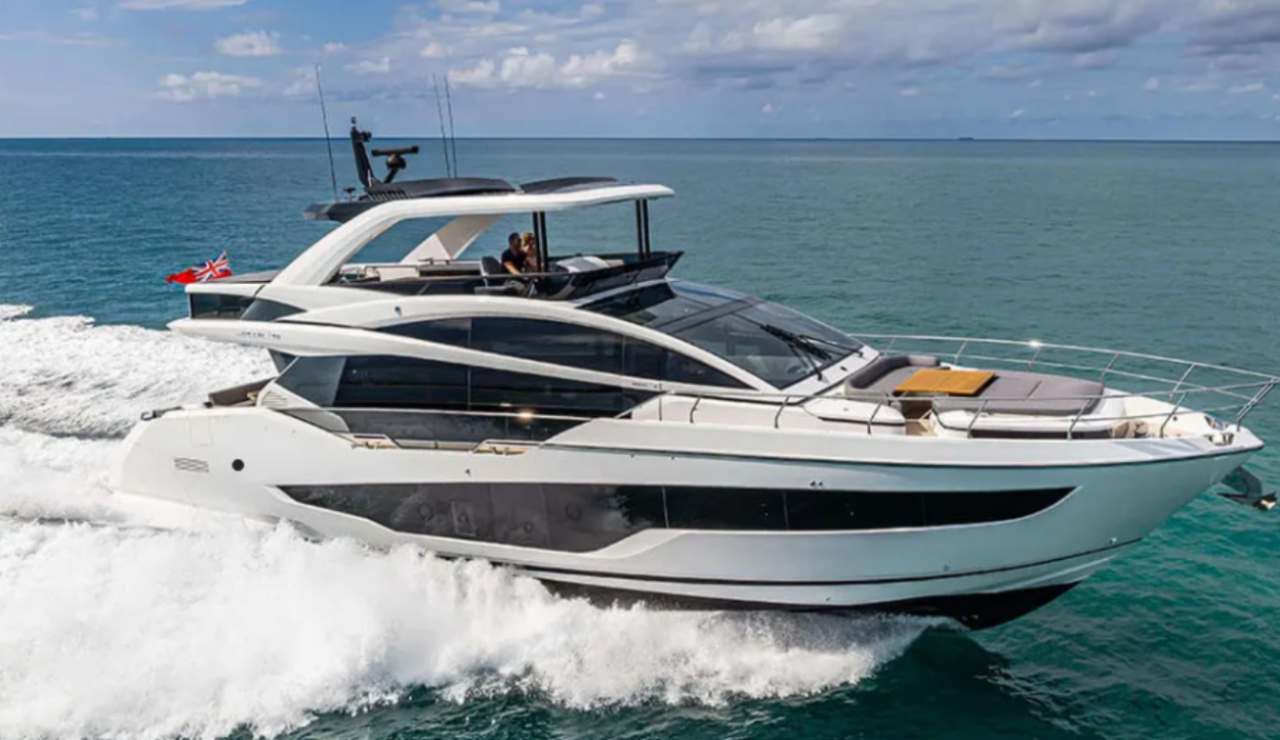
The Pearl 72 it is located in the 21–23 meter range of premium flybridges, with a setting that prefers usable volumes, privacy and dynamic comfort. Designed by Dixon Yacht Design for carena and outdoor style and furnished Kelly Hoppen for the interior, 72 proposes a rare distribution solution: two armed suites – one bow with private access and a full beam in the middle of the boat – flanked by two en-suite guest cabins. The naval architecture adopts a planing famine in GRP optimized for the typical mid-high cruise of the Mediterranean, maintaining a dry and predictable guide even with short wave.

Site profile: history, philosophy, reputation
Origins and identity “boutique”
Founded in 1998, Pearl Yachts born from the vision of the former commander Iain Smallridge, initially flanked by John Yarnold and, since 2003, supported by investors Tony and Margaret Whittaker. The stylistic figure of the brand is that of a boutique builder: few models, but recognizable, with stable design partnerships (Dixon for architecture, Kelly Hoppen for interiors), close quality control and a manic focus onusability real space. This footprint allows Pearl to propose unconventional distribution solutions, such as double shipowning suite introduced on 72.
Market recognition and perception
The reputation of the yard has grown thanks to a content/competitive price ratio and industry awards. Pearl 72 got the “Judges’ Special Award” (a) Motor Boat Awards 2023 and the “Best Interior (19–24 m)” (a) World Yacht Trophies 2023, to prove the quality of the project and the value perceived by industry.
In-depth technical analysis
Dimensions, hull and naval architecture
Pearl 72's hull is a variable deadrise planant, with a corner in the stern mirror that favors the compromise between transversal stability to low regimes, comfort in planata and efficiency of push with propellers of contained diameter. The wide hull openings are integrated by structural shoulders that stiffen the bandage, while guaranteeing natural light to all cabins. The width of 5.75 meters, in the category, enables a useful volume above the average, translating into more generous corridors, larger bathrooms and better accessible technical spaces.

- Full proof with important volumes to accommodate the second shipowning suite without compromising the technical gavones.
- Expansion of bow balanced to avoid dry impacts on the short wave; backed live edges for contained splashes.
- Charges transfer studied to maintain the center of the “window” ideal even with unbalanced tanks.
Building materials: hull, superstructure, interior
The building is in GRP (vetroresin) with differentiated laminations: more robust stratificies in high load areas (kid zone, bulkheads, machine room) and targeted overstructure lightenings to reduce the weight. The exterior finish, typical of British store yards, focuses on high UV resistance gelcoat. The interior, signed Kelly, articulate coherent material and colour palettes (measures like “Indulgence”, “Modern” and “Luxury”) with veneered essences selected, natural stones (Onice/Calacatta), brown metals and tactile textured fabrics.
Motors, propulsion and transmissions
The engine range usually provides MAN V12 1.400 hp as standard and option MTU 10V2000 M96L 1.600 hp for those who prefer the maximum speed and a more full torque to the average regimes. The transmission is on axle lines with fixed-step propellers optimized. The choice not to adopt IPS on this size and setting is consistent with the search for robustness and predictability at the long distance, as well as with easier access for ordinary and extraordinary maintenance in the machine room.
- Governance: generous timones, steering ratio adapted to the guide in the planata; manoeuvre joystick available in option via thruster integration.
- Reduction: ratios calibrated on helical curves that favour the push at 18–26 kn, where 72 spends most of the hours of real cruise motorcycle.

Performance: speed, cruise, autonomy, consumption
Tests collected on units with MTU 2×1.600 hp indicate a maximum by32–33 nodes and one cruise indicative around 23–25 nodes, with consumption compatible with the segment and a useful autonomy that, at project speed (24 kn), allows for ~200–220 nm routes including security reserve. Displacement regimes (~12–13 kn) see a significant increase in autonomy, useful for uncertain weather transfers or to optimize nightlife consumption.
Onboard systems: electronics, home automation, navigation
The steering wheel (main deck + fly) integrates multi-display for cartography, solid-state radar, autopilot and motor data management. The boat is prepared for networking NMEA/eth with monitoring tanks, levels and technical alarms. Domotics allows the management of light/climate scenarios and curtains, while the cabin crew hosts a control panel that replicates the main edge readings for 360° supervision.

- Stabilization/assessment: interceptors Fast response humphree and optional electric fins for comfort in navigation and “zero speed”.
- Energy: electrogen groups for hotel loads (HVAC, kitchen, AV systems) with soundproofing and anti-vibrating supports.
- AV & connectivity: Zone distribution with independent sources; 5G/Starlink preparation on request.
Ergonomics, acoustics and vibrations
On a 20–24 knot cruise, 72 shows a acoustic signature contained: flooring on antivibrating mats in sensitive areas, HVAC channeling with sweet curves (to reduce smoothies) and bulkheads with high critical mass between night sections. The rudder benefits from a sitting with lumbar support and correctly spaced commands; the angle of visibility at the bow remains wide even with more “pointed” trims thanks to interceptors.
Interior design, layout and architecture
The living room adopts a central galley that acts as a hinge between cockpit and bow dinettes: a modern setting that facilitates service and conviviality. Wide stained-glass windows eliminate the boundary perception between interior and exterior, while the choice of materials – noble woods, stones, browned metals – gives a “visual weight” important, balanced by colour palettes designed not to affect the eye during the evening use.
- Suite in the centre of the boat full beam with large windows, walk-in closet and separate private bathroom.
- Bow Suite with dedicated access from the salon, a solution that protects the privacy of guests/owners.
- Cabins guests en-suite in the center of the boat, configurable twin/double with systems “scissor” on request.


Innovation and research: efficiency, emissions, safety
- Electronic trim control (Humphree): reduces response times compared to traditional flaps, improves the incidence angle to vary the load and contributes to comfort on the beaking.
- Electric stabilization: low absorption fins, less maintenance than hydraulic systems, reduced noise.
- Natural lighting: large development hull windows with structural reinforcements, for the benefit of day energy autonomy (less use of artificial lights).
Life on board and comfort
THEoutdoor area combines a shady cockpit, a viable bow with sofa/preneurship and a modular flybridge organized in three areas (lunch, bar/wetbar, relaxation/preneurship with jacuzzi). The hydraulic poppiera platform facilitates tendering and ensures continuity with beach club optional. In charter, the layout allows separate flows crew/hosts without interference.

Technical plants, HVAC and onboard energy
- HVAC: multi-zone air conditioning, with low-speed loudspeakers in the sleeping area for acoustic comfort.
- Electrical system: separate paintings for essential services and “hotel loads”, logic of load shedding to avoid peaks; advanced inverter/charger predisposition for “green” moorings.
- Water & Treatment: tank ~950 L, optional reservoir for extended autonomy; boiler with thermal recovery from motor circuits when on the move.
Maintenance, accessibility and security
The machine room offers adequate passages around groups and easy access to filters. The fireworks, detectors and system fixed firefighting compliant with the application category, while the cable/tubation passes are sealed for real compartment. Sea catches are ordered and reported, with clear labelling for rapid interventions.
Navigation performance: tests, feelings and professional feedback
With sea 3–5 ft and colds 20–25 mph, test reports highlight a boat dry, which prefers progressive input to the rudder and returns clean trajectories without nerve corrections. The climb to the bridge is sweet, without “good” at half the torque curve; and the interceptors help you quickly set the ideal setup with variable loads and speeds. In narrow waters, the axle + thruster (with optional joystick) allows for composite movements, with pairs to manage on the timones in the event of a sustained cross wind.

Market and competition
Positioning for price and segment
Pearl 72 takes over core segment 70–75 feet. The real price depends on motorizations and equipment, but recent listings and announcements place the unit around $4,6–4,75 million (US market) or ~€4.0–4.1 million in Europe for new/seminew units with complete packages. It is a position aligned to the top-tier British and Italian brands, justified by interiors signature and a high level technical equipment already in standard configuration.
Direct competitor analysis
- Model
- Dimensions (L×B×T)
- Max performance
- Fuel / Water
- 21,99 × 5,75 × 1,70 m
- ~32–33 kn (2×1600)
- ~4,25–4,34 m3 / ~0,95 m3
- 21,77 × 5,52 × 1,72 m
- ~32–35 kn
- ~4,50 m3 / ~0,91 m3
- 22,30 × 5,60 × 1,80 m
- ~28–32 kn
- ~4,60 m3 / ~1,00 m3
- 23,02 × 5,73 × 1,63 m
- 34 kn
- ~5,00 m3 / ~1,20 m3
Competitive Strengths of Pearl 72
- Double Armoured Suite: a unicum in size, ideal for co-owners or luxury charter with two “primary” pairs.
- Design (Dixon/Hoppen): strong aesthetic identity and perceived quality “from superior size”.
- Sea package: garage for tender + PWC, hi/lo platform and optional beach club without penalizing the internal volumes.
- Dynamic comfort: stabilization and active trim that reduce fatigue and make the gait more “solid”.

Trade-off and considerations
- The fuel capacity is slightly lower than some 75’ (e.g. 5,000 L), but weight optimization and the efficiency of the assembly bridge the gap in the typical Mediterranean use.
- The price is aligned with the reference marks; however, the provision “ready-to-cruise” reduces the number of expensive options needed.
Customer targets and employment scenarios
- Private owner with family that wants privacy (dedicated bow suite) and acoustic comfort level.
- Luxury Charter that enhances the four en-suites and the double main suite to maximize the appeal on couples/families.
- Corporate hospitality for static events in the marina: exhibition “vetrina”, vivable bow and scenic flybridge.
Engineer depth
Weight distribution and center of gravity
The 72 layout displaces the “strong” weights (motors, generators, tanks) in the middle of the boat, close to the point of maximum thickness, to contain inertia moments and reduce the efforts on the beaking. The presence of beach club and the hydraulic platform is counterbalanced by an ordered machine room and by central technical volumes. This setting contributes to neutrality of arrangement on wide speed range.
Carena hydrodynamics and thirst
The geometry of the sections allows you to maintain a moderate angle of incidence in planata, with distributed pressures that limit impact vibrations. The interceptors act on the terminal portion of the mirror, generating a controlled door that allows retaliation the longitudinal arrangement in a few seconds. This results in time-to-plane reduced, better visibility from the rudder and consistent responses to load changes (mowers, guests, tender).
Torque structure and rigidity
Choosing large hulled glass requires careful design of structural shoulders and wallpapers: localized stiffness and bonding as a rule of art avoid “samplings” perceived in movement with transverse short wave. The result is a feeling of “monolicity” that, combined with effective technical insulation, limits noise and creaks even on repetitive waves.
Perceived roughness and microclimatic comfort
Floor thicknesses and elastic band supports reduce vibrational transmission. The channeled HVAC network is low-speed in cabins, with independent sensors to balance temperatures. In the living room, natural brightness reduces the use of artificial daylight, containing electric loads and heat generated by light sources.
Beach club operation and tender management
Hydraulic Poppiera Platform simplifies tendering/lifting (typically a Williams 345) and a PWC housed in the garage. The ♪ optional folding extends the available surface in satin. The free height and the suspension points are dimensioned for safe operations with sea “da rada”.
Image gallery


Future prospects and impact on the construction site
Pearl 72 represents the maturity pearl strategy: maximizing volumes without yielding to the indiscriminate growth of lengths. The double shipowning suite imposes a new standard in size, while electrical stabilization, active and advanced automation track the route towards more comfortable yachts, easy to live and to lead. stylistic coherence with superior models (82/95) suggests a roadmap clear: targeted increases in energy autonomy, additional acoustic optimizations and refinement of the flow of crews/hosts.
Video
Conclusions: positioning in the sector
The Pearl 72 distinguishes itself as a product smart e aware in the heart of segment 70–75’. The setting owner-centric with double main suite, the perceived quality “from 80 feet”, the complete sea package (garage + platform + beach club), the electrical stabilization and the active setup make it a sharp weapon for fast Mediterranean cruises and premium charters. To this is added a recognizable aesthetic story – Dixon out, Hoppen inside – that cements the value over time and protects the investment in resale optical. Trade-offs (fuel capacity less than some 75’ and price aligned to top brands) are compensated by a content/environment among the best in class. For the shipowner who wants character, comfort e identity without pursuing greater measures, Pearl 72 is, today, one of the most convincing choices.