
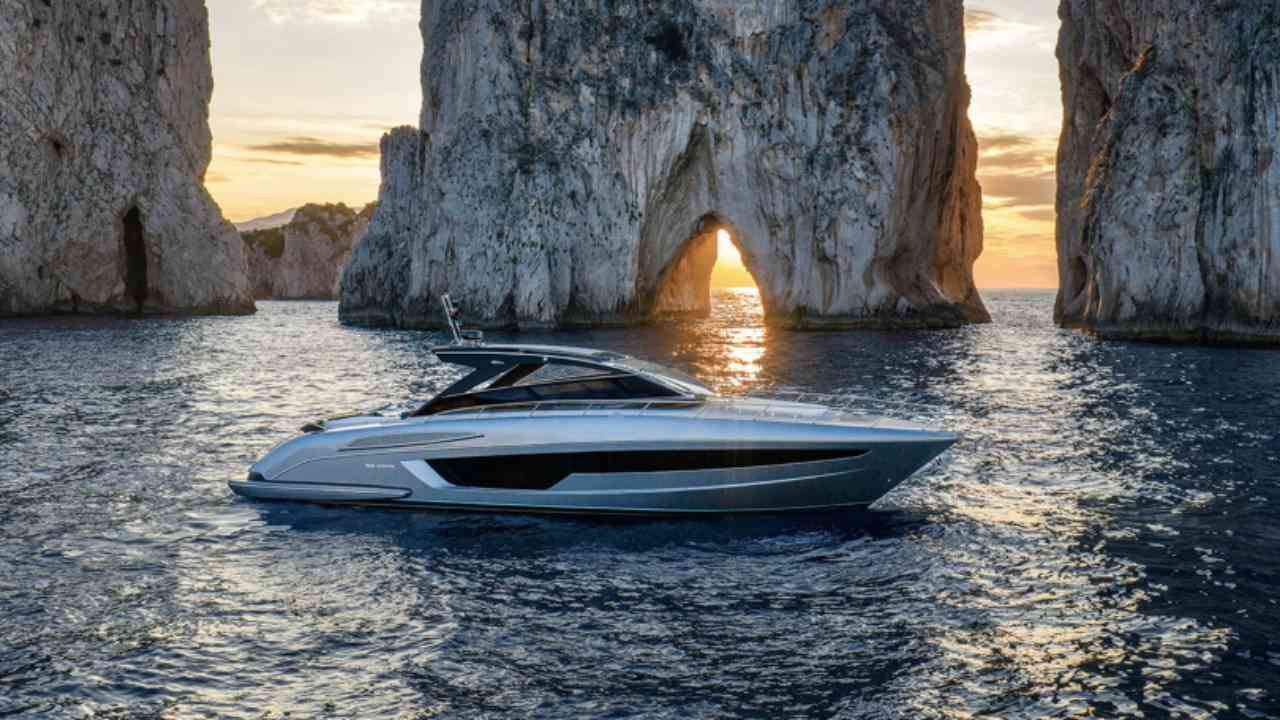
The 58’ Capri New interprets the open sport with a lexicon contemporary design: very low profile, hard-top integrated in the silhouette and hull optimized to maintain high cruising speeds with consumption under control. It is a boat that speaks the language of the rewarding guide but that, at the same time, puts in the center the real habitability, from the ergonomics of the well to the silence of the lower deck. With a length out all around 17,3 meters and a bay close to 4.7 meters, it offers stretched and lively proportions that anticipate its vocation: crossing the sea quickly, clean, comfortable.
A project built around the user experience
Nothing is left to chance: the hard-top is not an addition but a supporting part of external architecture, the distribution of volumes favors fluid passages and the variable layout of the cockpit allows to change function with few gestures. In this way, the boat remains faithful to the most refined tradition of the brand and, at the same time, adapts to the typical Mediterranean days: fast transfer, shave, lunch on board, diving and evening return.

The yard: identity, method and positioning
Historical roots and industrial continuity
The name Riva has been synonymous with Italian construction excellence for decades. The transformation from wooden icon to reference in composites has not excavated its figure: surface perfection, precision in detail, rigour in the assembly chain and quality control that is perceived at a glance. The 58’ Capri New fits into this trajectory with the goal of opening a formal and technical language intended to extend over other lengths.
Project philosophy
Philosophy is simple to state and complex to realize: beauty that descends from function. Clean lines are not an orpello but a result of measured engineering choices, from weight balance to technical volume integration.
Market performance
In segment 55–60 feet, Riva plays a game that is not only aesthetic: perceived reliability, widespread assistance and residual value push many shipowners to prefer brand continuity. The 58’ Capri strengthens this position by proposing a recognizable product and, together, able to interpret modern expectations: ease of conducting, acoustic comfort and plug&play of systems.
Dimensions and naval architecture
Main geometry
- Length outside everything~17,27 m
- Maximum~4,74 m
- Target fishing~1,60 m
- Tanks: fuel ~2.300 l; water ~530 l
- Dislocation: about 28 t vacuum, ~32 t full
The ratio of length and glare suggests a hull that searches for wet surfaces contained in the high ranges, with a push centre positioned to support the hard-top and glazing without penalizing the arrangement. The moderate fishing allows easy access in rada and in the ports with reduced backdrops, characteristic appreciated in Mediterranean contexts.
Expected water lines and behaviour
The poppie sections indicate a deadrise that remains “live” enough to damp the impact on the short wave, while the bow works to deviate the spray and keep dry the prodiera area also with wind of traverse. The start in the plan is rapid but progressive; the short and tidy trail confirms the efficiency to typical cruise regimes.

Materials and construction processes
Scafo and superstructure in composite
The 58’ Capri employs laminated in GRP with localized reinforcements in correspondence of punctual loads (hard-top base, set bases and bitten attacks). Where rigidity and insulation are needed, sandwich panels with variable density core are adopted. The care in print and post-work results in the typical mirror finish of the brand, which is also an index of structural uniformity.
Internal finishing and durability criteria
Inside convivono selected essences, UV treated skins, lightened stones and brushed metals. The parts subject to stress and vibration have elastic joints and anti-scribing systems; the coatings are chosen to resist the salsedine without losing tone, with attention to the igiencity of surfaces in frequent contact.
Propulsion, transmission and engine systems
Motor packages
- Configuration A: 2 × V8 ~1000 mhp
- Configuration B: 2 × V8 ~1200 mhp
The two solutions cover different profiles. The first points on a balance between performance and operating costs; the second search for power margin to maintain high averages even with important loads or sea formed. In both cases, the delivery is linear and the “time to plane” is contained.
Axis-line transmission
The choice of axis lines favours simplicity, robustness and mechanical predictability. The propellers are selected to minimize cavitation and vibration at the typical cruise speeds; the angle of incidence is optimized to contain losses and maintain the balanced arrangement to various fuel and water loads.
Auxiliary equipment and machine room
To support the propulsion we find sea water circuits with easily inspectable filters, silenziatori dimensioned to reduce the acoustic emission to the deck and multilayer insulation. The machine room, organized for walk-around inspections, allows quick interventions on filters, separators and ordinary maintenance points.

Performance, trends and autonomy
Speed and trim
With engines of about 1000 horses each, the maximum speed is placed around the 33 knots and the cruise backed is around the 27 knots. With the 1200-horse step on the side, the tip grows up to about 37 knots, while the comfortable cruise is located around 31 knots. The set remains composed, with trim corners that maintain excellent visibility from the dash even when pushing on the handcuffs.
Consumption and range of action
I tanks of about 2,300 liters provide adequate margins for rapid crossings typical of the Mediterranean weekend. In cruises around 27–31 knots, practical autonomy is around 200 nautical miles, variable with sea, loads and motor electronics settings. The consumption curve is homogeneous: when speed grows, the more powerful engines work at lower load rates, improving relative efficiency.
Onboard systems: electronics and home automation
Integrated bridge
The bridge hosts instrumentation aligned to the class: large multifunction display high readability, digital interfaces for power management, autopilot and control. The ergonomics is centered on the “single-point control”: the timoniere rules propulsion, trim and aids in a glance, with natural posture and armrest designed to reduce fatigue.

Automation and energy management
Domotics coordinates lighting, air conditioning, entertainment, pumps and water services. Preset scenes allow you to switch from the “navigation” profile to the “night break” or “port” mode with a touch. Energy management optimizes the use of generators and inverters, reducing noise and consumption, with battery charging cycles designed to extend their useful life.
External design, interior and layout
Externals: adaptive cockpit
The well is born as a multifunctional platform: living during navigation, dining at anchor, lounge at the end of the day. Transformable table, modular chairs and sunbeds that extends over the garage create three usage scenarios without redesigning the spaces. Discrete but strategic and secure handrails support operational safety.
Hard-top and natural ventilation
The hard-top channels the air flow, limits direct irradiation and increases thermal comfort in the cockpit. The dedicated openings give way to creating effective natural ventilation, useful to reduce the use of air conditioning during summer navigation.
Interior: philosophy of “silent comfort”
The lower deck offers two settings: two cabins plus accommodation crew, or three cabins for shipowners who provide frequent hospitality. The shipowning suite is centered to benefit from the maximum glare and less dynamic stress; the bow VIP exploits the longitudinal volumes with suspended furniture and large passages. The living area at the lower deck serves as a social zipper with full kitchen and generous storage.


Innovation, efficiency and safety
Hydrodynamic efficiency
The hull is optimized to stabilize the trim at the cruising runs, reducing the lost energy in the wake and the peak of resistance in the displacement-planned passage. The result is a “neutral” navigation that results in lower consumption and greater comfort, even when the wave is short and disordered.
Reduction of emissions and thermal management
The combination of propulsive efficiency and intelligent management of electric loads allows generators to work for shorter periods and more favourable regimes, with benefits on background noise and overall emissions. Insulation of the machine room reduces heat transmission to the living rooms, improving air conditioning performance.
Stabilisation and safety systems
Stabilizers are available to hold the roll in both navigation and anchor. The passive safety architecture includes calibrated antisdrucciolo, tientibene positioned where it serves and a layout of the technical equipment that makes periodic controls easy. Design aims to reduce operational errors, simplifying daily routines.
Life on board
Cabins and bathrooms
The shipowning cabin extensively exploits the bay and acoustically isolates the head read from the technical wallpapers. The bathrooms are designed with full height shower, easy to maintain surfaces and careful management of the slopes for disposal. The bow VIP, with the shape of the hull, adopts furnishing solutions that maximize the perception of width.

Areas day
The living area at the lower deck is designed as a versatile living room: conversation, media and dining alternate without path conflicts. The kitchen has durable floors, almost domestic appliances and crockery and cambuses in centering, so as not to compromise the weights.
Outdoor areas and access to the sea
In the aft, the area above the garage opens to become a real water flush relaxation platform. Stairs, tientibene and non-slip coatings are dimensioned for frequent entrances and exits from the sea, with separate water routes to avoid unnecessarily wetting the well.
Dynamics at sea: tests and perceptions
Vibro-acoustic comfort
The perception of the rudder is very compact: the boat does not “sound”, does not vibrate and does not transmit dry blows, also tightening the course on short bow waves. The voice of the engines is full but filtered; the work of the deadrise that breaks the wave without distractions is felt at the hull.
Screw and control
The entrance to the curve is progressive and predictable. The roll angle remains under control and the rudder returns feedback consistent with lateral acceleration. On exit, the bow closes the trajectory without waste, sign of a correct weight distribution and well-sized propellers.
Market and competition
Segment and relative price
The 58th Capri guards the high open band between 17 and 18 meters. It is aimed at those who want a product with strong aesthetic identity, superior finish and concrete performance, without pursuing extremities. The balance between brand value, equipment and performance justifies a premium positioning.
Direct competition and differences
- Azimut S6/S7: strongly sporting approach, sometimes with alternative transmissions; great exploitation of internal volumes.
- Princess V55/V60: focus on comfort british and soundproofing, very careful finishes and long cruises.
- Sunseeker Predator 60: accentuated external personality and performing setting, with rich features.
- Pershing 6X: higher point speed thanks to different propulsion philosophy, aggressive look and soul “driver pure”.
Compared to these names, the 58’ Capri focuses on the combination of sober elegance, a feeling of solidity and daily usability. The choice of axis lines favours “marinaresco” behaviour and linear maintenance.
Target customer
Experienced private shipowner, often with skipper support or a trusted technician in the most intense season stages; alternatively, high-end charter companies that intend to propose premium weekends for couples or families, with standards of comfort and consistent image with demanding clients.

Results and visibility
Fairs and awards
The apparitions in the main nautical events confirm the role of 58’ Capri as a manifesto of a new generation Riva voted to usability without sacrificing the class. The product is suitable for applications and shortlists in categories related to design, acoustic comfort and construction quality.
Evolutionary perspectives
Range development
The project lets you glimpse a complete family: more compact models for daily cruises and larger variations for those who want extra cabins, extended autonomous and additional technical equipment. The conductor wire remains the purity of the lines and ease of conduction.
Refining areas
In the next production cycles, the introduction of efficiency packages and further optimizations on power management are plausible. The constant search for weight reduction in high parts and NVH containment can generate even more comfort and an even more neutral dynamic response.
Iconographic deepening


Engineering synthesis sheet
- Category: open sportsman with hard-top
- Dimensions: LOA ~17,27 m; bay ~4,74 m; fishing ~1,60 m
- Capacity: fuel ~2.300 l; water ~530 l
- Dislocation: ~28 t (empty), ~32 t (full load)
- Propulsion: 2 × V8 in two power steps (~1000 / ~1200 mhp)
- Transmission: axis lines
- Benefits: Vmax ~33–37 kn; cruise ~27–31 kn; typical autonomy ~200 nm
- Layout: 2 cabins + crew or 3 cabins; modular cockpit
- Distinguished points: level finish, acoustic comfort, immersive guide
Technical evaluation and final positioning
Measurable strength points
- Project coherence: style and functionality proceed in parallel, without obvious compromises.
- Perceived quality: surfaces, couplings and vibro-acoustics place the boat in the upper segment.
- Guide: the rudder returns a full and progressive feedback; the setup remains legible in every condition.
- Modularity of spaces: adaptive cockpit and cabin options cover different usage scenarios.
Compromises to consider
- Axis line: compared to systems with active trim management, it sacrifices some efficiency points to low regimes, however gaining in predictability and robustness.
- Hard-top: comfort and protection are excellent, but require attention in weight distribution to preserve full-load neutral trim.
Video
Overall rating
Riva 58’ Capri New is an open substance that prefers concreteness to the special effect, while maintaining an elegance that has no equivalent. It is thought for those who want a boat capable of running fast, consuming with measure and offering high level comfort, without sacrificing the image of a brand that has written important pages of the boat. In a crowded competitive landscape, it stands out for the sum of details that count every day: ease of use, silence, finish. This is where the project really makes a difference.