
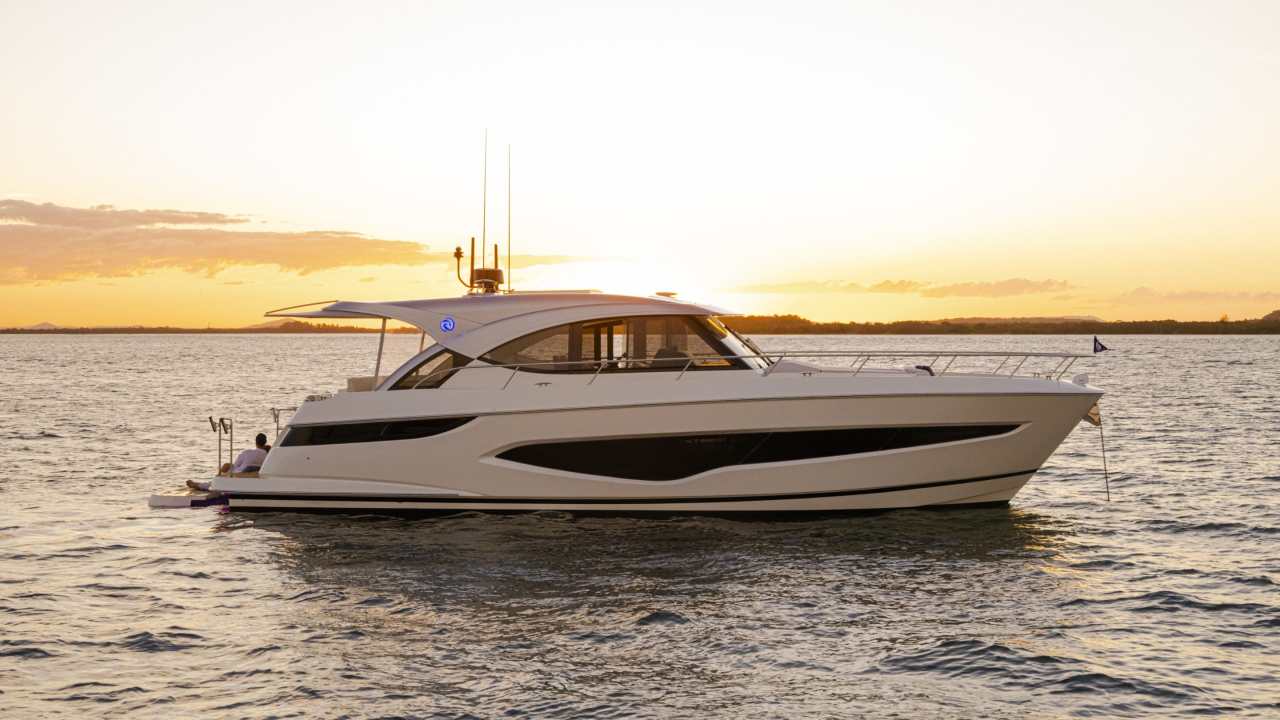
The construction site: industrial roots and design culture
Riviera born and grows in Australia, where the pleasure boat has always lived with weather and marine conditions that require structural robustness, simplicity of management and reliable planting. The industrial trajectory of the brand, developed in the area of the Gold Coast, tells the desire to preside over the 40–60 feet band with a careful series production, capillary quality controls and an organizational design in which design, lamination, assembly and testing dialogue closely. The international installed base, particularly strong between Pacific and North America, strengthens the brand's reputation as a manufacturer able to combine “ocean” solidity and a stylistic taste closer to global standards.

Ship geometry and main measures
Carena optimized for pod: balance between portanza and penetration
The 4300 Sports Express has been sized around a hull V variable with generous bow volumes, designed to interface to the best with the forward-oriented pod propulsion. The immersed surfaces confirm the objective of a soft entry on the wave and a transversal stability sufficient to reduce the lateral accelerations. Sustainability skates and stern exits are shaped in order to support the boat in the rise phase, keeping a natural trim without artificial supports. The distribution of solids and voids along the keel, together with a baricentric positioning of weights, works for progressive behaviour in narrow turns and an efficient drainage of flow in the wake.
Dimensions and volumes
The proportions of the model place the 4300 in the heart of the sport-express segment:
- Length outside everything: around 13.9 m
- Maximum: about 4,45 m
- Fishing: in the order of 1,2 m
- Fuel capacity: about 1,200 litres
- Fresh water capacity: around 400 litres
- Dry Dislocation: around 13 tonnes
This dimensional metric, with an important glare compared to the length, allows the yard to orchestrate a "hybrid" day area between inside and well, while under deck two cabins and a bathroom without sacrificing the useful height. In maneuver, the mass contained and the lever of the pods favor quick answers also in cramped spaces.

Materials and processes: structural composites and vibration damping
Exhaust and superstructure
The enclosure is laminated in fiberglass with polyester/vinylite resins, differentiating thicknesses according to the expected stresses. High load zones—such as motor bases, pod supports and scaffold joints—receive excessive reinforcements to break down any local flexions. In the superstructure, the use of core closed cells increase stiffness to equal weight, while chemical adhesion and mechanical coupling flange fixings ensure torsion continuity and absence of creaks over time. The care of bonding, often neglected, is actually an essential hub for perception of quality and silence on board.
Internal carpenters
In the interior, specific low weight panelling with light wood finishes and technical surfaces in service areas. The bulkheads, resined the madmen to the structure, stiffen the hull beam and distribute the loads, contributing to damping resonance and vibration. Generous seals around doors and barrels, plus careful sealing of cable passages, reduce aerodynamic whistles and acoustic transfers between the machine room and living room.
Propulsion and transmission: IPS ecosystem and control logic
Motor configurations
The project includes pairs of Volvo Penta D6 combined with transmissions IPS in scalar sizes: IPS600 (2×440 hp) covers the requirements of the majority of shipowners, while the IPS650 (2×480 hp) step offers extension margins and torque reserve in the presence of high loads or additional equipment. Pod transmission, with counter-rotating propellers pushing towards the bow, reduces the induced losses of the axis lines and improves overall performance at medium-high speeds.

Handling and joystick integration
The joystick of series lowers the learning curve in port: rotations on the spot, side translations, clearing of the apparent wind become intuitive operations also for those coming from smaller boats. Electronics coordinates the couple of pods and the steering angle, offering linear inputs and preventing “short” movements. In combination with the autopilot and the glass cockpit, the experience of conduct approaches a fly-by-wire nautical with gradual and logical support levels of coherent fail-safe.
Dynamic performance and consumption
Speed profiles
The Riviera 4300 SE, with adequately dimensioned and clean hulls, expresses maximum speed in the order of 31–32 nodes in the most powerful configuration. The “performance” cruise regime—in which acoustic comfort, consumption and trim align—is attested between 24 and 27 knots. In this performance corridor the boat flows naturally, with an impennated trim and visibility from the rudder that remains wide even in the transition phases.
Consumption and autonomy
The sum between efficient fairing and pod transmissions—notes for the best propulsion efficiency— translates into consumption by lesser mile than traditional axis lines to equal use scenario. The tank fuel, around 1,200 litres, allows coastal crossings without supply anxiety, maintaining a reserve margin for changed weather conditions. The autonomy, of course, function of speed, loads and state of the sea, is suitable for typical cruise strategies of the Mediterranean and the Atlantic coast of North America.
Onboard systems: electronics, home automation and plants
Digital command bridge
The bridge adopts the paradigm of glass cockpit with multifunctional screens that aggregate cartography, radar, engine data and service management. The interface offers customizable pages, contextual alarms and sensible redundancies for critical information. The autopilot dialogues with the joystick for coordinated maneuvers and preset paths, while the AIS and environmental sensors complete situational awareness.

Electrical and hydraulic systems
The electrical system balances utilities in AC e DC with inverter/charger sized to support shaving life. The air conditioning system operates on separate thermal zones, with attention to the noise perceived at night. The hydraulic section integrates boilers and pumps with variable capacity to reduce frequent ignition cycles; critical circuits, such as felt and fire-fighting in the machine room, are duplicated with level alarms and temperatures to anticipate risk situations.
Design and layout: three-dimensionality of outdoor spaces
Organization of outdoor environments
The experiential heart of the 4300 SE is the breakdown of the external bridge in functional levels: the stern platform operates as waterfront for contact with the sea and dinghy operations; the central well welcomes conviviality and culinary preparations thanks to the kitchen block at the threshold, able to serve inside and outside; the front sun or on the rigid roof offers a third environment accessible in slow navigation and stall. The passers are wide, continuous, with tientibene in intuitive positions: simple but decisive elements for perceived safety.
Cabin and living room
THEhard-top, with sliding opening, naturally ventilates the environment and creates a visual continuum between sky and sea. The dinette faces the kitchen, while the control station—with adjustable seat and lumbar support—is designed for long permanences to the rudder. The extended glazing eliminates shadow cones and heat stagnations, improving the driver’s attention and the crew’s housing quality.

Lower deck
Undercover we find the forward shipowning cabin and a second cabin dedicated to guests, plus a bathroom with independent shower. The furnishings, sober and contemporary, favour easy to maintain surfaces and generous content volumes. Artificial LED lighting with balanced colour temperatures promotes a relaxing atmosphere without sacrificing functional visibility in service spaces.


Applied innovation and environmental efficiency
Reduced consumption and emissions
In 4300 SE, innovation is not the spectacular gadget but the sum of consistent choices: pod propulsion for better performance, weights controlled in superstructure, glass surfaces treated for IR cutting, modular air conditioning to limit absorption peaks. The result is a boat that, at equal use, burns less fuel and reduces radiated noise, two concrete benefits in the daily life of the shipowner.
Safety and stabilization systems
Passive safety is manifested in the robustness of the structural joints and in the hold of the plants; the active one in the diffuse sensory and in the non-intrusive alarm logic. On board it is possible to integrate stabilization solutions on request, useful to attenuate the roll to anchor in crowded bays or with residual ondous motion. More generally, onboard architecture is designed to give early evidence to any anomalies, allowing punctual interventions before problems turn into boat stops.
Life on board: real usability and micro-rectual daily
Use habits and flow of movements
A boat is judged in the details: where to place a tray while opening a tientibene, how to bypass a dinette with a child by hand, how to circulate the air during a long stop without always depending on the electrogen group. On 4300 SE these micro-rectuals have been studied: the kitchen block facing cockpit favors service, the steps are continuous and the number of steps is reduced. The platform of poppa, with a well sized scale, it becomes a natural extension of the day to the sea; coming back, courtesy lights and handrails in a logical position accompany the movements in safety.

Boots and maintenance
The theme of boots is solved with accessible compartments, sturdy hinges and cushioned closures. Technical spaces—such as the place under the pagliolato of the well—accept mandatory safety equipment and small spare parts at hand. The machine room is organized to reach filters, separators, oil outlets and valves without twists: a fundamental premise to keep the boat in efficiency and reduce workshop time (and costs).
Sea trial: rudder perceptions and comfort in navigation
Directional answer and trim management
From a dynamic point of view, the Riviera 4300 SE is precise on small route corrections and never brutal on sudden maneuvers. In acceleration the bow does not obscure the field of view, while the in virata support remains full and progressive. The natural trim reduces the need for corrective interventions, leaving the timoniere the pleasure to set the trajectories finely. In the transfer ranges, the predominant sensation is composed, with a hull that “cuts” and not “slows”.
Rumourity and vibration
The comfort is an important piece: the combination of insulation of the machine room, “soft” hull on sea strokes and pod transmissions limits resonances and troubles. On board it converses without straining the voice also to supported cruises; the rudder does not return parasitic vibrations, and the furnishings do not emit cygolii that would betray unwanted flexions.
Competitive analysis and positioning
Market segment and price range
The 4300 SE takes over sub-segment of open hard-top around 45 feet with premium ambitions. The basic configuration is already well equipped, but it is the value proposition— ease of use, perceived reliability, usability of external spaces —which makes it competitive. For European shipowners with home-port in the Mediterranean, the versatility between weekends and micro-cruises is a convincing reading key; for the American market, accustomed to joystick systems and an idea of outdoor living room extended, the model speaks a familiar language.
Comparison with direct rivals
In comparison with well-known names of the European shipbuilding industry, the Riviera 4300 SE plays the map of the oceanic footprint: drainage schemes, large passers, flats everywhere and concrete attention to the maneuvers in port. Some European proposals favour scenographic interiors and very pushed lounge solutions, often faced with less “equipped” outdoors for intensive use of the sea. Here, while not giving up elegance, the priority is effectiveness: the balance between aesthetics and engineering remains firm, avoiding overloads of furniture that do not add functional value.
Customer targets: use profiles and purchasing motivations
Private owners
The typical customer is a shipowner who wishes to return to use the boat often, without depending on numerous crews and without facing long learning curves. The possibility to enter the port with a hand on the joystick and to set the course with clear tools reduces anxiety and complexity. The family appreciates the modular spaces of the well and the safety of the side passages.
High-end charter
In the charter premium the 4300 SE offers the flexibility to build “rich” experiences in a few hours: diving from the platform, service from the block kitchen facing the sea, fast lunches, comfortable shaving stops thanks to air conditioning and shading. The boat allows a quick rotation between one exit and the other, fundamental for the economic margins of the operators.
Company of representation and corporate hospitality
For companies that use the boat as an instrument of relationship, simplified management, elegant but not “gold” image and perceived quality of materials offer a serious and lasting image return. The 4300 SE lends itself to demonstration days without generating excessive logistic complexity.

Industrial results and recognisability
Commercial tax and traction
The model has benefited from a presentation in very popular exhibition contexts, where the format “sport-express” with triple external use has attracted attention. The solid construction site image, with mature manufacturing processes, helps the commercialization of the 4300 SE at dealers looking for reliable products, capable of holding well the first years of exercise and maintaining consistent residual values.
Premiality and perception
Even in the absence of media clamors, the 4300 SE conquers for consistency: it does not promise revolutions, but it offers a technical package without frills, voted for viability. In the current panorama, in which the “window effect” sometimes dominates, this pragmatic approach is often rewarded by experienced shipowners and captains who measure products on real metrics, not on suggestive renderings.
Prospects: possible evolutions and trajectory of the brand
Software integration and micro-hybridation
Looking forward, the natural direction for a similar model is a greater software integration: predictive diagnostics, over-the-air updates for the bridge, intelligent management of the electric load in satin. On the energy front, the introduction of more capacious battery packs and optimized charging systems could extend the “engine-off” times, reducing the use of the generator without sacrificing comfort.
Customization and modularity
A further growth margin concerns the modularity of the well and the possibility to reconfigure the dinette according to the profile of use (family, recreational fishing, entertainment). The DNA of the 4300 SE—focused on functionality—it lends itself well to targeted customization packages, which do not distort balance between weights, onboard flows and component accessibility.
Iconographic deepening


Data sheet
- Model: Riviera 4300 Sports Express
- Category: sport-express with hard-top and continuous passers
- Carena: V variable optimized for pod transmissions
- Propulsion: double Volvo Penta D6 with IPS size 600/650
- Power: 2×440–480 hp (depending on configuration)
- Maximum speed: in the order of 31–32 nodes (ideal conditions)
- Return Cruise: 24–27 nodes
- LOA: ~13,9 m; ♪: ~4,45 m; fishing~1,2 m
- Tanks: fuel ~1.200 L; water ~400 L
- Layout: living room under hard-top with kitchen at door; two cabins; a bathroom with separate shower
Video
Final assessment
Project coherence
The Riviera 4300 Sports Express stands out for the consistency of the sete. The carena dialogues with the pods, the plants are designed for maintenance, ergonomics descends from a real use and not a rendering. There is no single “spectacular” element to steal the scene: is the harmony of the parts to create value, with the result of a “silent” boat in the best sense of the term—which does well everything that promises.
Why choose it
Those who prefer efficiency, handling and perceived quality of the spaces will find in 4300 SE a reliable ally. The model reduces the anxiety of the mooring, simplifies daily routines and guarantees sustained cruising rhythms without penalizing comfort. It is a product inspires confidence in the rudder and that it can be enjoyed with few margins of compromise, both in short outputs and in weeks full of coastal navigation.