
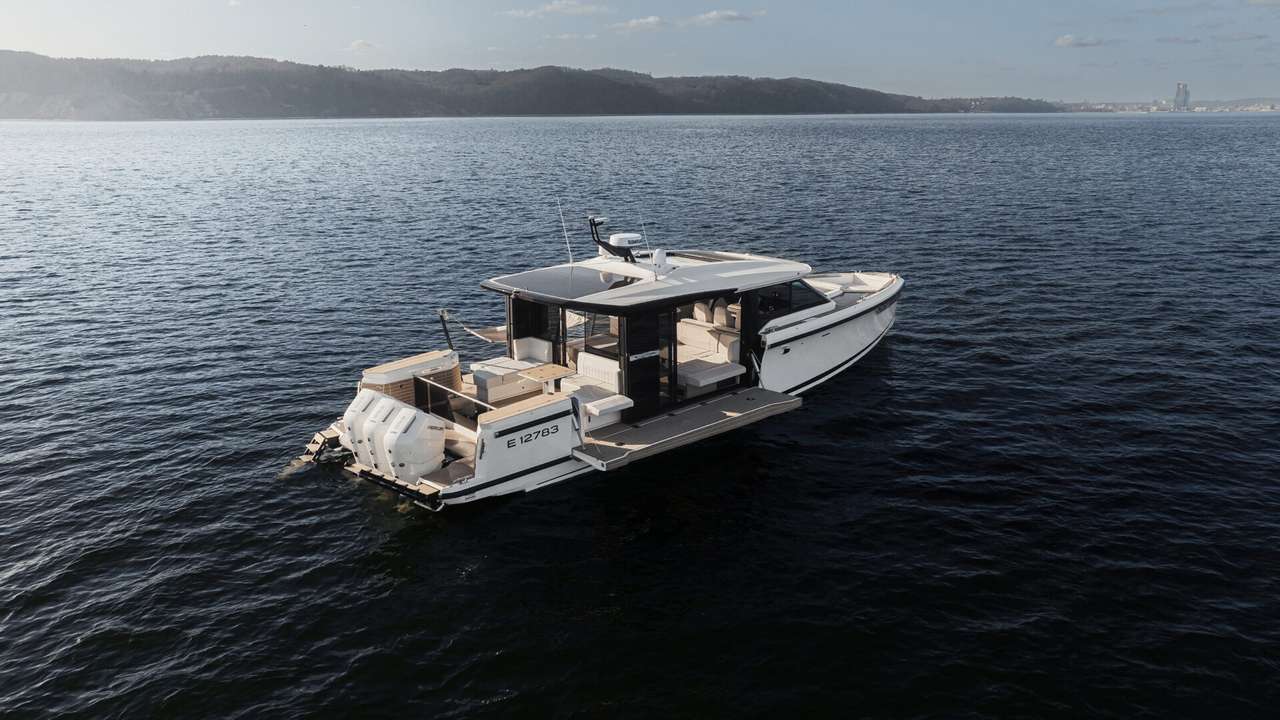
The Saxdor 460 GTC requires an orderly configuration because engines, openings and layouts are closely connected. The platform can employ three outboards and accepts a maximum declared power of 1,275 hp; the wheelhouse can close or open through sliding glass and roof, while two terraces lower the walls of the main bridge. On the lower floor the cockpit is a variant that modifies spaces and accesses. This guide organizes the official card in a sequence of order and delivery checks. It does not attribute performance tested by the editor and maintains the initial configuration published by the optionals to be confirmed in the contract.
Configuration and sequence of synthetic checks
| Area | Summary | Delivery control |
|---|---|---|
| Initial engines | 3 Mercury V8 from 300 hp | Record serials, propellers and weights |
| Maximum power | 1.275 hp | Verify combination certification |
| Fuel | 1.300/1.330 l | Solve divergence in specification |
| Fresh water | 160 l | Try pump, level and utilities |
| Grey water | 80 l | Test collection, vent and discharge |
| Black water | 80 l | Check indicator and suction |
| Plan | Up to 3 16′′′′ display | Control network, visibility and alarms |
| Layout | 2 cabins, optional third | Compare plan ordered and built |
Choice of three outboards
The published official list associates the base with three Mercury V8 from 300 hp, while the page indicates a maximum of 1.275 hp. Between the two extremes it is not enough to choose the power: they count weight of each engine, compatibility of the transom, alternators, commands and certification. The order card must report complete model, stem, relationship, propellers and color, as well as government devices. Serials, levels, fixings, alignment and freedom of rotation are controlled at delivery. Any performance must be recorded with load, fuel, people, sea and conditions, without transferring results from a different configuration.

Commands, steering and maneuver
Three engines require synchronization and clear start-up management, crazy, trim and steering. The verification sequence must verify that each display correctly identifies the engine and that the alarms remain legible from the driving position. End-of-the-race, interference between land and platforms, emergency stop and response to authorized maneuvers. If joysticks, autopilots or other aids are ordered, they must be reported as specific components and tested according to manual. The presence of automations does not replace a procedure to govern in case of failure to a module or power supply.
Fuel tank and given to clarify
The official page has two values: 1.330 liters in the first metric block and 1,300 liters in the repeated table. The contract must fix nominal capacity, material, number of tanks and usable volume. In delivery they identify vents, vents, valves, filters and sensors, controlling smells or leaks in the rooms. The indicator should be calibrated at multiple points when the procedure allows it. To plan autonomy you need actual consumption and a reserve chosen by the shipowner; the figure of 45–50 knots declared by the yard is not a sufficient base to obtain routes.

Electric networks and energy balance
The model page does not publish a complete set of batteries, alternators and utilities. Precisely for this reason the electrical configuration must be required before the order, without deducting capacity from the photos of the dashboard. The dossier should include schematics, tensions, protections, switches, chargers, dock network and actuators loads. Three engines can offer more charging lines, but the logic of separation between start and service must be explicit. The test measures tensions at rest and during simultaneous manoeuvres, verifying that terraces, roof and equipment do not generate fallen or alarms.
Terraces: implementation and interlocking
The side terraces expand the bridge when they are lowered. Before delivery, you will experience opening and closing in sequence, listening to any misalignments and checking blocks in the navigation position. Documentation must clarify limits of people and load, conditions of use and emergency manual maneuver if required. Sensors or interlocks should be tested, not only observed on the display. Hinges, actuators, pipes or wires must remain inspectable. Gaskets and drains deserve a test with water, while furnishings, tops and parabords must have boots that do not enter the movement zone.

Poppa, platforms and motor access
The stern combines three outboards, side steps and terraces. The verification sequence must simulate ascent from the water, passing through the dock and maintenance, with the engines in the permitted positions. Non-slip surfaces should be evaluated wet. The beams of cables and pipes should not bend, rub or remain exposed to trampling. There is also the storage of the planned ladder and access to the washing points. Any tender or additional equipment must comply with loads, radius of engines and escape routes; a promotional photo does not constitute authorization for installations not listed.
Wheelhouse closed or open
The passage from an open-bridge protected environment involves mobile roof and large glass surfaces. The test must cover all permitted positions, controlling guides, end of race, seals, drains and blocks. With the closed environment there are ventilation, disconnection and exits; with all openness the stability of the panels and protection of the occupants. The correct sequence should be reported in the on-board manual. Actuators require recognizable electrical protection and access for maintenance. Salt and sand must be removed without pushing debris into the mechanisms.

Plank up to three Simrad displays
The yard indicates a configurable dashboard with up to three 16-inch Simrad screens. The quantity does not guarantee redundancy: it is necessary to define which sensors, processors, networks and feeds serve each display. Models, serials, software, cartography and licenses are recorded at delivery. Engine data, depth, location, alarms and shutdown ordered. The layout must leave visible compass, essential commands and horizon. Reflections, visual through the mounts and use by sitting or standing must be verified with glass and roof in actual configurations.
Fresh water and real autonomy
The declared capacity of fresh water is 160 liters. It is not possible to translate it in days of autonomy without knowing people, showers, kitchen and habits. The check sequence identifies tank, vent, vent, pump, filter, collectors and boiler if installed. Each tap is tested, measuring pressure stability and checking losses after the cycle. Indicator and access for cleaning must be included in the delivery. Any additional dissalators or accumulations are configurations to document, with electrical consumption, prefilters, discharges and weight separated from the published standard value.

Grey and black water
The page declares two distinct capacity of 80 liters: one for grey waters and one for blacks. The plant plan must show which utilities converge in each tank, where there are pumps, vents, valves and vents. In testing, clean water is used to control levels, seals and discharges according to the applicable rules. Odours or wastes should not be masked with products, but retracted to ventilation, siphons or connections. Valves must be accessible and marked. The separate shower requires a dedicated check of the collection and the eventual exhaust pump.
Prodier cabin and ventilation
The front cabin is part of the published layout. The delivery must check the size of the bed, access to the rooms, lighting, ventilation and closing of the openings. Coatings and mattresses should not prevent essential inspections. If under the cabin passes plants or is the gavone still, they serve separation, drainage and clearly documented access. Takes, lights and emergency systems must be tested with the available power supplies. Viability does not deduce itself from the only photographed surface: there are real heights, movements, boots and the possibility to go out without obstacles.

Central cabin with single beds
The yard has a new central two-bed cabin. The location exploits the glare, but can be found near structures, tanks or technical areas. The shipowner should compare floor and built boat, checking ventilation, declared soundproofing, accesses and escape routes. The beds must remain fixed and the storages closed during the motorcycle. Any service panels should be opened in delivery to check that they are not only decorative. Complimentary lighting, sockets and cabling protection must be tested with the rest of the active utilities.
Optional Poppier Cabin
The third cabin is indicated as an optional and modifies both the main bridge and the lower one in the published layouts. Before the order, it should be clarified which technical rooms or storages replace and how the access to the plants changes. The variant adds furniture, potential occupants and loads in the area already affected by the engines. Therefore separate weights, ventilation and soundproofing must be updated. In delivery we compare drawings, openings and markings. A contractual option must also appear in manuals and schematics, avoiding generic documentation related to the no-cabin version.

Declared speed and test protocol
The maximum published range is 45–50 knots, accompanied by the warning that performance can change for equipment, weather and load. The delivery test must therefore be repeatable: there are engines, propellers, software, fuel, water, people, background status, wind, wave and regime. Besides the tip count progressive acceleration, temperatures, pressures, alarms, trim and ability to maintain a chosen cruise. The editorial staff did not carry out this test and does not transform the construction site into a judgment. Any differences should be analyzed with the dealer on the specific configuration.
Documents, optional and final distinction
Page, brochure and list describe an evolving model and warn that specifications can change. The contract must freeze version, engines, colors, layout, plants and accessories. Each item combines price, weight, position, power supply and manual. The final distinction is compared with the boat before signing, recording serials and photographs of the rooms. One should not consider standard what appears only in images. The discrepancy of the fuel is a concrete example of the usefulness of this procedure: the solution is a written confirmation of the number of hulls.
Programming maintenance of mobile parts
Roof, glass and terraces multiply guides, seals, actuators and sensors. The maintenance plan must indicate cleaning, controls, compatible products and intervals. It is useful to record opening times, noises and initial games to recognize variations. Water and salt should be removed from drains without unapproved lubricants. Electrical protections must be identifiable, while a fault must not force to leave an uninsured opening. Also hardware of the cabins, doors and furnishings must be tried periodically, because a free element can become dangerous in navigation.
saxdor 460 GTC final verification sequence
Delivery only closes when configuration and documents coincide. There are three engines, steering, power supply, terraces, roof, glasses, bridge, tanks, pumps, cabins and drains. Each test has condition, outcome and signature; each defect requires correction and new verification. The 460 GTC promises transformation and declared speed, but reliable use depends on well-identified and accessible systems. The owner must know which protection feeds an actuator, which valve isolates a circuit and which version of the layout possesses, without relying on assumptions or equipment seen on other specimens.