
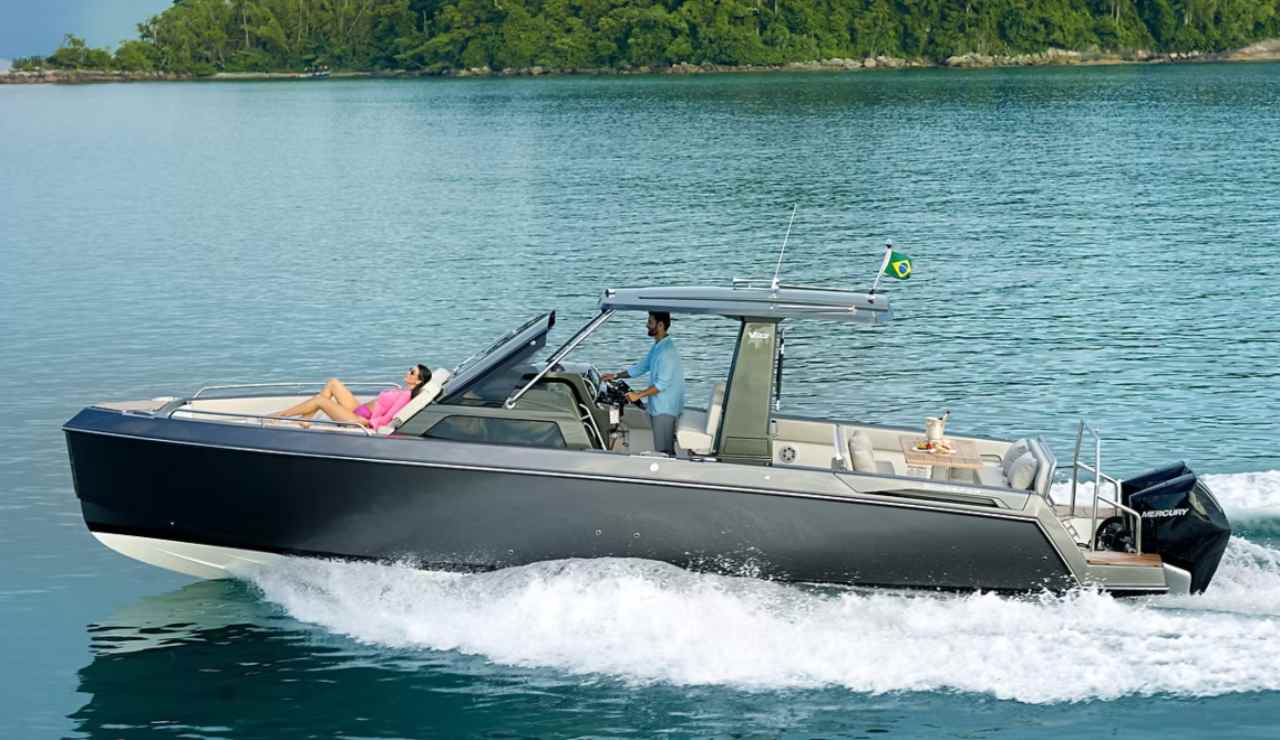
Schaefer V33 is the 10.3-metre walk-around with which the Brazilian construction site Schaefer Yachts has consolidated its presence in the high-performance dayboat/weekender band. Designed by Márcio Schaefer, the V33 was born to combine themediterranean appeal of european walk-arounds with a production engineering strict and typical American market layout solutions: deep well, high walls, large sunbathing surfaces and an amazingly viable cabin for measurement. The object of this analysis is to return a complete and technical framework—from structural design to performance—for an audience of designers, surveyors, captains and advanced shipowners, without sacrificing the exposition clarity for those who approach this type for the first time.
The test and benchmark boat is a version twin outboard with pair of Mercury V8 300 hp, a widely diffused solution that enhances V-carena a deadrise 18,9° and offer a very happy balance between acceleration, noise and operating costs. The V33 is also configurable with diesel/benzine poppieri groups, confirming the modular approach of the platform. dimensional and capacity data are consistent between the official website and European/sheets US: LOA 10,30–10,33 m, bay 3,35 m, fishing 0,45 m, empty displacement ~4.950 kg, fuel tank 570–700 L, water 150 L.

Site profile: history, construction philosophy, reputation
Origins and positioning
Schaefer Yachts is the largest Brazilian manufacturer for volumes and range width: founded by Márcio Schaefer in the early 1990s, it exceeded the 3,000 units delivered and garrisoned the 30–83 foot band with verticalized industrial processes (woodworking, moulding, assembly) and a strongly engineering footprint.
Philosophy “high comfort speed”
The yard declares the goal of navigating safely and comfort even with weather format, pursuing the so-called “high comfort speed”: the highest speed that can be maintained with a low vertical position and acceleration, thanks to the geometries of carenas and the distribution of the treated masses. The moderate V-carena of the V33 fits perfectly in this line: not extreme as the 22–24° typical of pure offshore fisherman, but more than enough to cut the Mediterranean wave while maintaining transversal stability and consumption more contained.
Reputation and international penetration
The entrance decided in Europe and North America is witnessed by the press coverage (Motor Boat & Yachting, BoatTEST, Boatsales AU), the commercial network and the presence in international exhibitions. The V33, first model of the V-Line, was a pioneer for the next V44/V55, strengthening the brand in the premium dayboat segment.

In-depth technical analysis
Dimensions and naval architecture
- Length outside everything (LOA): 10,30–10,33 m
- Maximum garlic: 3,35 m
- Fishing: 0.45 m (with raised outboard)
- Deadrise aft: 18,9°
- Vacuum Dislocation: ~4.950 kg
- Fuel capacity: 570–700 L (changeable for market/supply)
- Fresh water capacity: 150 L
- Approval: CE B/C depending on the versions and the market
The proportions reveal a V-carena moderate with multiple longitudinal skates and chine pronounced to contain sprays; the V at 18,9° points to a compromise between comfort in sea size e propulsive efficiency. The flares of bow is well marked to increase portance and dryness of the bridge. The important glare with respect to the length contributes both to primary stability and to external habitability (continuous corkscrew, protected passersby, generous seats at the bow and at the boat center).
Materials and construction process
The hull is in fiberglass (GRP) with infusion techniques for the main structural elements; the differentiated layering for areas allows to optimize rigidity/mass. The construction site presides over the processing of composites and carpentry, key factor for quality control and to maintain tight tolerances on the couplings. Overstructure and T-top are in composite with localized reinforcements (attached areas, bases of tientibene, electronic support bases). External floors in teak (opz.) on bridge and plank; in the cabin, light panelling with wood-effect finishes and technical-sea upholstery.

Motors, propulsion and transmissions
The V33 was born “outboard-centric”. The most popular layout in Europe and the USA provides twin Mercury Verado V8 300 hp with joystick of mooring and integration on “glass cockpit” bridge (Garmin/Simrad to dealer choice). Alternatively, some markets are available poppieri groups gasoline/diesel (e.g. Volvo Penta) for those looking for a larger stern plan or specific remittance needs.
- Common standard option: 2× Mercury V8 300 hp (outside)
- Commands: electronic DTS, autopilot integration
- Transmission: outboard with steel propellers, final ratio calibrated for 43–45 kn peak
- Control: Joystick by maneuvers, Active Trim, digital assistants

Performance: speed, consumption, autonomy
The stated and measured performance converges on very consistent values. Motor Boat & Yachting tested a V33 with twin Mercury 300 detecting 43 kn of maximum speed, 56 L/h to 20 kn e 200 m of autonomy to 20 knots; Boatsales AU reports autonomy in the order of 219 nm @ 3.500 rpm (with tank 700 L, 95% usable), confirming an efficiency profile in the average for the category.
- Top speed detected: 43 kn (MBY)
- Indicative Economic Cruise: 22–28 kn to reduce L/nm
- Typical consumption at 20 kn: ~56 L/h total (MBY)
- Typical autonomy: 180–220 nm depending on loads, sea, set-up
Onboard systems: electronics, home automation, navigation
The bridge is conceived as glass cockpit with 12–16′′′ MFD, engine data integration, volvo Penta autopilot with Shadow Drive in versions with compatible autopilot for Mercury outboard; joystick e Active Trim simplify trim and maneuvers. Audio devices Fusion Apollo with 4–6 speaker, sub and amplifier in premium versions; winch still with remote control; possibility of gyroscopic stabilization Seakeeper on request, very appreciated on stand-by fishing or rada.

Design and architecture of spaces
The stylistic trait is markedly European—high walled with minimal windows, neutral tones, T-top full-beam—but without sacrificing “US-style” functionality: opposite sessions in cockpit, convertible dinette, wet-bar complete behind the leaning-post, transformable bow sunbed, side planks (on request) and large undercover gavones. The cabin, volumetric walk-around center-cabin, offers transformable double/queen and separate bathroom in height of man, detail not discounted on 33’.
Innovation and research: efficiency, stability, safety
- L/nm optimisation: moderate V profile with skates to extend sweet spot 22–30 kn with neutral trim.
- Stabilization: preparation for Seakeeper (US/EU versions), useful in fishing and shaving.
- Digital integration: mFD (lights, fridges, pumps) and engine monitoring via NMEA2000.
- Structure: localized reinforcements in high load areas (T-top supports, seating bases, bulkheads) to reduce vibroacoustics.
- Passive security: high walls, continuous tientibene, wide corridors, bulwark padded—useful for families and charters.
Onboard life, comfort and layout
The standard layout privileged sociality and usability. On deck, the stern dinette is modulable: face-to-face with folding table (which becomes sun-pad), or open living room for handling fishing/diving equipment. At the bow, opposite seats and chaise-longue front march with generous handrails. The cabin, surprising for volumes, allows overnight for two with boot, USB sockets, optional air conditioning and separate toilet. In navigation, the aerodynamic protection of the windscreen and T-top reduces fatigue; in shaves, tents prolong the shadow both at the bow and aft.


Navigation performance: test synthesis and feedback
Some constants emerge from independent tests:
- Predictable asset: entry into ready planata, absence of trends marked at porpoise with neutral trim.
- Rollio in rada: content for measurement; very effective with gyroscope (if installed).
- Rumourity: MBY reports ~88,5 dBA @ 20 kn in dashboard—competitive value for outboard V8 out of 33’.
- Comfort sea-state 3: the deadrise from 18.9° with full glare guarantees “dry ride” with sprays kept low from the chine.

Market and competition
Price and segment positioning
In the US market, broker lists and requests adjust V33 in range ~US$320k–420k depending on engines, electronic packages, T-top, teak, “seakeeper-ready” and customizations.
Direct competitor analysis
Pardo 38
- LOA: 11,9 m; i'm sorry 3,60 m; fuel: ~1,000 L; speed: 40–50 kn depending on engines (also triple outboard); price: premium.
- Focus: top-leg finishes, upper cabin volumes; higher costs/consumptions for mass and installed powers.
- V33 vs P38: More compact/light screen → best L/nm efficiency e handling; I speak more “lux flagship” with vast range of customization.
Fjord 38 Xpress
- LOA: 11,63 m; i'm sorry 3,64 m; fuel: ~758 L; max speed: ~45 kn with 2×350 hp.
- Focus: iconic design “open terrace”, large lounge areas.
- V33 vs Fjord 38: Schaefer presents more liveable cabin and protection T-top full-beam more extended; Fjord primes by setting “terrace on the sea”.
Axopar 37 Sun Top
- LOA: 11,50 m; i'm sorry 3,35 m; fuel: 722–730 L; max speed: 38–48 kn; cruise consumption: ~2,3 L/nm @ 28 kn with 2×300 hp.
- Focus: scandinavian efficiency and modularity, many variants (aft cabin, wet-bar, etc.).
- V33 vs Axopar 37: V33 is located halfway: more mediterranean line e more “cosy” cabin, with efficiency in route very close to the nordic best-in-class.
Industry Trend
- Mediterranean Walk-around with strong attention to sociality in blanket and essential overnight.
- Outboard V8/V10 with advanced joystick and electronic integration to reduce the neophyte learning curve.
- Stabilization on 30–40 feet as an optional now mainstream for charter/families.
- Customization colors/composites/woods: Schaefer's integrated supply chain enables competitive times and costs compared to EU top brands.

Abitability: study of spaces and ergonomics
Covered
The blanket is the heart of the V33. The modular well turns from living room to platform activities with few, intuitive operations disconnect poppiera can become a “king-size” sunbathing by lowering the table on a telescopic stand; under the chairs a passing storage volume opens. The station gourmet/wet-bar behind the leaning-post integrates fridge, sink and grill (option), allowing to serve continuously bow and stern. I symmetrical passers and protected allow you to reach the bow area—true “arms plaza” for sociality—where the sessions at U and the chaise-longue frontemarcia enjoy nicely arranged tientibene and cup holders.
Plane and guide
The bridge hosts two MFDs, digital motor indicators, command joystick, trim tabs and Active Trim. Ergonomics: visual line free on 360°, windscreen with thin frames, large footrest platform, double seat with side references. The aerodynamic protection t-top and windscreen reduces spray and turbulence around the head, improving intelligibility of instrumentation at sustained speed. In option, triple sitting e wiper with wipers.

Cabin and toilet
Undercover, the volume is surprising for a 33’. Theopen-space front converts into a double; the separate bathroom at full height with electric toilet, sink and shower, transmits a perceived by “mini-cruiser”. Technical materials and washable surfaces ensure robustness and easy maintenance in charter context.
Special equipment: sport fishing, diving, charter
Schaefer introduced the V33 SF (Sport Fish), fisheries-oriented development live tub, gates, free maneuver spaces and options tuna door. This derivation confirms the flexibility of the platform and expands the user basin (families alternating day/fish cruises). Learn more about equipment and layout in the BoatTEST reportage and dedicated video content.
Experience at sea: engineering data analysis
Acceleration and plan. With 2×300 hp, the boat enters the bridge in a few seconds, with transient without cavitation hints on steel propellers. Load distribution (central tanks, protected batteries, symmetric gavones) minimizes trim varying weights.
Dynamic comfort. The combination of chine wide and full bay improves secondary stability; moderate V filters the typical impact frequencies of the Mediterranean short wave. The 43 maximum nodes detected by MBY confirm the goodness of the weight/power ratio and the T-top aerodynamics.
Efficiency. With 700 L (or 570 L in some configurations) and cruises 24–28 kn, you get autonomous in the order of 170–220 nm real on board load, superimposable values to the best Scandinavian alternatives to parity of powers, even with a more volumetric cabin hospitality-oriented.

Target customer
- Private owners wishing a one-boat solution for intensive daycruise and weekend to two, with focus on ease of management and versatility.
- Luxury Charter (day premium charter): social layout, separate toilet, T-top protection and optional stabilization are choice drivers.
- Representative companies and club: flexibility of staging (fish, diving, family day) and competitive operating costs.
Prices, orders and awards
The V33 is in the band US$320k–420k with double outboard motorization and optional medium-high packages, according to availability and area. The V line has received great welcome in the main fairs (Southampton, Cannes, Miami) and the international press has often highlighted building quality and equipment from “mini-ship”.
Future prospects and construction roadmap
With the arrival of V and the evolution of the range, the V33 platform benefits from technological carry-over on electronics, plants and materials. It is reasonable to expect further integrations of compact stabilization systems, packages energy-saving (motor alternators, smart load management), and progressive onboard systems hybridization (not propulsion, where outboards remain more rational today for weight/power on 33’).
Image gallery


Synthetic technical comparison (V33 vs rivals)
- Efficiency/Consumption: V33 (2×300) and Axopar 37 (2×300) are aligned around 2.2–2.5 L/nm between 25–30 kn; Pardo 38 and Fjord 38, larger and heavier powers, require greater power and show higher consumption at equal speed.
- Cabin habitability: V33 offers separate bathroom “full-height” on 33’, a plus not discounted; Pardo 38 primes for absolute volumes.
- Cover ergonomics: Fjord 38 dominates by concept “terrace”, V33 stands out for protection and balanced usability bow/pepper.
Survey and management considerations
- Plant inspection: wide technical gavones; recommended periodic check T-top sealings and cable ducts.
- Balance: on versions with many optional aft (grill, seakeeper), care propeller selection and distribution loads.
- Refitting soft: mFD/sonar upgrades and audio packages are simple for open well layout.
- Resale value: growing demand on Med/US markets thanks to brand awareness and price/dotation ratio
Video
Conclusions: positioning and engineering judgment
The Schaefer V33 is a platform consistent and modern that maximizes daily usability without sacrificing the possibility of night rest in comfort for a couple. The carena at 18,9° is an intelligent compromise: it allows medium-range consumption, offers predictable behaviour on the mediterranean short wave and allows you to fully exploit the progressive delivery of V8 Mercury. From the point of view ofnaval architecture, stand out: center load distribution, effective skates in supporting the platform 25–30 kn, chine wide for dryness and firm stability. The cabin in height of man with separate bathroom is a competitive plus; the dashboard icing and digital integrations bring the user experience to the 40-foot premium.
In comparison with direct competitors, the V33 ranks as “efficient-comfort dayboat”: less extreme than Pardo 38 and Fjord 38 in terms of statement stylistic and powers, but more usable and rational for management/consumption; next to Axopar 37 for efficiency and handling, with a more Mediterranean formal language and a more welcoming cabin. For private shipowners and for charter operators looking building quality, modularity and balanced operating costsThe V33 is a technically sound and commercially sensible choice.