
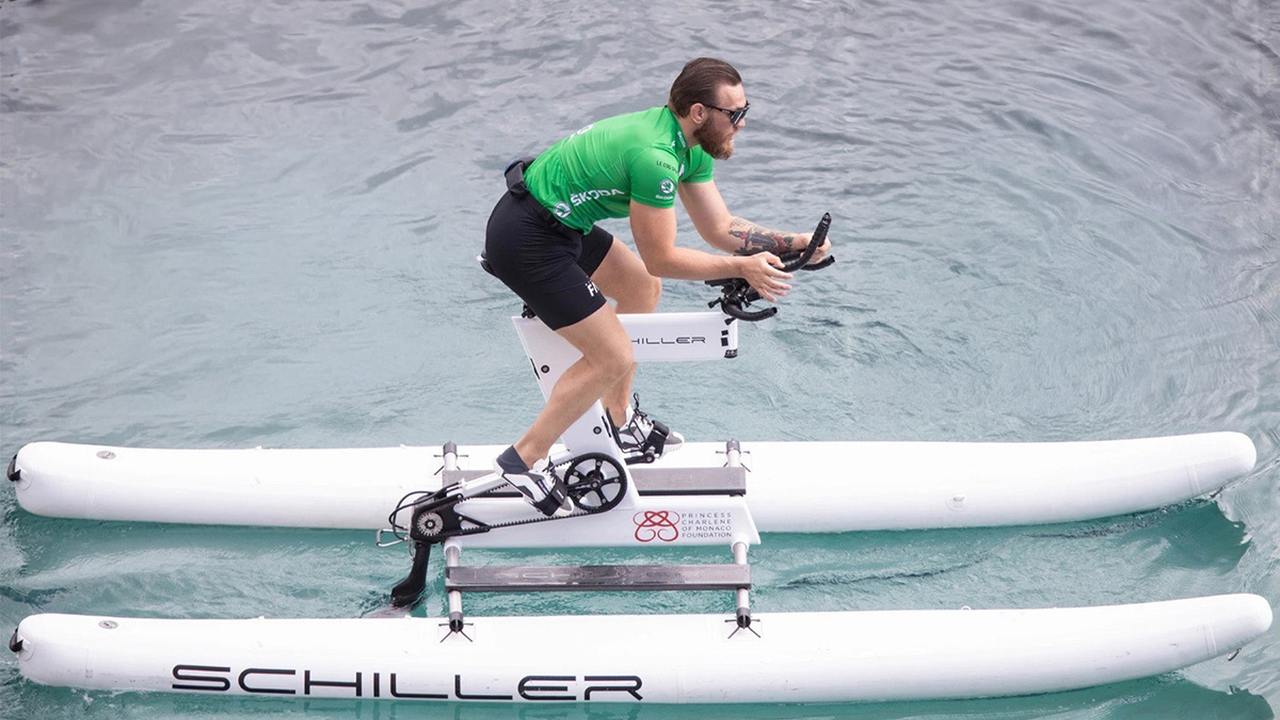
The Schiller S1-C belongs to the family of pedal units, but replaces the classic pedal shell with two high-pressure inflatable pontoons, a bicycle frame and a propeller transmission. The manufacturer defines it water bike and insists on the cycling cadence offered by Gates Carbon Drive. In the taxonomy of the portal, therefore, it is in the section pedaled as a single-seat and removable evolution of the human drive on water, not as a traditional skate.
The apparent simplicity hides several systems: drop-stitch pontoons, cross-sections, T6 aluminium frame welded TIG, belt, ratio 1:7,5, helix, helm and bamboo platforms. The safety depends on the assembly and choice of the size as well as the ability to pedal. The official pages also contain uneven load limits: the white product page indicates 300 pounds, the general section speaks of 450 pounds and a passage describes the frame resistance over 500. It makes faith the limit of the specific unit, never the most favorable number.
Declared data and points to be clarified
| Voice | Summary | Required control |
|---|---|---|
| Configuration | Catamaran pedals | Pontons and attacks must be symmetrical |
| Transmission | Gates Carbon Drive | Voltage, alignment and rinse |
| Report | 1:7,5 pedivella-elica | Fluidity and absence of interference |
| Cruise speed | 4–6 mph, about 6–10 km/h | Indicative, depends on athlete and conditions |
| Maximum speed | 11.5 mph, 18,5 km/h | Manufacturer's statement, not editorial proof |
| Average fall | 40–60 rpm | Depends on experience and sea |
| Assembly | Less than 10 minutes | Manufacturer's objective, does not replace the verification sequence |
| Frame cutters | Media / Large | Choice on height and horse |
| Maximum load | 300 or 450 lb per page | Use plate and manual of the specific unit |
| Claimed galley | Over 800 lb | Not equal to the permissible operating load |
Two pontoons drop-stitch
High-pressure pontoons use a drop-stitch structure to maintain the shape with relatively rigid surfaces. The catamaran configuration offers a wide base and separates float and propulsion. However, it does not make it impossible to overturn, especially with lateral wave, high load or incorrect pressure.
Before the varo, pressure is controlled according to manual, valves, abrasions, seams, delaminations and symmetry. Temperature and sun change pressure. A softer pontoon alters thirst, resistance and government.

Floating does not mean flow
The manufacturer mentions over 800 pounds of float, but this value is not the operating limit. Reserve, stability, structure and behavior are different concepts. The FAQ indicates a total of 450 pounds, while a product card speaks of 300 for the cyclist; the frame is described as capable of supporting over 500.
The prudent rule is to use the most restrictive value applicable to the plate and configuration purchased, asking for written confirmation if documents diverge. Person, animal and material on the platform enter the load. You do not deduct capacity from a frame test.
Frame T6 welded TIG
The frame is T6 welded TIG aluminum and powder coated for corrosion protection. Treatment reduces exposure but does not make metal immune in saline environment. Graffi, contact points, bolts and joints with different materials require attention.
After each exit at the sea, rinse with fresh water and dry. Periodically welds, paint, threads and couplings are observed. A crack or deformation should not be repaired as on a normal bicycle without knowing loads and alloy.
Gates Carbon Drive
The belt replaces the metal chain and transmits the pedal to the propeller group. It is suitable for an environment where salt and water would make a traditional chain expensive, but it requires correct alignment and voltage. Sand and objects can damage it.
The verification sequence looks at teeth, edges, tension, pulleys and noise. It does not lubricate with products intended for chains. After a bump or disassembly the alignment occurs before pedaling under load.

Report 1:7,5 and cadence
The stated ratio of 1:7,5 multiplies the rotation of the pedivelles towards the propeller. An average cadence indicated between 40 and 60 rpm therefore produces a much higher regime on the propulsive group. Fluidity and low losses become important.
The resistance felt depends on propeller, wind, wave, pressure and load. A sudden increase can indicate legion, vegetation or bearing. It stops the pedal and inspects safely, without forcing the system.
Owner propeller
The propeller converts the cadence into a push and also allows the reverse according to the manufacturer’s instructions. It is exposed to bumps and fouling. Before entering the water you control blades, fixing and freedom of rotation.
During the launch the group should not hit the bottom or the pier. After use we remove algae and wires. Minimum damage can create vibration and reduce performance; replacement must respect the expected spare.
Integrated steering and handlebar
The direction follows the movement of the handlebar, making the command intuitive. Cables, reinforcements or system connections must be mounted without games and with full running. The neutral position must match an aligned rudder.
Before the varo you try right, left and return. In water you start at low speed. A bicycle handlebar does not mean that the answer is identical to the ground: wind and current act on the whole catamaran.

Declared speed and real limits
Schiller declares a cruise between 4 and 6 hourly miles and a maximum of 11.5, equivalent to about 18,5 kilometers per hour. They're manufacturer's performance, not a proof of the editorial. Athlete, trim, pressure, wave and wind significantly change the result.
The maximum speed must not become a safety criterion. With short sea or traffic it is more important to maintain control and margin to return. The plan considers wind on the return and not only the ease of the way.
Medium and large size
The average size is indicated for heights from 157 to 180 cm and horse from 66 to 86; the large from 173 to 198 cm and horse from 76 to 94. The bands overlap, but the choice must allow effective extension without blocking the knee.
Saddle and handlebar are adjustable. You write down positions for different users and check the locks. A horny erroneous posture, reduces control and can move the center of gravity unnecessarily.
Neoprene pedals and straps
Custom pedals use a neoprene belt. The foot must remain stable but be able to get rid of it quickly. Adjustment, wear and sand must be checked before each exit.
Suitable footwear improve grip and protection. A too narrow belt can complicate a lift or abandonment. The procedure is tested on the ground before the launch.
Bamboo Platforms
The treated bamboo pawns offer support and access. They must be dry, intact and secured without play. Finishing, edges and attacks undergo water, sun and concentrated loads.
They are not automatically passenger seats. Each person or object must fall into the allowed configuration. On the platform are only provided accessories, without interfering with rudder, pedal or lift.

Assembly in less than ten minutes
The manufacturer declares an assembly under ten minutes and without special tools. It is a goal of practicality, not a reason to jump controls. The first times you work on a clean surface, following order and planned pairs.
Pontoni, traverse, chassis, transmission and helm must reach their respective stops. At the end you run an independent spin: no advanced piece, no partial attack, free steering and symmetric pressure.
Transport and storage
The S1-C is designed to enter many utilitaries and SUVs once disassembled. Vehicle size, module weights and fixing modes must be verified. Metal parts should not rub on pontoons during transport.
Salt and water are removed before closing the equipment. Pontoni, belt and frame are kept dry, protected by heat and UV rays according to the instructions. A bag does not replace ventilation.

Beach, pier or boat
The manufacturer contemplates more modes, but each has risks. On the beach sand and seabed threaten propeller and belt; from the pier it is necessary to control height and current; from a mother boat you need grips and free area.
You wear the floating device before the maneuver. The propeller stays far from the bottom and the cyclist rises while maintaining centered weight. A second person can stabilize in the first exits.
Sea and surf ban
Schiller describes the S1-C as suitable for open sea and wave, but explicitly prohibits use in surfing due to the high center of gravity. These two statements are not contradictory: tackling controlled chop is not equivalent to dropping a fringe.
Marine warnings and local rules must be respected. The personal limit can be much lower than the capacity of the medium. If wind or wave grows, you return before the course becomes marginal.

Personal safety and legislation
The administrative classification may vary according to country, area and authority. Before use, individual device obligations, distance, signalling, lights and interlocked areas occur. The fact that it is operated on pedals does not eliminate the navigation rules.
Protected telephone, ground contact, route and return time are part of the plan. Clothing and thermal protection depend on water, not only on air. You should know how to stay with unity and ask for help.
check sequence before exit
They control weather, alerts, pontoons, pressure, valves, frame, attacks, belt, pedals, propeller, rudder, saddle and handlebar. Load and size are confirmed. Floating device and communications are ready.
On the edge of the water is repeated steering and helix, the bottom is observed and the return is planned. No accessories must move. The verification sequence is also used after a short transport.

check sequence after exit
There are noises, shocks or increased resistance. Fresh water rinse pontoons, frame, belt, propeller, rudder and hardware. Sand and salt should not dry in the couplings.
Modules are dried before storing. Residual pressure, abrasions, paint and fixations are controlled. Small damages are documented and resolved before the next exit.
Maintenance and spare parts
The manufacturer emphasizes the compatibility of many cycling components with workshop assistance, but propeller, rudder, attacks and structural parts remain owners. A mechanic must know the marine exposure and not automatically apply street procedures.
Manual, serial number and distinct. Straps, pontoons and critical spare parts deserve a plan. Craft modifications can compromise warranty, resistance or security.

Accessories and front platform
A platform can increase transportation capacity, but changes surface to the wind, distribution and load. It must be planned for the S1-C and mounted with the correct attacks. Animals and materials need systems that do not create entrapment.
Laptop, bags or lights must be fixed without limiting steering and pedaling. Each accessory enters the total weight. The cleanest configuration is often the most reliable.

Technical judgment
The Schiller S1-C interprets the pedal as a removable and performing water bike. Pontoni drop-stitch, chassis T6, Gates Carbon Drive, ratio 1:7,5 and helix owner form a coherent system, different from recreational means to shell.
The critical point is documented: the different weight limits published impose a confirmation on the specific unit. Assembly, pressure, weather and rinse require discipline. With correct size and sequence of checks, it offers a technical and transportable form of human propulsion; used as if declared stability canceled risks, it loses its margin.