
Configuring a Swan 51 means transforming a 15.55-metre hull platform into a consistent system for cruise and high navigation. The Nautor board declares 16,90 meters out of everything, 4,85 meters of glare, 18,000 kilograms of light displacement, Yanmar 4JH80 engine of 80 hp, 650 litre tanks of diesel and 500 water. Interiors, energy, sails and options should be read on the separate unit. This guide prefers plants, configurations and delivery controls; it does not give the boat measured performance and does not consider installed what appears only in a range image.
Swan 51: Configuration matrix
| System | Base declared | Delivery Verification |
|---|---|---|
| Scafo / outside everything | 15,55 / 16,90 m | Record real footprints |
| Baglio | 4,85 m | Boat seat compatibility |
| Cheese | 2,45 m standard | 2.05 m only with reduced option |
| Timing | Two in pond compartments | Games, seals and links |
| Engine | Yanmar 4JH80, 58.8 kW / 80 hp | Serial, hours, alarms and maintenance |
| Fuel / water | 650 / 500 l | Valves, vents and indicators |
| Hot water / collection | 40 / 100 l | Scheme and tests |
| Services | AGM 24 V, 300 Ah | Balance of loads |
| Banking | 230 V, 32 A, 50 Hz | Protections and cable |
| Charger | 70 A | Battery curve and compatibility |
First decision: keel of 2.45 or 2.05 meters
The standard fishing is 2.45 meters; the reduced keel brings the value to 2.05. The choice does not only concern access to less deep bottoms. It must be associated with habitual route, ports, expected performances, keel plan and specimen documents. The published 6,300 kilograms ballast is expressly referred to the standard keel, so it is not automatically transferred to the reduced version. In delivery, identification, joint, accessible locks, shock signs and surface protection occur. The full-load real immersion must maintain a prudent margin compared to the planned backdrops.
Second decision: sails and equipment
The rig measures are IG 20,70 meters, J 6,10, P 19,90 and E 6,70 meters. The declared areas are 80 square meters for the rank and 67.1 for the bow; the gennaker area is still to be defined in the tab. The configuration must therefore be closed with an inventory of sails, materials, grammatures, winders and certificates, without deductions. The long prodier gavone is designed to hold also sails equipped with anti-tortion cable. During the testing, we try to insulate, reduce, wind up and recover in safe conditions, annotating frictions, fine running and abnormal loads.
Double steering and pond compartments
The two moths support control when the boat is disbanded. The axes are placed in separate ponds, a feature that must remain inspectable. The verification sequence includes seals, games, bearings, arms, connections and emergency systems provided by the documentation. It is checked that no added passage has compromised the compartment and that drains or sensors are accessible. Dry compared the two blades; in water the answer on the two walls and motor. A seemingly fluid helm in the dock can show differences under load, so static evidence is not enough.

Engine Yanmar: identification and start
The declared auxiliary engine is the four-cylinder Yanmar 4JH80 from 58.8 kW, indicated as 80 hp. The first verification is documental: serial number, delivery date, hours, maintenance, calls and spare parts. The start must be cold, with temperatures and tensions noted. Pressure, charging, cooling, unloading, vibration and transmission insert. The type of axis or saildrive line should not be presumed if it is not confirmed on the separate boat. The public card does not provide consumption or motor speed: autonomy and performance are calculated only with data measured on the real configuration.
Standard Bow thruster and maneuver
Nautor indicates the bow thruster as standard, designed to facilitate mooring and conduction with reduced crew. Delivery must identify brand, model, power supply, protection, command and service access. The battery is charged and under load, observing voltage drop, times of use and response of controls. The tunnel and accessible areas must be inspected during the feed. The propulsor does not replace planning and control of the boat: side wind, tanning and delay of the system remain part of the manoeuvre. The emergency switch and exclusion procedure must also be known to the crew.

Diesel: 650 liters to manage
The nominal capacity of the fuel is 650 liters. Before talking about autonomy we need measured consumption, regime, state of the sea and reserve. The verification sequence reconstructs vent, vent, tank, indicator, interception, prefilters and engine power. It seeks accessibility for inspection and cleaning, verifying that pipes and clamps do not show threading or rubbing. The indicated level should be compared with the one known during the supply. A possible generator, provided as an option in the space of the local engine, would change the scheme and the balance of consumption: its presence must be contracted and documents.
Fresh water and boiler
The water tank contains nominally 500 liters and the boiler 40. The test starts from mouth and vent, continues with pumps, autoclaves, indicators, taps and showers. Noises, abnormal cycles, losses and quality of accessible fittings are noted. The capacity does not guarantee a certain duration, because people, kitchens and showers change consumption. If there is a dissalator, it must be treated as a separate plant with measured production, water quality, filters and conservation procedure. It is not considered included without distinction. The boiler is tested both in the mode provided by dock and with the eventual thermal source documented.

Collection: 100 liters and valve scheme
The capacity published for the collection tanks is 100 liters. The number does not describe the system alone: it is necessary to reconstruct which utilities confluence you, where pipes and vents pass, how suction and emptying occur and which valves are sealable according to regulations. Odours, inconsistent indications or continuous cycles of pumps require diagnosis. You control clamps, fittings and accesses without sudden disassembly. The procedure on board must distinguish use in port and in navigation. Logs and compatible products help to avoid damage to seals and sensors.
24 V service desk
The electric base declares AGM batteries services from 24 V and 300 Ah to the discharge of twenty hours. Nominal energy does not coincide with all usable energy: discharge depth, temperature, age and loads affect. The final configuration requires a budget that lists electronics, lighting, pumps, refrigeration and other really installed utilities. Date of batteries, locks, fuses, switches, ventilation, voltage drops and monitors occur. If the owner changes technology or capacity, it must update chargers, protections, weights and documentation; a replacement is not correct only because it enters the compartment.

12 V start and circuit separation
The starter battery is indicated as AGM from 12 V and 50 Ah. The voltage difference from the service counter requires a clear understanding of separation, charging and common references. The start-up test sequence, insulation, possible emergency parallel and instrument readings. Cables and terminals must be identified, protected and fixed. A resting voltage does not demonstrate the capacity of the battery: it serves a test consistent with the directions of the manufacturer. The added circuits must have their own protections and not bypassing or monitoring.
230 V and 70 A charger
The dock entrance is declared at 230 V, 32 A and 50 Hz, with 70 A charger. Delivery checks socket, cable, authorized adapters, polarity, differentials, grounding and protections. The charger must be configured for the installed and tested AGMs through the planned steps, observing current, voltage and temperature. The value of 70 A does not mean that each condition requires the maximum current. Contemporary loads, columns limits and continuity of the protection conductor must enter the minutes. Interventions on the alternating network compete with qualified personnel.

Optional generator and technical space
The local motor is described as soundproofed, easily accessible and equipped with space for an optional generator. Preparation does not mean installation. If the group is ordered, power, mass, supports, ventilation, exhaust, fuel socket, cooling, painting and interlocking with the dock should be documented. You measure behaviour with progressive loads and control noise, vibration and alarms. Accessibility for filters and impellers counts as the initial operation. If the compartment remains free, it should not become a boot that obstructs motor access or alters ventilation and weight distribution.
Salone: configuration before aesthetics
The main living room uses a C sofa and receives light from many openings. Folding, table, chairs and boots can be arranged according to multiple options. The verification sequence must start from the signed planimetry: position, fixings, sockets, lights and technical access compare with the delivered. Table and doors must be tested in simulated navigation, verifying positive and flat closures. Boccaporti, obscurants and seals require a test with controlled water. The images show possible atmospheres, but do not replace the list of selected essences, fabrics and appliances.

Kitchen and budget of users
The kitchen is designed with domestic equipment, to be specified in the order. Brand, model, feeding, absorption, ventilation and fixing are recorded for each device. Refrigeration, cooking and small appliances enter the balance sheet of the service counter and the dock. Locks, pins, drains and possibility to move with the inclined boat. The accessible pipes should not rub; the outlets close to the water require appropriate protection. Sliding and crockery must have safe storage. A complete kitchen in photography can belong to a different layout and should not be given for included.
Three cabins, two service units
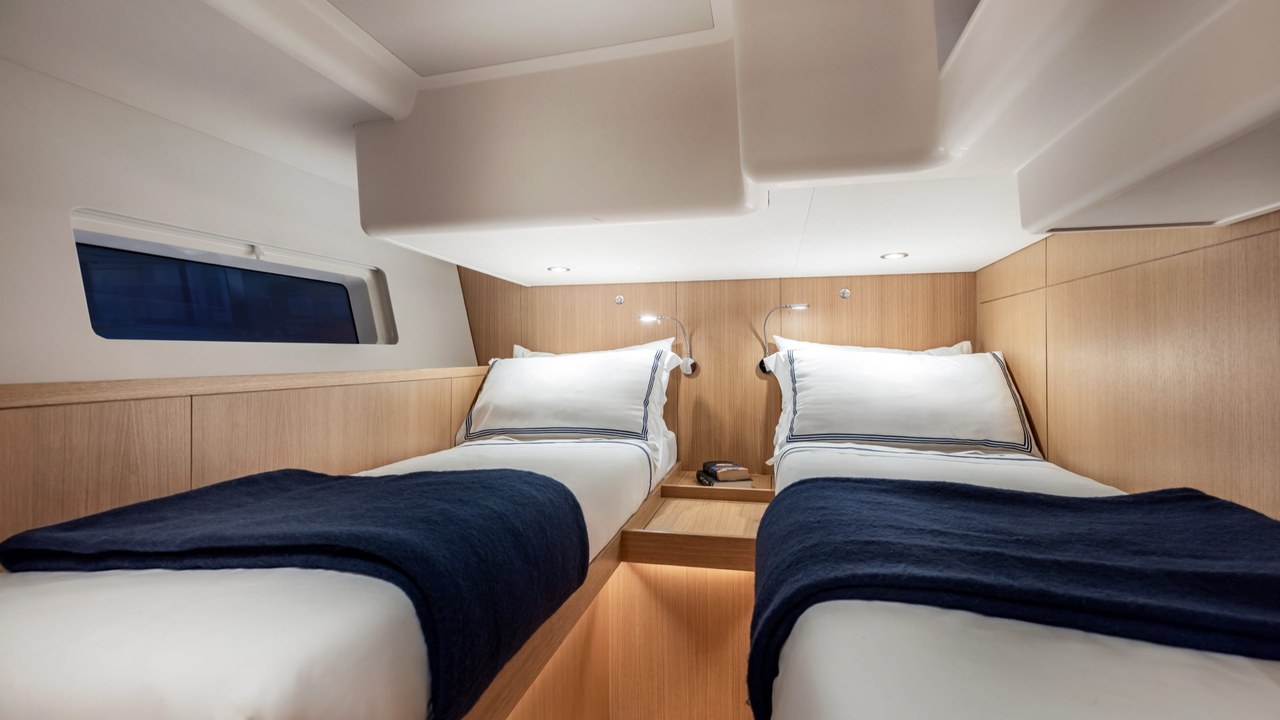
The announced layout includes shipowning cabin at the bow with private bathroom and shower, plus VIP cabins and aft guests sharing a bathroom with shower. Ventilation, lighting, obscuring, closures, accesses and escape routes in each environment. Removable mattresses and panels allow to control condensation and technical areas. In the bathrooms there are pumps, drains, taps and shower separation. The number of bunks does not define by itself the certified capacity: plate, manual and specimen documents prevail. Luggage distribution should be considered in the loading floor.

Four atmospheres signed by Misa Poggi
Swan Soul, Scandi Vision, Blue Genoa and Velvet Vibe are the four finishing proposals curated by Misa Poggi. Woods, fabrics and skin change tone and perception, but technical choice must include samples, codes, surface treatment and maintenance modes. It is checked that panels and furniture remain removable where access is needed. Natural materials and clear finishes require consistent procedures for moisture, sun rays and cleaning. At the delivery detailed and distinct photographs signed create a useful basis for future warranty and repairs, avoiding confusing variations allowed with defects.
Electronics and optional: separate rule
The public page does not define a universal electronic package. Sailing, pilot, communications, radar, AIS, sensors and entertainment must be verified by brand, model, software, network and power. The same rule applies to retractable rigid bimini, generator and other optional. The test creates a matrix with apparatus, serial, version, manual, protection and test performed. Loss of sensors, alarms and degraded modes are tested, not only ignition. Passwords, licenses, accounts and configuration backups must switch to the owner without depending on the technician's phone.
Delivery test in five stages
The first phase freezes documents and separate; the second controls hull, keel, thymoni and dry sea sockets. The third test system in the dock, including energy, water, drains, motor and equipment. The fourth concerns maneuver, rig and sails under recorded conditions. The fifth repeats the anomalies after the interventions. Each row of the minutes indicates requirement, outcome, measure, photo, responsible and expiry. Performance is not invented: if there are no official values applicable, the data is kept measured with all conditions. No verbal promise closes non-compliance.
Programmed maintenance and registers
The register must integrate manuals Nautor, Yanmar, rig, batteries and order equipment. Before leaving with the boat you can control the bilge, valves, energy, levels, rudder, visible tailoring, passports and safety. The next ranges cover engine, cooling, exhaust, batteries, chargers, pumps, boilers, tanks, bow thruster, sails and maneuvers. At each alge you can see keel, two thymeans, propeller and sea sockets. The intervention is complete only when it contains hours, spare, technical and final test. A readable history distinguishes normal wear, repeated defect and undocumented modification.
swan 51 final verification sequence
The Swan 51 offers a clear base: two timones, standard or reduced keel, 80 hp Yanmar, bow thruster, three cabins and 24 V service plant. The complexity arises from the choices of sails, interiors, electronics and optional. For this reason effective delivery does not seek a generic yes, but connects each component to separate, serial, test and manual. Tanks and batteries are transformed into autonomous only after real measures; performance remains associated with conditions. A coherent, accessible and documented configuration makes the boat easier to manage and maintain over time.