
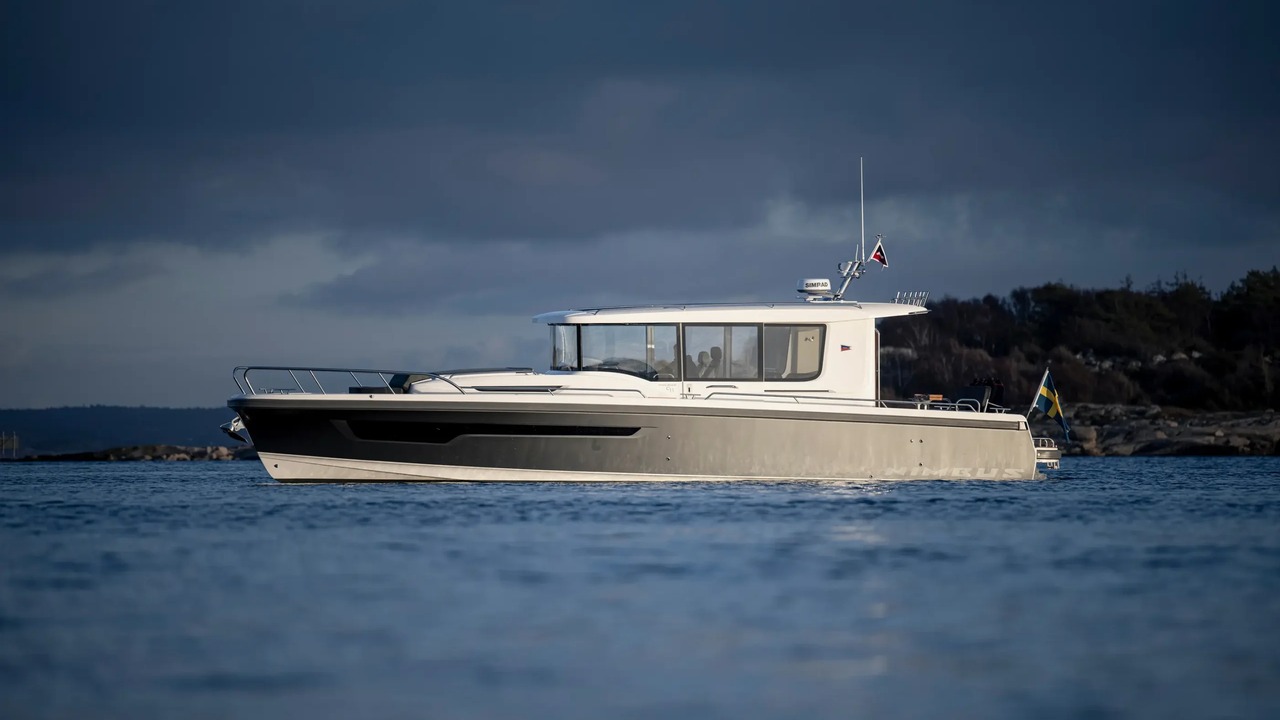
Nimbus C11 is a closed commuter of 12.40 meters that combines transformable panoramic salon, external passers-by and a dual step air-lubricated famine. The board declares 3,46 meters of glare, 0,90 of fishing, 850 liters of fuel and a speed greater than 45 knots according to configuration. The standard equipment includes two 300 hp Mercury Verado V8, automatic concealers, bow thrusters and a 12 inch Simrad NSX display. The real complexity, however, lies in the integration between doors, roofs, plants and optionals: before the purchase it serves a precise distinction and a sequence of checks able to separate predispositions, standard equipment and components actually installed.
Data sheet and points to be checked
Length and berth place the C11 among the motor boats designed for rapid transfers and extended use. The declared weight without engines is 6,600 kilograms: fuel, water, propellers, batteries, people and optional carry the operating weight on a very different level. The maximum declared height of 3.75 meters should be checked including antennas and roof accessories. The design category is B for ten people and C for twelve; the maximum capacity is 12. Certificate and tag of the individual specimen remain the decisive documents.
| Voice | Summary | Configuration control |
|---|---|---|
| Length | 12,40 m | Total encumbrance in the boat seat |
| Baglio | 3,46 m | Distanze, parabordi e trasporti |
| Weight | 6,600 kg without engines | Operating weight and useful load |
| Fishing | 0,90 m | Propelled version |
| Fuel | 850 l | Truly usable capacity |
| Fresh water | 135 l | Autonomy for four beds |
| Category | B10 / C12 | Certificate of the specimen |
Carena air-lubricated double step
Nimbus describes the bottom as a balanced, ventilated and equipped with two steps, with sharp bow, flare and contained bridge threshold. The air and the discontinuities of the bottom can reduce the wet surface in the project field, but the behavior depends on weight, propellers and trim. The test must therefore note configuration and load, avoiding comparisons between different specimens without common conditions. Steps, skates, symmetry, repairs and humidity are controlled at the start. Breaks or changes on the bottom require documentation, because they alter a geometry that works at high speed.

Declared speed and autonomy
The current page indicates a speed of more than 45 knots. The description of the model contains independent reference different for outboard and outboard, respectively 205 and 285 nautical miles, without turning them into universal guarantees. Sea, temperature, bottom, load and regime change both results. The correct verification sequence provides for measurements on return, consumptions read by verified tools and a defined reserve before departure. Economic gait must be identified on the specimen, not chosen because it coincides with an advertising number. Also comfort and stress count as much liters per mile.
Panoramic exhibition and open-closed transformation
The living room is the functional center of the C11. Two large side doors, the poppiera glaze closure and two electric roofs allow you to switch from a protected environment to a much more open configuration. Each mobile element must close evenly, have free downloads and remain still in navigation. Guides, seals and actuators are tried several times, even with the boat in the water. The panoramic view is an advantage only if reflections, fading and mountaineering do not create blind areas. Natural ventilation should be evaluated before dimensional air conditioning and generator.

Side doors and movement flows
The sliding doors quickly connect rudder and passers-by and are wide enough to facilitate the crossing. In mooring they allow the rider to reach a top without crossing the whole hall, but they require a procedure: locked door, safety cuff and communication with the crew. Thresholds, drains and closures must be controlled to avoid infiltration and crushed fingers. An object left in the guide can prevent the seal. During the test, vibrations and noises are observed at various stages. The verification sequence must include open/closed stops, keys, spare seals and access to actuators.
Bridge, seats and two 12 inch displays
The dashboard has space for two 12 inch plotters; the standard equipment includes a 12 inch Simrad NSX. The seats allow two people to stand in front of the console and the driver can drive sitting or standing. Before delivery, ergonomics with more bodywork, seat adjustment and steering wheel accessibility, handcuffs and controls occur. The optionals include professional cushioned seats and joysticks: they should not be attributed to each specimen. Alarms, engine and navigation data must maintain a clear hierarchy even when radar, AIS or cameras are added.

Standard and alternative propulsion
The standard configuration uses two Mercury Verado V8 from 300 hp. The declared alternatives include two Mercury Verado V10 425 hp and two Volvo Penta D4 DPI 320 hp. Outboard and outboard change weight, technical access, maintenance and distribution of poppiero volume. The choice requires a comparison of annual hours, cruise speed, local assistance, noise, maneuver and spare parts availability. The greater power is not automatically the best solution. Certificate, installation, propellers and software must correspond to the ordered combination; any performance data must be related to the precise configuration.
Zipwake and bow thruster SE100
The Zipwake automatic concealer and the SE100 bow thruster appear in the standard equipment. The first manages the setup through interceptors, the second helps the manoeuvre at low speed. Both require dedicated controls. For Zipwake there is calibration, actuators, sensors and possibility of manual use; for the bow thruster there are tunnels, propeller, absorption, batteries and operating life. No aid compensates for an unbalanced load or a maneuver started too late. The shipowner must know how to react to an alarm and how to return without depending on unavailable automation.

2,500 litre poppiero
The stern deck houses a foldable bench with parabord holders and a 2,500 litres declared compartment for equipment, tools and luggage. The capacity is remarkable, but weight and fixing must be managed. Rigid objects cannot shock cables, pumps or mechanisms; wet ones require drainage and ventilation. The verification sequence records opening, lighting, locks, drains and manual access in case of failure. If the compartment is used for professional loads, it is necessary to define limits and anchor points. Filling the volume completely without weighing the content can compromise thirst and plan.
Hydraulic platform and external rudder
Optional features include an extended hydraulic bath platform and a straight-mounted outdoor driving station, with plotter and joystick. They are functional but complex accessories. The platform adds actuators, weight, commands and crushing risks; it must have blocks, declared flow rate and emergency procedure. The external rudder requires safe selection of the active station, control protection and visibility on the engines. The test tests every interlock and checks that it is not possible to command the boat from two stations at the same time. External wiring and pipes must be protected from salt and shock.

Kitchen, refrigerator and undercover distribution
Undercover there is an equipped kitchen, two cabins and a toilet with shower. The standard declared refrigerator is 75 liters. The kitchen must be noted component by component: power supply, sink, drain, ventilation and locking systems. It is not enough to know that the boat is prepared. Each drawer must be closed with sea, while pumps and valves must be reached without invasive disassembly. The refrigerator is tested at the dock and batteries, recording absorption and temperature. Surfaces near the passages must avoid dangerous edges when the boat moves.
Four beds and real comfort
The two cabins offer four beds in 2+2. The verification must include measures, ventilation, lighting, obscuring and exit possibilities. Mattresses and bases must dry; odours or alonies require a control of doors, condensation and discharges. The large prodier load door facilitates access to the front cabin, but adds seals and locks to be maintained. Four bunks do not guarantee autonomy for four people: water, storage, waste and energy must be dimensioned on the program. Before ordering voluminous optionals you should check where personal bags, blankets and equipment will end.

Fresh, black and grey water
The declared capacities are 135 liters of fresh water and 80 litres of black water; the grays are optional. The verification sequence identifies tanks, pumps, filters, valves, vents and discharges, reporting them on a scheme accessible to the crew. Every user is tested and it is observed if the pump keeps pressure on closed taps. For blacks they control suction on the ground, indicator and permeation of the pipes. Greys require a separate verification, because sink and shower can have different circuits according to set-up. Nominal capacity and usable volume are not synonymous: tank trim and shape influence reading.
Air conditioning, generator and stabilization
The C11 is designed for air conditioning, diesel generator, gyroscopic stabilization and Humphree active system, but preparation and installation were different. The contract must list the brand, model, power, location and interfaces of each present system. The generator involves cooling, unloading, fuel and maintenance; the air conditioner needs sea sockets and condensate drains; the gyroscope requires structure, energy and ventilation. Active systems add sensors and actuators. A complete package increases comfort, but also weight and stopping possibilities: technical access and local assistance are decisive criteria.

Batteries, charging and solar panels
Solar panels on the roof are indicated among the optional, along with many utilities. Before defining them an electric budget is prepared: starter batteries and services, voltage, usable capacity, alternators, chargers and absorbers per hour. Panels can support light and maintenance utilities, but production and shading vary. They do not automatically replace generator or ground connection. Cables, fuses, detachments and mass points must be labeled. The check sequence measures tension at rest, fall during start, charge current and operation of alarms, keeping an updated pattern after each change.
Roof, carrier and actual height
The racks are among the optional and can accommodate long equipment, while antennas and panels occupy the same roof. Each high load increases wind resistance and changes the center of gravity; it must comply with load, fixing points and overall height. The declared value of 3.75 meters should be measured on the specimen ready to navigate. The two electric roofs must remain free and not interfere with cables or equipment. The verification sequence includes seals, drains, end of stroke and manual command. Before a road transfer or a low bridge, no approximate data is sufficient.

Testing of docking plants
The test begins with power from the ground and batteries, trying separately every user. Battery chargers, sockets, lights, bilge pumps, autoclaves, refrigerator, toilets, doors and tettucci. The energy options are started in the planned combinations, observing tensions and protections. Water circuits are filled, leaks are sought and discharges are not affected. Electronics and sensors must communicate without errors. After at least one complete cycle, rooms are reopened and connections and pumps are carefully touched to detect heat, vibration or abnormal smells.
Sea trial with measurable matrix
At cold engines there are tensions, levels and feel. At low speed you will experience snow, steering, doors, visuals and maneuvering aids. The acceleration takes place for regimen points with GPS speed, consumption, trim and trim; each point is repeated in the opposite direction. Transition is observed in planata, response to interceptors, turns and cross-country skiing. Doors and furnishings should not vibrate or open. If the configuration includes a second rudder, try the station selection. Water, odours, temperatures and movements are sought when returning.
documentary and delivery verification sequence
Number of hulls, certificates, category, engines, props and software must coincide with the distinct. Manuals and schemes are required for boat, propulsion, plants and optional. Any unfinished predisposition is identified to prevent it from being exchanged by equipment. Serial numbers, guarantees, hours and versions of devices are recorded. For a used, it serves maintenance history, invoices and works on the bottom, transmissions and electricity. An independent expertise checks moisture, repairs and subsequent installations. The delivery is closed only when anomalies and agreed interventions are responsible, expiry and proof of resolution.
Technical judgement and recommended configuration
Nimbus C11 is designed for those who consider weather protection, side access and fast transfers parts of the same program. Transformable exhibition, two cabins and large passages allow it different uses, but the long list of predispositions imposes discipline in order. The best configuration is not the one with every option: it is the one in which propulsion, energy, stabilization and air conditioning have technical access and consistent capacity. An experienced shipowner asks for weights, patterns and tests before adding complexity. With clear, measured testing and planned maintenance, the C11 offers a complete commuter platform without relying on generic promises.
