
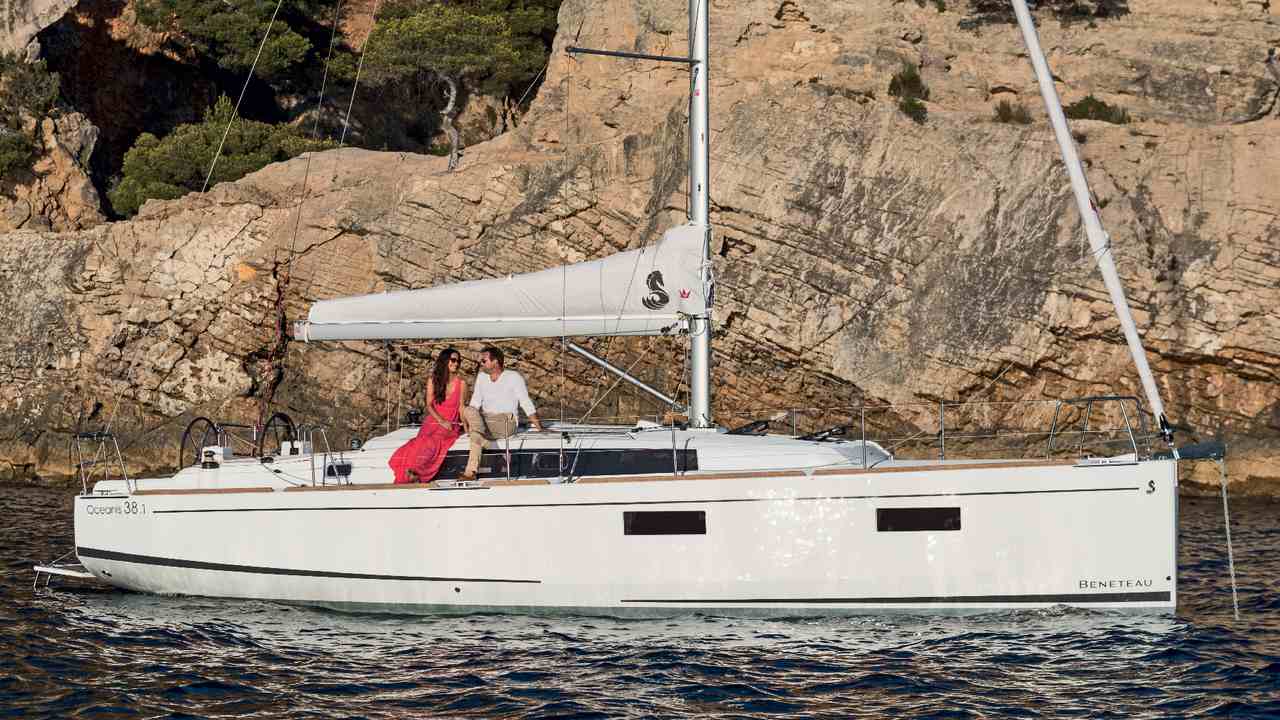
Oceanis 38.1 is not configured with one formula. BENETEAU indicates six versions, two or three cabins, different kitchen and salon organizations, four rowing profiles, mobile drift and arc presence. For those who value a used specimen, the first operation is not to estimate never measured performance, but to reconstruct the real configuration. This guide only uses stated data and transforms the variety of the model into a sequence of controls on documents, plants, accessibility and equipment.
Identify the version first of all
The name Oceanis 38.1 is not enough to describe the boat in front. The official page talks about six versions and choices regarding cabins, bathrooms, kitchen, lounge and storage. Compare identification number, yard documents, drawings and physical layout. A commercial card can mix different variants; a correct verification associates each element to the specific unit and records any changes after delivery.

Table of declared data
| Parameter | Value | Check request |
|---|---|---|
| Length outside everything | 11,80 m | Stern and protrusion configuration |
| Maximum | 3,99 m | Documents and compatibility of mooring |
| Dry weight | 6,850 kg | Charges and changes present |
| Height on water | 16,88 m | Additional antennas and tools |
| Minimum/maximum fishing | 1,64 / 2,09 m | Appendix installed |
| Fuel | 130 l | Tank and circuit |
| Water | 200 l | Tanks, pumps and pipes |
| Maximum power | 40 hp | Actual motor and transmission |
| Cabins | 2 or 3 | Real Layout |
| EC | A8 / B9 / C10 | Plate and file of the unit |
The numbers are model references. Operating weight, autonomy and actual dimensions change with equipment, liquids, people and accessories.
Four profiles, four different inventories
The documentation depicts deep keel with arch, mobile drift with arc, no arc-free drift and reduced bowless keel. The verification sequence must start from the installed profile, because it determines components, accesses and maintenance. On the mobile system it is necessary to identify mechanism and state according to the documents of the unit; on the fixed pins it is controlled joint, accessible fixings and traces of impact. Fishing values should not be automatically assigned without feedback.
Two or three cabins: effects on plants
The number of cabins changes volumes, passes and access to services. In the two-cabin version it can change the availability of storage to the stern; with three cabins there are multiple doors, lights, sockets and ventilation points. It is not enough to count the bunks: you control access routes to tanks, pumps, rudder and wiring. A more capacious installation can be less convenient for maintenance if panels or furniture limit inspections.

Shipowner's cabin and double doors
BENETEAU describes a separate bow cabin from double doors, designed to increase privacy and perspective when doors are open. Alignment, closures, hinges and front behaviour occur in the control phase with the boat not perfectly on the floor. There are also mattresses, bases, ventilation and surfaces close to the hull. Persistent odours or alonies require research of origin, not a simple aesthetic treatment.
L kitchen or longitudinal kitchen
The official configurations include different solutions for the kitchen. The page highlights the kitchen in L, while the layouts also show longitudinal organizations. Before buying, you need to map stove, fuel, refrigerator, sink, taps, drains and ventilation. Fixings and locking systems are controlled, especially where the movement could open doors or move objects. Actual equipment should be read on the tags, not deducted from the photographs.

Dinettes, table and eight declared places
The manufacturer declares the possibility to accommodate up to eight people around the table of the living room. The data describes the layout, not comfort during each use. The on-board test must check room for legs, access to the kitchen, passage to the bow and operation of the table. Bases, hinges and locking systems must hold without games. It is also useful to check the possible transformation of the dinette, if present and documented.

Foldable Carding Table
Among the stated solutions is a carding table that can fold to free space. The component must be tested in all positions, controlling the stop, hinges and interferences with sessions or steps. If it hosts tools or sockets, the wiring must follow the movement without being crushed. A later modification may have changed function and loads; for this they compare photographs, documentation and real installation.
Electric panel: read before operating
The framework should be examined at a fixed plant, starting from labels, protections and correspondence between switches and utilities. We look for signs of heat, oxidation, improvised bridges and unidentified cables. Then you reconstruct batteries services and starter, detachments, chargers and available sources. The presence of inverters, solar panels or specific electronics is not presumed: they are accessories to be confirmed on the unit and to be recorded with brand, model and scheme.

Batteries and energy balance
A useful verification sequence separates nominal capacity, real status and usage profile. Technology, age, capacity, resting voltage and under load behaviour are noted with suitable tools. Refrigerator, lights, pumps, tools and pilot can create very different absorptions according to the preparation. The energy budget requires measures, planned hours and margin; it cannot be derived from the single size of the boat. Also ventilation and fixing of the benches deserve control.
Fresh water: 200 liters declared
The rated water capacity is 200 liters. To verify the plant, tanks or tanks are identified, vents, pumps, expansion vases, filters and utilities. The seal is tested with pressure and the pump cycle is observed. Odours, colored water or intermittent operation require cleaning and diagnosis. The amount actually usable also depends on the geometry and the fisherman, so the autonomy should not be declared without measured experience.
Fuel: 130 litre circuit
The official figure is 130 liters. The verification includes reservoir, inspectability, vent, vent, valves, pipes, filter and engine power. We're looking for rubbing, unsuitable ties and piping. The indicator should be compared with known levels when possible. Consumption and autonomy depend on actual engine, regimen, load, propeller and conditions; without a registered test there are no forecast values as if they were measures.
Motor and limit of 40 hp
The board indicates 40 hp as maximum power, not as universal installation. The tag identifies motor and serial number; the booklet reconstructs maintenance and spare parts. They control supports, silent block, straps, losses, cooling circuit, sea grip, exhaust, alternator and control panel. Inverter, seal and axis line or installed transmission require proper verification. A short cold starter offers information, but does not replace a complete test.
Pumps, bilge and discharges
Each pump must be identified, fed and tested. The bilge is inspected clean, checking floats, alarms, tubes, non-return valves and outlets. The drains of the well and the platform must be free. In the services there are sea sockets, clamps and valves, without supposing undocumented materials or deadlines. Accessibility counts how much operation: a hidden and unreachable component can complicate urgent intervention.
Electronics: package and real installation
The official layouts mention a Raymarine electronic package, but the current kit can be different for market, options or updates. The verification sequence records displays, sensors, pilot, VHF, AIS and transducers really present. Ignition, data network, alarms, updates and readability occur. A trademark indicated in the promotional material does not prove that each component is original or still installed. Changes and integrations must have protected wiring and understandable documentation.
Double steering and emergency government
The two wheels are a feature of the project. Control searches for abnormal games, noise, friction and differences between sides. They inspect columns, accessible renewals, industry or components provided by the configuration, as well as the rudder shovel outside the water. The position and use of the emergency government must be clear and safe. Ergonomics are evaluated by reaching commands and instruments, not only by looking at the well.
Frog arch and maneuvers
Since the arc does not belong to all profiles, it must be established whether it is original and consistent with the version. Bases, bolts, seals, attacks and interferences with caps are controlled. For manoeuvres there are drizze, scotte, stopper, winch and winders, annotating wear and compatibility. It does not attribute a reduced-powered management facility without a test: instead, if the real circuit allows ordered operations and if the components are sized and maintained.
Aft platform: functional test
The platform is open and closed according to the unit procedure. Hinges, cables or actuators, blocks, bars, ladder and drainage are observed. The movement must be regular and the area free from people. We look for cracks or humidity near the fixtures, as well as undocumented repairs. When closed, the platform must be retained correctly. Its practical value depends on the state of mechanisms, not on the dimension alone.

Finishes White Oak and Walnut
The construction site declared the choice between a White Oak atmosphere and a Walnut, with coatings and matching fabrics. The identification helps to find spare parts and to understand if panels have been replaced. Color variations, swellings, edges, fixings and hidden areas are controlled. Humidity can occur far from the entrance point, so a halo must be followed with measurements and inspection of porters, windows, lande and plant passages.

CE certification and documents
The declared values are A8, B9 and C10. They must be compared with plate, declaration of conformity and manual of the specific unit. Maximum number of people, load limits and correspondence of identifying data occurs. Maintenance bills, work on the limb, plant replacements and structural repairs complete the file. The absence of documents does not automatically demonstrate a defect, but increases uncertainty and must be reflected in expertise and negotiation.
Try in water without inventing results
A serious test defines in advance what to measure: cold start, temperatures, charging voltage, government response, vibrations, plant sealing and instrument operation. Loading, wind, sea and regime should be noted. Promotional statements on agility, speed or stability remain attributed to the manufacturer until they are verified with protocol. This review does not claim to have performed a test at sea and does not present estimates as results.
final verification sequence for contract and delivery
Before signing, you need profile, layout, engine, accessories inventory and consistent CE documentation. Before delivery we repeat tests of batteries, pumps, motor, government, platform, kitchen, services and electronics, recording anomalies and agreed remedies. The bead allows to complete appendices, rudder, sea grips and helix. The decision becomes so verifiable: you do not buy a generic Oceanis 38.1, but a precise configuration with known conditions and costs.